

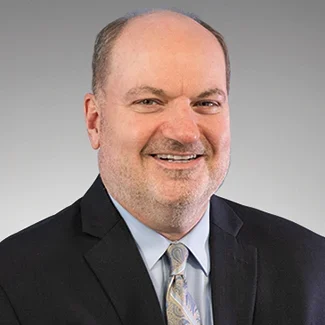
Former Exact Sciences Chair and CEO Kevin Conroy talked about his leadership journey Tuesday evening during an event at the Madison Club, and spoke of the influences and experiences that led him to build one of the leading cancer detection businesses in the world — and may include a future in public service.
Conroy, who led Exact Sciences for 17 years before its recent acquisition by pharma giant Abbott, fielded questions for over an hour from moderator Mark O’Connell, executive director of the Wisconsin Counties Association, and audience members who gathered in the Atrium Room of the Madison Club for its inaugural Leadership Lab. The Leadership Lab series, a partnership between In Business Madison, the Madison Club, Action Coach and the University of Wisconsin-Madison, is a new networking series for emerging professionals, entrepreneurs and experienced business leaders to connect, learn and grow.
It was a revealing talk featuring a man who was raised by a nurse mother and a state lawmaker father in Flint, Michigan, trained in intellectual property law, worked in private practice in Chicago, and entered the healthcare field as an intellectual property lawyer for GE Healthcare.
Conroy was appointed to his first biotech leadership role at Third Wave Technologies with little managerial experience, but he found a way to build two corporate teams that far exceeded expectations at both Third Wave — a molecular diagnostics company that developed a breakthrough cervical cancer screening test before its 2008 acquisition by Hologic — and Exact Sciences.
Since the landmark acquisition closed in March, Conroy is exploring interests that include education, scientific advancement and public policy, and he’s not ruling out a role in public service.

Cancer fighter
Exact Sciences, now a wholly owned subsidiary of Abbott, is best known for its non-invasive Cologuard tests for colorectal cancer.
Conroy, who serves on Abbott’s board of directors, is credited with transforming Exact Sciences from a small biotech firm into a prominent cancer diagnostics company.
During his tenure, Cologuard became the first medical device to simultaneously receive FDA approval and national Medicare coverage. Millions of Americans have used Cologuard to screen for colorectal cancer, the second leading cause of cancer deaths in the U.S.
The story of how Cologuard overcame barriers to the early detection of colon cancer is perhaps the most compelling aspect of Conroy’s business career.
When considering the challenge Exact Sciences faced in developing a cancer screening test to find cancer at an early stage, Conroy said it’s important to understand the biology of colon cancer.
“When we started out to solve this problem, we asked, ‘Why we can’t simply find a biomarker for somebody who has a cancer in their blood?’” he said. “Well, because the tumor isn’t deeply connected to the blood supply because it’s really small (at its earliest stages), so there isn’t much DNA being shed into the blood.”
A tumor might be just 2 centimeters, but a human being’s colon is 5-1/2 feet long, “and the DNA that you see in a colon, most of that is normal, healthy DNA,” Conroy said. “It’s like a needle in the haystack when you’re looking for this mutated or altered DNA in a background of massive normal DNA.
“If you fill this room with hay and put a needle in the middle of it, that’s what you’re trying to find with testing,” Conroy said.
“And by the way, 70% of the composition of the stool is bacteria — 70% by weight,” he said. “Bacteria has its own DNA, so you’re talking about trillions of copies of DNA and you’re looking for maybe 5 copies of tumor DNA. Good luck.”
Conroy said that’s why Exact Sciences has had an impact on the fight against colon cancer in the U.S. and why he thinks Abbott, with its global reach, “will be able to take this all over the world.”
Finding tiny changes in DNA can be the difference between discovering colon cancer in its first stage, which has a 98% survival rate and does not require surgery or chemotherapy, and discovering it in stage four, which has an 8% survival rate because at that point, the cancer has spread throughout the body.
Stage one cancers are therefore eminently treatable, but before Cologuard and the newer advanced version Cologuard Plus, they were not usually found in the colon.
“There are 150,000 people who die who have colon cancer every year in Europe, versus 50,000 in the United States,” Conroy said. “They don’t screen for colon cancer nearly as much as we do. I mean they barely screen for colon cancer in most countries.
“So, my hope is that you take this amazing innovation all over the world with Abbott’s amazing products.”
Exact Sciences’ work on cancer screening isn’t limited to Cologuard. Its product portfolio also includes Oncotype DX, a genomic test that guides treatment decisions for breast cancer; Oncodetect, a molecular residual disease (MRD) test to assess cancer recurrence risk; and Cancerguard, a multi-cancer, early detection blood test.
Giving thanks
During the Leadership Lab — which brought together an audience of about 100 students, business professionals and local leaders — Conroy shared the credit for his success with his former Exact Sciences team members; his wife Sheila, which caused him to choke up at one point, and mentors and scientific colleagues such as the late UW-Madison scientist Dr. David Ahlquist, a pioneer in early cancer screening who kept encouraging him to hunt breakthroughs when the company hit snags in Cologuard’s development.
Before the program, In Business Madison asked Conroy, 61, if he is content with serving on Abbott’s business board, or whether he would like to lead another life sciences company.
He said he’s still letting the future play out. During the interview with O’Connell, he left open the possibility of public service. Conroy said he had toyed with the idea of running for governor in 2010 but decided against it.
With his experience working with federal regulators, admiration for a father who served in Michigan’s state Legislature, and his comments during the Leadership Lab that schools must do a better job teaching children to read, public service isn’t out of the question.
“You know, it’s only been six months, so the first thing that I’ve been trying to prioritize is spending more time with my amazing wife Sheila and our three daughters — Meghan, Grace and Molly,” Conroy said.
“I’m still a young man, at least I feel that way most days, so I just want to make sure that whatever is in the future, it has an impact on the greater good,” he said. “Whatever form that might take, I don’t know. I happen to have a lot of different interests, so who knows?”

