
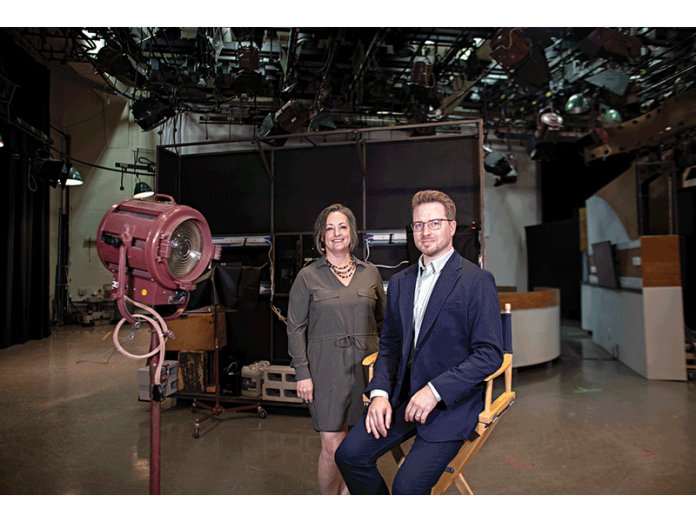

Wisconsin Public Media Snapshot
Founded: 1917, as the first public radio station
Top executive: Jordan Siegler
Employees: 280 full-time; 40 part-time and student staff
Annual revenue: $60 million
Industry: Broadcasting
During the Congressional debate earlier this year over proposed spending cuts that would gut the Corporation for Public Broadcasting, millions of people organized to convince lawmakers to save federal funding for public media.
The effort failed, but that support gives state public media executives hope that the outpouring can mitigate the damage going forward.
In August, the CPB began to shut down its operations following the passage of a federal recissions package and a Senate Appropriations Committee bill excluding $1.1 billion in funding for the national organization.
President Donald Trump’s signature sealed the CPB’s fate, and the majority of its staff positions will be eliminated with the close of the fiscal year on Sept. 30. The recission clawed back previously approved congressional funds that would have been allocated to the CPB, 70% of which was distributed to local public media organizations.
In the meantime, executives at Wisconsin Public Media and the Educational Communications Board, which have served as a statutory public media partnership for decades, are figuring out what, if any, programming and positions — WPM employs about 280 full-time and 40 part-time and student staff — will be cut in response to the loss of $6 million in federal funding.
The lost funding represents 10% of their combined $60 million annual partnership budget.
Jordan Siegler, interim executive director of Wisconsin Public Media, the division at the University of Wisconsin-Madison that oversees PBS Wisconsin (television) and Wisconsin Public Radio (WPR), believes the support evident during the congressional debate will translate into assistance that will help make up for the funding loss.
Siegler, who is serving in an interim capacity after the death of Executive Director Heather Reese, said advocacy work occurred under the umbrella of Protect My Public Media, a national collective of organizations that raised their voice in support of public funding for the services his organization provides.
“There were over three million messages received by Congress over the course of the past couple of months as we’ve worked to help elected officials understand the full scope and role of public media in this country and what might be lost if the funding were to go away,” Siegler said. “Of those three million messages, we know tens of thousands of them came from Wisconsinites.
“I do have confidence that the public will really seek to understand what this means for the public media service in the state,” he said, “and then show up and provide their support to ensure the sustainability of these services.”
Some pruning has already begun. In June, WPR reported that it notified at least 15 full-time employees they will be laid off.
As part of a strategic decision to focus more on local content and programming, WPR also said it will, later this year, end four of its programs, including the nationally syndicated “To the Best of Our Knowledge.”
The other canceled programs are “BETA,” “Zorba Paster On Your Health,” and the statewide “University of the Air.”
WPR said the layoffs and programming changes are connected to sustained operating budget challenges following the pandemic.
Working out of Vilas Hall on the UW-Madison campus, Siegler said WPM is in an extremely privileged position, even in the wake of these challenges. It has nearly 50,000 Wisconsin Public Radio members and more than 75,000 PBS Wisconsin members sustaining monthly memberships. These are individuals or households that make a financial commitment “that allows us the flexibility to produce a lot of our own original content,” Siegler said.
Membership has its privileges, such as PBS Passport where members have access to a deeper content library of programming, but most of what public media provides is free.
“That’s the point of public media,” said Marta Bechtol, executive director of the Educational Communications Board, the partnering organization. “It’s to be public. It’s not to be behind a paywall.”
In addition to sustaining monthly memberships, revenue sources include major and planned gifts, state and university funding and business sponsorships.
“Businesses are also underwriting our service as a critical piece of our revenues,” Siegler said. “It depends on the year, but it’s between $3 and $5 million in business sponsorships, and we would love to grow that as we look to our future.”
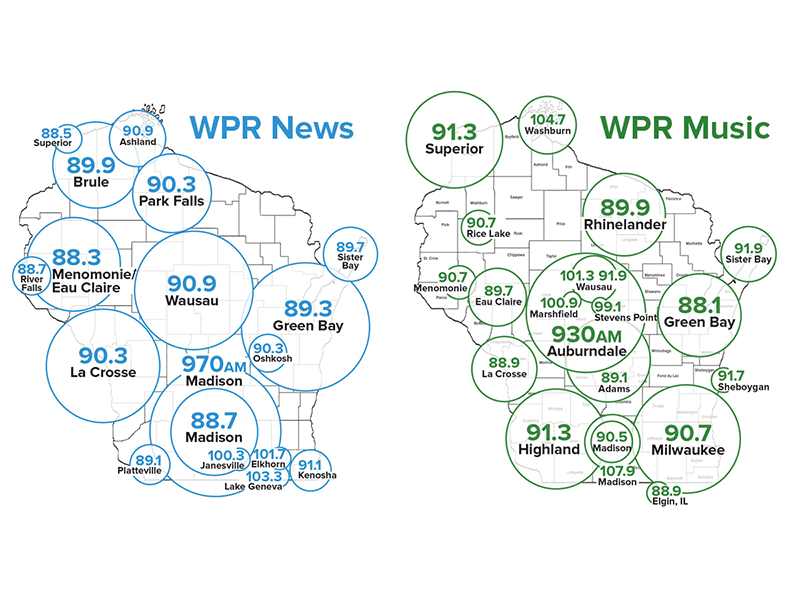
The funding supports a variety of statewide programming on two radio networks, WPR News and WPR Music, PBS Wisconsin, and 39 stations in all. Combined, the radio stations reach about 330,000 Wisconsin listeners each week.
On WPR News, listeners will hear several news and talk shows from the “Wisconsin Today” morning news program to the popular “Larry Meiller Show” call-in program.
WPR Music has 13 hours a day of locally hosted classical music programming.
PBS Wisconsin airs everything from documentaries to arts, culture and local series programming. There are also a number of shows, including K-12 content, in its education space.
“We know that these services resonate deeply with Wisconsin audiences,” Siegler said, “and coupled with the national and international programming that we can bring in partnership with NPR (National Public Radio) and PBS (Public Broadcasting Service) and other content producers, we believe very deeply in the service that we provide.
“We’re facing some very significant challenges, and some of that service will evolve, but at its core, public media will remain a strong and vital piece of the fabric of this state. I’m very confident in that and that confidence is rooted in the public’s investment in what we do.”
Siegler said Wisconsin “invented public media” and noted that “it’s rooted on the UW-Madison campus, having grown out of experimentation in the university’s physics department.”
Nationally, public media has grown to about 1,500 public radio and television stations across the country. Every station is going to be a little bit different when it comes to content creation, but one piece to the post-CPB puzzle is greater content sharing between statewide and national services. Siegler said that’s already happening to a certain extent, but it probably will intensify as the effects of federal cuts become clearer.
“It’s our job to work with each other, but also with those national partners and with other GMs and CEOs across the country who are dealing with this same challenge,” he said.
What was lost
The Corporation for Public Broadcasting a private, nonprofit corporation authorized by Congress in 1967 — 50 years after the first public radio station was established in Wisconsin in 1917 — was the steward of the federal government’s investment in public broadcasting.
It supported the operations of more than 1,500 locally managed and operated public television and radio stations nationwide with educational content, local journalism, emergency communications, cultural programming and other services.
Siegler said these content partners have archives and new work in development, so for some period of time the state entity does not expect a huge disruption in its service, but eventually there will be a shift in what it’s able to provide following the loss of CPB.
Some of the national fallout has begun. On Aug. 14, the New York Times reported that PBS, the national organization, slashed its own budget by 21% following rescission.
Siegler said he is still waiting for information that will affect national programming pipelines, including the types of shows that drive significant membership revenue. These are shows that WPR does not produce itself, including “Antiques Roadshow” and the documentary series “Nature” and “Nova,” which come through its national partnership with PBS and received funding from CPB.
“If we lose any of that, what does that do to our business?” he asked. “What does that do to our ability to retain and grow membership, and how do we potentially offset the loss of that with local service?”
Among the unresolved issues is continuity for music rights and royalties that are considered essential to the public media system. Siegler said CPB worked on contracting and content development the entire nation benefited from.
Structural changes
One helpful development is the restructuring that began about one year prior to the loss of federal funding. Siegler said the organization is restructuring internally between Wisconsin Public Radio and PBS Wisconsin to become one team — one organizational chart — to meet audience demands across multiple platforms.
“There’s so much opportunity in bringing the two teams here closer together to strategize across TV, radio, digital, community engagement, education and all the spaces that we work in,” he said.
“We are undertaking that work right now, and it will continue to unfold over the year ahead. I do see some of these new challenges that we face from the funding loss and the pending closure of CPB tying much more closely into how we’re thinking about our one team restructure.”
Bechtol said the statutory partnership between WPM and the Educational Communications Board, an independent state agency, has existed for decades and was based on work done as the former State Radio Council grew and became ECB at the university. The UW Board of Regents holds the Federal Communication Commission licenses for Wisconsin Public Media.
ECB partners with UW-Madison to operate the WPR and PBS Wisconsin networks to distribute both public media and educational services to residents statewide. Its responsibilities include the technical infrastructure and delivery of broadcast services, and it maintains National Oceanic Atmospheric Administration transmitter stations throughout Wisconsin, playing a key role in the Emergency Alert System, including Amber and weather service alerts.
Bechtol said ECB and WPM were weaved together to form a statewide network so they could efficiently and effectively blanket the state to ensure that all people who live within its borders have access to the emergency alerts and other content.
“We have been pooling our resources, our people, our systems for a very, very long time,” she said, “and when people say we should be able to find more efficiencies, we’re kind of the model of … efficiency. We have always been looking for them. This whole restructure that we have internally is a continuation of ongoing efficiency finding.”
Since Wisconsin Public Media is a division of UW-Madison, it also receives funding through the university system. WPM also receives state funding support, which was not affected by the federal cuts.
Bechtol said about 30% of its $22 million portion of the partnership budget is state funding and that money goes to providing the infrastructure, the people who manage and take care of the infrastructure, and the utilities that run the infrastructure.
“It’s really just the engine part of public media,” Bechtol said. “It’s a super-efficient system. We are in partnership with the university. We are in partnership with all kinds of county and municipal governments, other state agencies and federal agencies.
“This is not equipment that is used just for ECB and for public media,” she said, referring to the Vilas Hall studio. “It is used very broadly for lots of civic services, municipal services, state services, federal services, all of those.”
Bechtol said non-commercial FCC licenses can be granted to a number of different entities — state governments, municipalities, universities and even churches.
She said municipalities that serve large populations will always be able to bring in more income, so those public media entities probably will be more sustainable.
Rural areas with public media services might not have a large enough donor base to sustain a television station on their own, she said.
Meeting the challenge
Siegler has no doubt there are committed Wisconsin Public Media fans out there, ready to preserve a valued institution. With the support of subscribers, donors and strong strategic partners such as the Friends of PBS Wisconsin and the Wisconsin Public Radio Association, which are independent 501(c)(3) organizations that exist to support services from PBS Wisconsin and Wisconsin Public Radio, Siegler believes the challenges can be met.
“I’m not the type of leader that’s going to ring the alarm without understanding the context of it,” he said. “I previously had a career in fundraising and development, and I know how precious those relationships are — and that they’re built on trust.
“At this moment, I believe that in order to earn and keep the public trust, it is our job to help the public understand how our public media services may need to evolve after these funding cuts.”

