
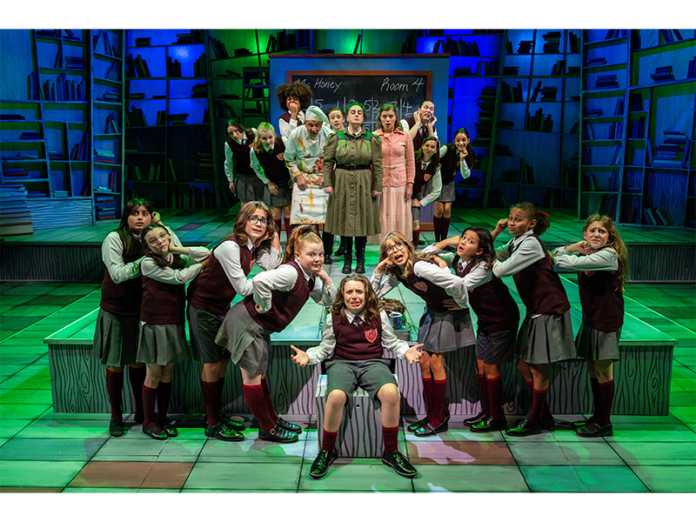

When businesses invest in youth arts, they’re not just funding theater, they’re investing in problem solvers, collaborators and leaders.
As Children’s Theater of Madison celebrates 60 years, one truth stands out: investing in creative youth is an investment in our region’s economy.
What began in 1965 with four visionary Zeta Phi Eta sorority sisters — Nancy Thurow, Mary Ann McHugh, Jean Riley, and Gertrude Burley — has grown into one of Wisconsin’s most respected professional theaters for young people.
Over six decades, CTM has served more than 850,000 children and 1.5 million patrons, produced 255 mainstage productions, and worked with schools from across Dane County and beyond.
The organization’s dual-leadership model, an artistic director and executive director working in tandem, has ensured that creative excellence and fiscal responsibility are always in balance.

Creative infrastructure
Few stories capture CTM’s collaborative spirit better than the creation of Madison Youth Arts Center (MYArts). The 65,000 square foot, $35 million facility, co-developed with Madison Youth Choirs, opened in 2021 as one of the largest private investments in youth arts in Wisconsin’s history.
With Pleasant T. Rowland’s lead gift, MYArts became home to CTM, MYC, and other youth arts organizations. The center features two theaters, 14 studios and classroom spaces that serve over 25,000 young people each year.
“I can’t think of a gift I could give that would impact more than this in the arts and for young people,” Rowland said at the opening.
But MYArts is more than a building, it’s infrastructure for innovation. It’s where students, artists and educators come together to create, experiment, and develop the kind of critical thinking and collaboration that power a thriving economy.
Each year, CTM employs 15 full-time staff and more than 125 artists, educators and technicians. Collectively, these jobs feed into Dane County’s $346.7 million annual creative economy, which supports 4,677 local jobs, according to Americans for the Arts.
And the ripple effect extends far beyond the stage. More than 21,000 patrons attend CTM’s mainstage season each year. Add 11,500 students through school matinees and 8,000 patrons for “A Christmas Carol” alone and you have an economic multiplier that fills restaurants, garages and hotels across downtown Madison.
From stage to workplace
CTM’s impact isn’t just measured in ticket sales, it’s measured in skill development. Through academic-year classes, summer stage programs and the Young Playwrights Festival, CTM serves 1,400 students annually, building precisely the kind of human capital businesses crave.
Students learn to empathize, communicate, collaborate, adapt and lead — skills consistently ranked among the most sought-after by employers. Global CEO studies list creativity as the No. 1 leadership trait for success, while LinkedIn has named it “the most important skill in the world” three years running.
At CTM, these lessons are nurtured every day:
1. A child finds their voice and confidence.
2. Teens learn resilience through complex staging challenges, practicing time management and resilience.
3. Diverse casts discover empathy through shared storytelling.
Our alumni go on to become professional artists and administrators, engineers, educators, entrepreneurs and civic leaders — professionals who carry forward the creativity and adaptability they learned through participation.
Artistic engine
Dane County’s economic engine is powered not just by innovation but by livability, and arts and culture are at the heart of what makes Madison magnetic.
A 2023 national poll found that 86% of Americans believe arts and culture are essential to community livability, and 79% say they’re vital to local businesses and jobs. When companies consider where to expand, they look for communities that value creativity, family engagement, and quality of life, all of which Madison’s arts ecosystem provides.
For employers, supporting the arts isn’t charity, it’s strategy. Arts investment attracts talent, boosts morale, and strengthens the fabric of the city.
CTM’s success mirrors the balance every business must master, purpose and performance. With over $600,000 in annual contributed income, a loyal patron base and sustainable operations, CTM has navigated leadership transitions, economic uncertainty and even a pandemic without losing sight of its mission to inspire and prepare young people through theater.
Collaboration isn’t a luxury in the arts, it’s a strategy for revitalization and growth.
Next act
As CTM marks 60 years, our focus is not only on the next generation of creative leaders, it’s also on sustaining the arts ecosystem that has been built for generations to come.
Madison is home to an extraordinary network of venues, organizations and talent. Yet Wisconsin ranks 49th in the nation for public arts funding, investing just 20 cents per capita, nearly ten times below the Midwestern average.
That gap poses a real risk. Without consistent, unified investment, we jeopardize the very infrastructure we’ve worked so hard to build. Culture is infrastructure, not amenity. It is essential to Dane County’s health, innovation and competitiveness.
Every successful region, from Denver’s Scientific and Cultural Facilities District to Pittsburgh’s Allegheny Regional Asset District, treats arts funding as civic necessity, not a luxury. These models prove that strategic, predictable investment delivers measurable returns in tourism, jobs, tax revenue and talent retention.
Our opportunity now is to follow suit: to unite business, government and philanthropy around sustaining the creative assets that make Madison thrive.
CTM’s next act isn’t just about producing plays, it’s about preserving the ecosystem that has shaped tens of thousands of young lives, strengthened our economy, and defined Madison’s sense of place.
When businesses invest in youth arts, they’re not only supporting students, they’re safeguarding a cornerstone of Madison’s identity and future prosperity.
Allen Ebert is the executive director of Children’s Theater of Madison.
To share your thoughts on a current business topic in a future Open Mic column, email Katie Dean at katie.dean@ibmadison.com for consideration.

