

Abbott’s relationship with Madison’s Exact Sciences is off to a good start, based on the laudatory comments of Abbott Chair and CEO Robert Ford.
Ford, discussing Abbott’s second quarter financial results with investors during a Thursday morning conference call, expressed optimism about future cancer diagnostics sales, citing his confidence in the Exact Sciences team.
Abbott, which completed its acquisition of Exact Sciences late in the first quarter — so the second quarter was the first full quarter that the Madison company contributed to sales — said overall second quarter results included sales growth of 4.8%, which represents an acceleration compared to the previous two quarters.
The company also reported adjusted earnings per share of $1.31, which exceeded the midpoint of its guidance range and consensus estimate.
The second quarter performance enabled Abbott to reaffirm its full year guidance for comparable sales growth of 6.5 to 7.5% and raise its earnings per share guidance range to $5.45 to $5.60.
Sales diagnosis
Ford said in the area of cancer diagnostics, sales growth for Cologuard was 13%.
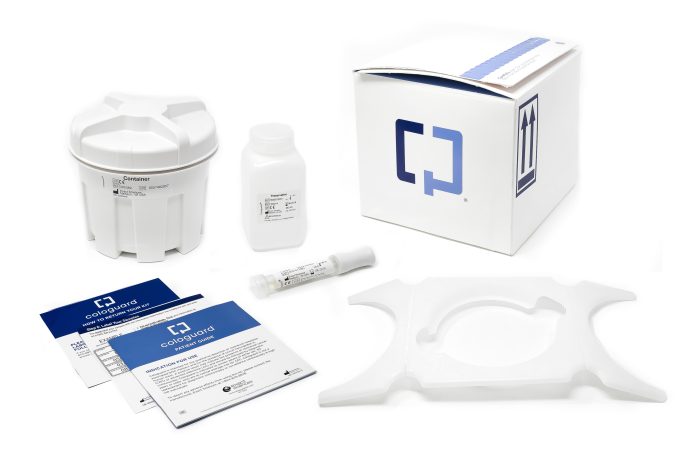
Cologuard, a colorectal cancer screening test developed by Exact Sciences, is benefiting from a growing base of both new and repeat Cologuard users.
“We continue to expect cancer diagnostics growth in the second-half of the year to be higher than the first half, supported by increasing volumes from Care Gap programs, recently launched tests and continued international adoption,” Ford said during the conference call.
One reason for his optimism is that in May, the American Cancer Society updated its colorectal cancer screening guidelines, reaffirming Cologuard and Cologuard Plus as preferred screening options.
“This designation reflects Cologuard’s market leading accuracy and superior ability to detect cancer at earlier stages compared to other available tests,” Ford said.
Responding to a question about future guidance from equity research analyst Vijay Kumar, senior managing director of Evercore ISI, Ford said its deal model with Exact Sciences called for even higher Cologuard sales in the second half of 2026.
“Our deal model that we put together to support the acquisition for 2026 had mid-teens (growth), and I feel confident that we’ll achieve that,” Ford said.
“The model called for the second-half to be higher than the first half, and the integration is going very well,” Ford said. “We’re not seeing any kind of issues or disruption. I’m just very impressed by the team there, their understanding of the market, and they’ve done a good job here at making sure that I understand all the different detailed kinds of elements of how this market works.”
Another reason for his optimism is that care gap volumes ramp up in the second half of the year.
Care gap programs are health initiatives designed to identify situations in which patients miss recommended preventive screenings, routine tests or chronic disease monitoring. Used by health plans (insurers) and healthcare providers (clinics), they use data and proactive logistics to connect with patients using outreach, at-home test kits, and digital tracking to eliminate barriers to healthcare access.
“Care gap programs … help the health systems achieve their HEDIS (Healthcare Effectiveness Data and Information Set) credit, their CMS (Centers for Medicare & Medicaid Services) star ratings, and that focus from the healthcare systems, for some reason, tends to happen in the second half,” Ford said.
HEDIS, developed by the National Committee for Quality Assurance, is a standardized set of performance measures used by most U.S. health plans to measure, track and compare healthcare quality.
Ford said Abbott has visibility into these programs thanks largely to Exact Sciences’ knowledge of market access.
“The team there is an incredible team in terms of their market access team,” Ford said. “They’ve got work to do, there’s no doubt, but there’s a lot of visibility to those programs, and there’s a lot of conversations that are happening with the health systems. They’re seeing a need to continue to push on earlier detection with Cologuard.”
Ford also said the transition from Cologuard to the more advanced Cologuard Plus will provide a “a little bit of a tailwind,” but there are a lot of key growth drivers in the medium and long term.
“If you look at the growth from Cologuard users, they’re exceeding our expectations,” he said. “So, there’s certain forecasts of how many new users we’ll be able to bring in, and the (Exact Sciences) team is actually exceeding that target.”
In addition, Ford said the number of repeat users in Cologuard, or rescreens, is both expanding and reliable because “we have the names (and) people want to stay up to date with their screening,” Ford said. “So, that rescreen funnel is expanding and that’s a great opportunity for us.”
Additional growth could come with the recent launch of Cancerguard, a new multi-biomarker cancer screening test developed by Exact Sciences, and the expansion of international sales for products in Abbott’s cancer screening portfolio.
“I’ve been involved in some of the discussions around that, and we’re going to be making some pretty interesting progress there with certain (foreign) governments,” Ford said.

