

Project snapshot:
• Library building size: 12,000 sq. ft.
• Pavilion size: 4,000+ sq. ft.
• Total project cost: $18.6 million
Funding sources:
– Flexible Facilities Program grant ($4.25 million)
– Madison Public Library Foundation capital campaign ($4.5 million)
– City of Madison capital fund ($9.85 million)
• Construction completion: July 2026
• Imagination Center opening: September 2026
• Employment positions: 21
An area of Madison that has been a resource desert will soon have an oasis in the form of the Imagination Center at Reindahl Park.
The center’s groundbreaking in May marked the culmination of over a decade of work, and is the first step toward providing adequate resources to a community that has long been underserved.
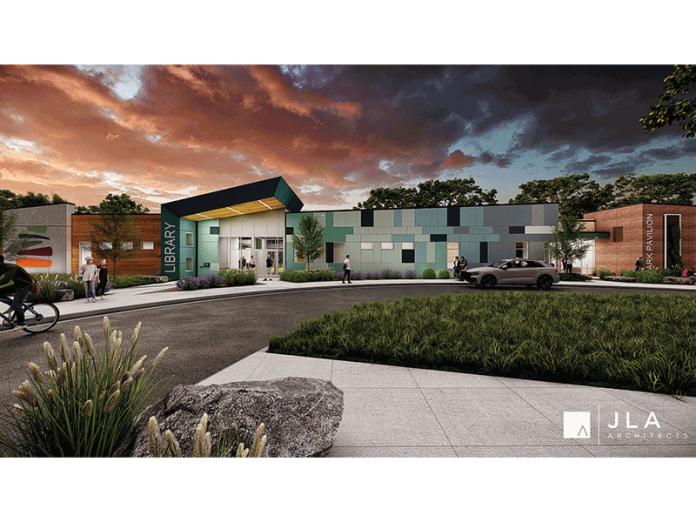
Located on the city’s northeast side, off of East Washington Avenue at Portage Road, the multifunctional indoor-outdoor library and community space will be situated on 91 acres of parkland. It represents Madison Public Library’s first new library in 25 years and the first to be located within a Madison park.
The Imagination Center is a collaborative effort between City Engineering, Madison Public Library and the Parks Department. It will feature a roughly 12,000-square-foot library building, an adjoining patio space and an enclosed, four-season park pavilion more than 4,000 square feet in size.
While construction is in its early phases and won’t be complete until next summer, plans for the Imagination Center paint a vivid picture of the innovative, sustainable, resource-rich spaces soon to be enjoyed by Reindahl Park’s nearby community members and visitors.
A long time coming
Tana Elias, director of the Madison Public Library, said the Imagination Center has been “many years in the making,” with discussion surrounding the project tracing back to 2007 and capital funding approved since 2018.
“To finally be at the construction stage this many years later is exciting,” she said. The project “is gaining traction … because we actually have shovels in the ground.
“There is something very real about seeing that (building) outline.”
Elias said feedback from a lengthy community engagement process centered on the area’s need for library resources and shared community spaces — especially as Reindahl Park’s existing pavilion was only accessible during certain months of the year and “really quite rudimentary in terms of what it offered.”
Sabrina Madison, alder for District 17 and a self-proclaimed “library nerd,” obtained similar feedback from neighbors and, following her first election in April 2023, decided to make the Imagination Center her No. 1 priority.
“When I heard that the project was still at risk of not being built, I was like, ‘That is not going to happen,” she said. “I’m going to ensure this happens.”
Madison was re-elected this past April and noted that the area she represents has historically been given less priority than other parts of the city despite being among Madison’s fastest growing and most diverse communities.
“Over here … we have a higher population of folks who are rent-burdened,” she said, “and oftentimes, when you can already barely pay your rent, you don’t have additional money for internet access, for example.”
She said her constituents also felt “super left out” when it came to community meeting spaces.
“They had no place just to get together, to play bridge, maybe a card game, or to host a family reunion — a space that would have indoor amenities,” she said. “We have no senior center … despite having a higher number of elders over here.”
Madison found the lack of free and safe teen-focused spaces particularly troubling.
“I grew up in libraries. Libraries have always been my happy, safe place,” she said. “There’s no central space over here that’s free where teenagers might have programming centered around them. Most, if not all of our libraries, have some programming that’s teen-oriented.”
For years, progress on the Imagination Center was stymied by the obstacle of obtaining adequate funding. The project’s total cost is roughly $18.6 million, including construction.
Madison said backing from other alders as well as Mayor Satya Rhodes-Conway has helped build momentum, and a Flexible Facilities Program grant from the state of Wisconsin brought $4.25 million to the table.
“Accepting that grant says that the library has to be open by a certain date next year,” she said. “So regardless of what anybody says, now it has to be done.”
The Madison Public Library Foundation agreed to provide $4.5 million in funding through a capital campaign, and around $3.2 million of that amount has been raised so far, according to Elias.
The balance — about $9.85 million — will come out of the city’s capital fund.
The remaining financial challenge concerns the Imagination Center’s future operating costs, a conversation that will be ongoing at the City Council this fall.
“We will … either secure that additional operating funding through the city’s budget process, which runs through November of this year, or make some adjustments within our own budget and reduce some services internally so that we’re able to bring that library online,” said Elias. “We’re excited to be able to bring this project forward. I know that the neighbors have been asking.”
A natural design
The Imagination Center’s massive scale and unique location were carefully considered in the planning and design process, which sought to create an engaging new space and protect the natural environment.
Rafeeq Asad, a project designer for JLA Architects, the architect for the Imagination Center, said the theme “nature is for everyone” guided many of the firm’s choices.
“It’s just a cool project,” he said. “So, how do we design this building so that everyone can experience the library and its programmatic uses, but then also the park and the surrounding uses as well?”
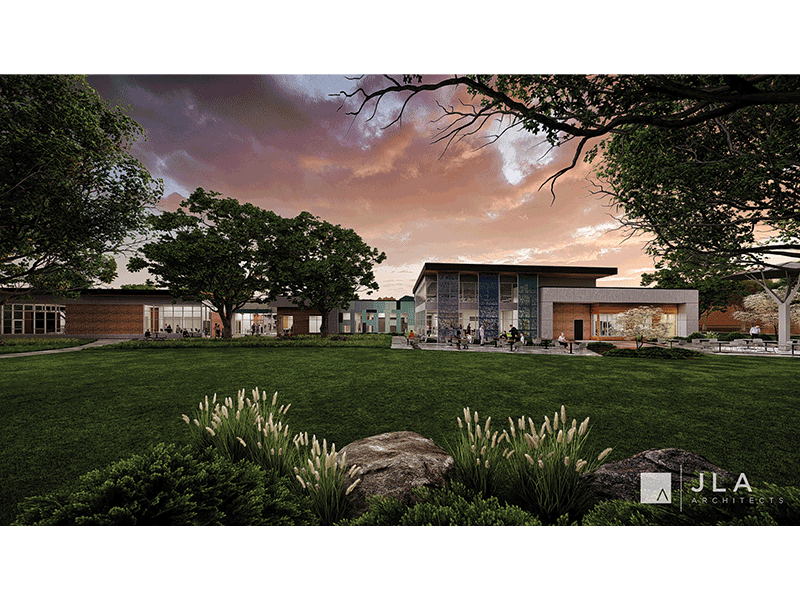
One of the Imagination Center’s most notable elements will be its expansive windows, offering broad views of the parkland outside. Interior design features will also lean into natural colors like green and brown.
“You’ll really feel like, while you’re in the library … you’re also taking in the nature and the … views from surrounding Reindahl Park,” Asad said.
Brent Pauba, project manager for the city’s Engineering Division, added that the building was configured so as to protect many of the park’s older trees.
“If you were to look at (the Imagination Center) from a bird’s eye view, you’d see that it wraps around some of the larger growth trees,” he said. “It’s really beneficial to save trees. It takes a long time to have a tree mature … and it’s very rare to have a new building to have old trees right next to it on day one.
“It will increase the quality of the exterior spaces, and it will also increase the quality of the interior spaces looking out onto those mature trees.”
Landscaping plans are likewise cognizant of the area’s natural features and will work to improve stormwater management and incorporate native plant species.
“Generally what that means is less watering, less intensive use of our water systems, less herbicides and pesticides to maintain those landscapes,” said Pauba. “So there’s quite a lot of qualitative benefits.”
Plans for the Imagination Center also focused heavily on sustainability, with multiple elements contributing to an environmentally conscious and energy efficient building design. Among these are what Pauba called a “good building envelope,” a solar array and a geothermal field.
The first element refers to the insulative quality of the Imagination Center’s roof, walls and floor, Pauba said.
“From a high level, this is just minimizing the loss of heat and cooling of the building, which is a nice passive way of making something more energy efficient.
“Also, that envelope is really what the designers call ‘tight,’ meaning that air and moisture have more difficulty going from the inside to the outside, and vice versa, so this is also good for indoor air quality and energy sayings.
“So we’re holding energy in for a longer period of time, and then we’re also … producing energy onsite.”
The solar array, which will be situated on the Imagination Center’s roof, has the potential to produce sufficient energy to power the facility, at least on sunny days, according to Pauba.
“It’s tough to quantify how much energy will come from it because there are so many variables — how many clouds are in the sky, how many tree leaves are in front of the panels,” he said, “but the project team designed it to produce, under ideal conditions, about 120 kilowatts of energy, which roughly correlates to the anticipated energy use of the building.”
The geothermal field, meanwhile, is a system that helps with preheating and pre-cooling to reduce energy bills and fossil fuel consumption.
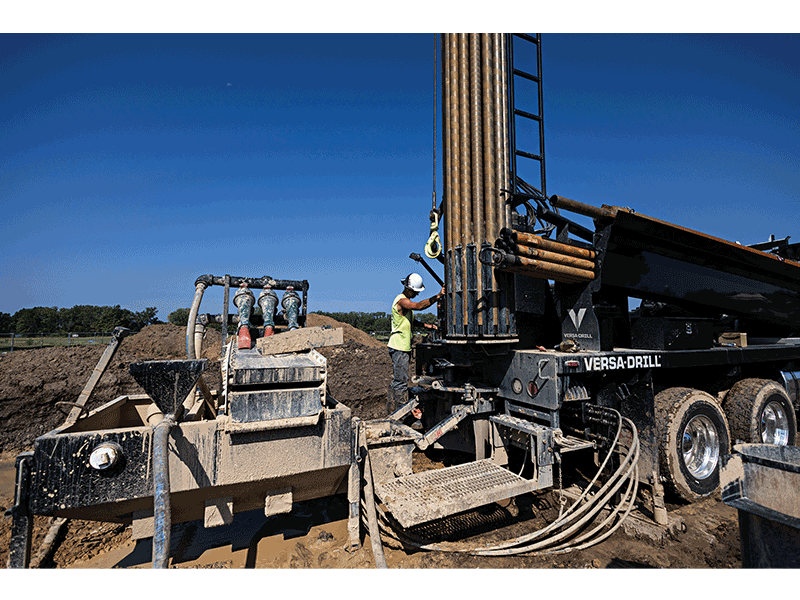
“There are these really big straws that are drilled into the ground,” Pauba said. “The idea here is that, as you get closer to the center of the earth, it gets hotter. So what we have is about 45 borings (large metal tubes) that go 200 feet down, and then the building pushes liquid down into them and heats that liquid up, and then can use that.
“That system, like the solar array, has been sized for the building and is considerate of the … use of the building.”
The crown jewel of the Imagination Center’s sustainability features is a roughly 20-foot tall solar tree, similar to the solar array in its functional purpose but carrying aesthetic weight as a highly visible element on the adjoining patio space.
“There are … pre-manufactured solar panel systems that are meant to also provide shading for folks underneath,” said Pauba. “This one looks very much like a tree, and the (leaves and branches) of the tree are actually solar panels. So it’s similar to the system working on the roof … and will produce energy for the facility.”
“At night, you’ll definitely see this glowing from East Washington (Avenue),” Asad added. “It’s one of those extra elements that will bring some excitement to the project.”
While Pauba said the city does not have specific numbers in terms of projected energy savings, he emphasized that the project will objectively use less energy to heat, cool and light the facility — which is environmentally responsible but also inevitably helps the bottom line.
“A lot of the costs of a facility actually are not the first-order costs of constructing the building, but over time the amount of money we spend on energy,” he said. “There will be a significant decrease in operational costs because of these systems. They all have kind of buyback cycles. If you spend this money upfront, in 15 years you’re going to be making money from it.”
Filling the resource void
The Imagination Center’s library building will consist primarily of an open-concept space for collections, with rooms for meetings, classes, maker space and more around the perimeter.
Elias said these main areas will offer the same services as other Madison Public Library facilities. For one, the center will serve as an absentee voting and election site.
“Public libraries are the first step in contacting city government, in a lot of cases,” she said. “We register people to vote. We help people get signed up for school. We help people connect to the economic development department to find out resources about how to start a business or what kind of permits they need.”
Like other citywide library facilities, the Imagination Center will also provide access to books, computers, free Wi-Fi and events, which are funded through Madison Public Library’s general programming budget.
“Right now, we work with a wide variety of artists and storytellers and many different community partners to host free events in all nine of our existing libraries,” said Elias, “and we would just extend that to this 10th library.
“We also work with a variety of nonprofits and organizations. … For example, we’ve worked with the city’s Metro department to share information about when routes change, or when they implemented the new Fast Fare system. And we work with providers in the area of social services and health services to get information out to people.”
The Imagination Center plans to expand Madison Public Library’s current partnerships and seek out new partners, like the nearby Sandburg Elementary School, which for the first time will have access to library resources in its own neighborhood.
Other potential partners may be groups already using Reindahl Park for activities like community gardening or sports leagues.
“We worked at the Parks Alive events happening around the city this summer to meet some of the other partners in that area and learn a little more about the neighborhood,” said Elias. “Libraries are just a very important part of a community … in terms of connecting with each other.”
Meanwhile, the Imagination Center’s enclosed pavilion will be available for rent and is designed to accommodate a range of events and gatherings.
Coming in 2026
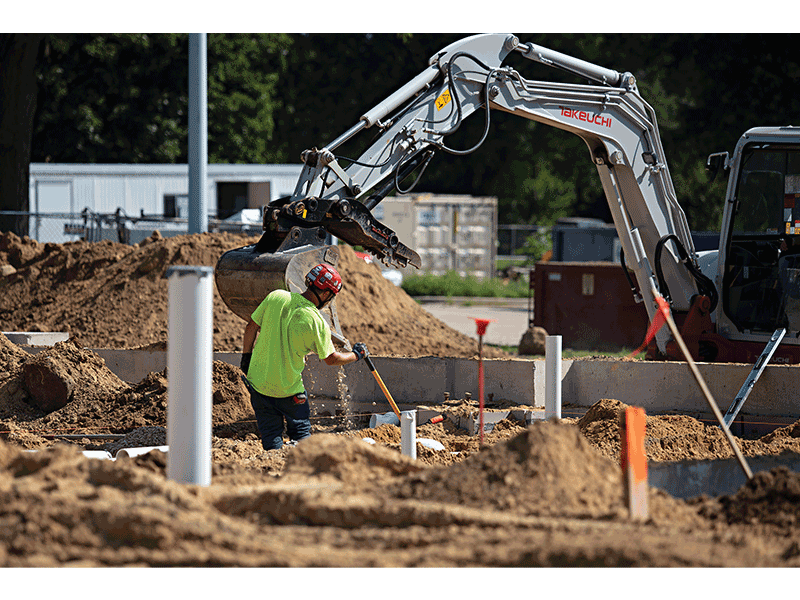
Construction on the Imagination Center is scheduled to be complete in July of next year, with the Imagination Center’s official opening to follow in September.
The center, at least initially, is set to operate Monday-Friday from 10 a.m.-8 p.m. and Saturday from 9 a.m.-5 p.m., much like other Madison Public Library buildings.
Elias said that, budget-permitting, the Imagination Center will employ a full-time supervisor, three librarians, three library assistants, a clerk and then 13 hourly positions.
For Ald. Madison, the project represents “one of the key successes” of her time in office and the culmination of a more than 10-years-long community effort.
“When I first got over here in office, I held these community engagement dinners, and there was a young person who is the son of one of my supporters,” she said.
“We were talking about the library, and this kid was like, ‘What’s it gonna take, like another 50 years?’ … This is a kid who’s been growing up with no neighborhood library.
“When we did the groundbreaking, he and his mom were there. So you don’t know how happy I was for that kid, especially, to see the shovels going into the ground and know that it would be not 50 years, but just one more year, and he’ll be able to come to it.”

