
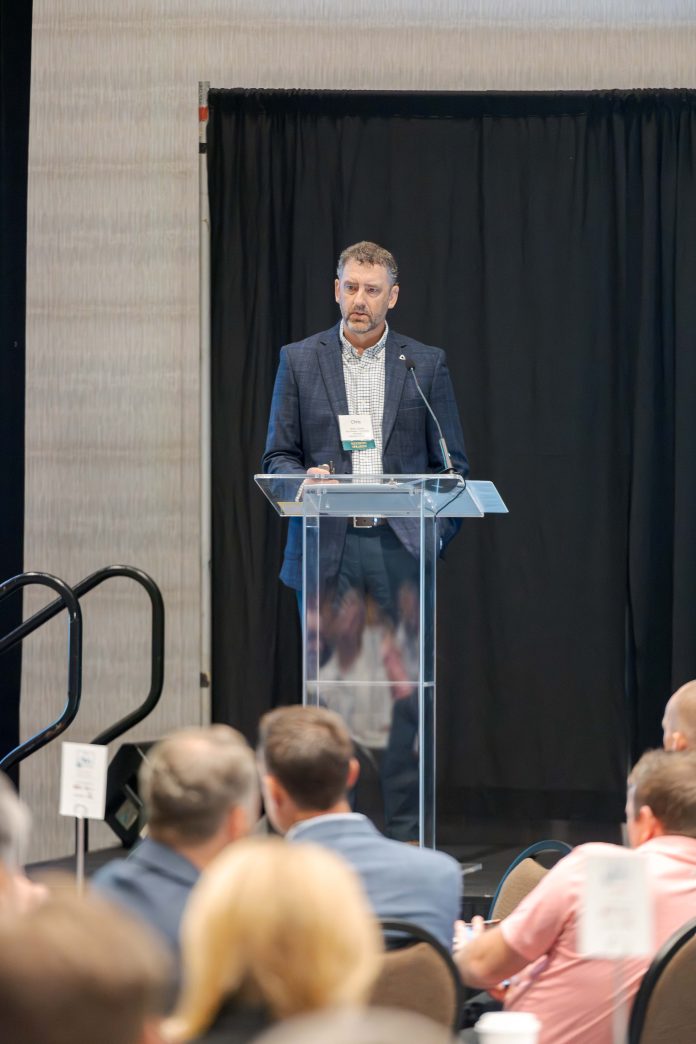




A struggling office market, continued housing challenges, and financing opportunities were explored by panelists in banking, law, accounting, and real estate during IB’s June 13 Real Estate and Construction Symposium program.
Held at the Marriott Madison West, the program was keynoted by Chris Caulum, vice president–commercial brokerage for Oakbrook Corp. In his keynote address, Caulum noted the Madison real estate market has largely recovered from the COVID-19 pandemic shutdown, but the office market continues to struggle. Not only is there little new office construction, but some notable employers are subleasing large segments of existing space in their facilities.
While Madison’s office situation isn’t as dire as other metropolitan markets, the office vacancy rate of 13% is still more than three points higher than it was in the last pre-COVID year of 2019. In addition, absorption has not returned to its stronger pre-pandemic levels, and tenants have more power to renegotiate leases. “COVID did what two recessions could do,” Caulum stated.
One factor is the desire of the workforce to maintain at least a hybrid schedule of working from home and the office. There are some employers who are in a position to require a return to the office — Epic systems, Caulum noted, has a “work-from-work” policy — but most employers would be wise to maintain flexibility, especially those whose work is easier to do remotely. “If you can objectively measure their performance,” Caulum advised, “then it’s easier to let them work from home.”
Other panelists, notably Chris Richards, managing director for Colliers, worry that the next economic recession, even with Madison’s traditional insulating effects, could return the local office market to Great Recession level vacancy rates.
The bright sides
The news is much brighter in the industrial, multifamily, and retail markets. Industrial inventory has grown nearly 10% in the past five years, with vacancy now just above 2%. The most notable industrial project is a planned Amazon warehouse north of I-94 in Cottage Grove, which will consist of five stories with 360,000 square feet of space on each floor. According to Caulum, village officials still hope the project will be completed in the next 10–15 months, but there is some doubt that Amazon will find enough Madison-area workers to fully staff the facility, so some automation is expected.
The demand for multifamily construction is largely driven by Greater Madison’s population growth, which shows no signs of abating. However, developing affordable housing units continues to be a challenge because the existing economic conditions — including rising construction expenses and land costs — point toward more upscale multifamily projects as the most financially prudent, according to Gretchen Richards, first vice president of investment properties–multifamily for the Madison office of CBRE. Higher-end apartments with finer finishes are getting built, but not as many of the middle-market, mid-sized projects are being pursued. “A lot of people are pencils down at the moment,” Richards said.
James West, vice president of the Madison office of CBRE, cited studies that show Madison is not keeping pace with its housing needs, and he cited a telling statistic about younger homeowners. “First-time homebuyers are looking at a $4,000 monthly mortgage cost,” he stated. “If that continues to get worse, I don’t see how we’ll be able to keep pace.”
Chris Ehlers, president of Veridian Homes, the area’s most active home builder, noted that the median home sale price has gone up $100,000 since 2021, and higher interest rates for home financing is one of the incentives that older homeowners have to stay in their homes and age in place. About 70% of Dane County homeowners have a mortgage rate of 3.5% or less “locked in,” he says.
Financial factors
A second panel focused additional attention on commercial construction financing challenges, including the fact that more banks are keeping their powder dry for existing clients, according to Brian Hagen, senior VP–director, commercial real estate banking with First Business Bank. Good deals are still getting done, Hagen noted, but one effect of the 2023 Silicon Valley Bank failure is that bank liquidity is declining.
The limitations of tax increment financing (TIF), with its “but-for” funding test, was a topic of discussion. Thanks to more than $6 million in TIF money, city of Madison officials recently confirmed they’re on track to build 553 more affordable apartments on the old Hartmeyer site on Madison’s north side, but this form of financing still has limited applications. The but-for test stipulates that the development would not happen without some assistance — endorsing the use of tax dollars to promote growth but only in certain circumstances.
Another topic was existing state levy limits on county and municipal governments. Asked whether relaxing the limits, which would require state legislative action, would enable municipalities to put more skin in the development game, attorney Kevin Ramakrishna of the Reinhart law firm indicated the issue is more fundamental than incentivizing commercial construction. Ramakrishna said the limits don’t allow the city to keep up with population growth, which puts more pressure on the property tax to maintain the city’s service levels. “It really becomes kind of a human issue,” he stated.
Laura Cataldo, a director with Baker Tilly’s development advisory practice, touted the tax credit provisions of the Inflation Reduction Act (IRA), which is one of the newer financing opportunities for energy upgrades, especially a direct-pay provision that developers and governmental units can take advantage of. While recipients of the credits must be in compliance with prevailing wage and other legal requirements, the $270 billion allocated for the credits, which can be paired with other energy incentives, do not have to be used for large solar farms — they can be used for EV charging stations and other small-scale energy improvements. “It’s a very powerful tool that can be stacked on top of state programs,” Cataldo noted. “It’s created a strong demand for energy projects and developments.”

