
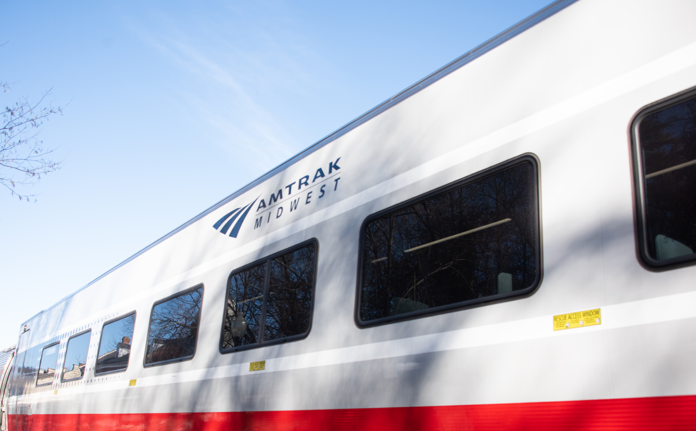

The success of an extended Amtrak line between Madison and Milwaukee, which could begin service as early as 2030, could lead to additional corridors of Amtrak service throughout Wisconsin, according to an Amtrak official and a high-speed rail advocate.
With the prospects for passenger rail between Madison and Milwaukee — the so-called Hiawatha West service — looking better than they have in years, additional routes eventually could be added between Milwaukee and Green Bay and Madison and the Twin Cities.
The long-term possibilities, which largely depend on support from an often-skeptical Wisconsin Legislature and the availability of federal transportation grants, were discussed during an April 30 webinar of the Madison and Milwaukee Downtown exchange program, which focused on the proposed Hiawatha West Amtrak line.
The webinar, moderated by Jason Ilstrup, president of Downtown Madison Inc., featured Arun Rao, senior director of network development for Amtrak, and Rick Harnish, executive director of the High-Speed Rail Alliance, a nonprofit dedicated to connecting North American communities with high-speed trains.
Harnish said for the past 100 years, public policy has forced people to drive motor vehicles, and as a result, generations of people have a hard time imagining other ways to travel.
“So, it’s absolutely critical that we start with the idea that people need to travel, not the idea that cars need to move,” Harnish said.

Choice corridors
As part of the Federal Railroad Administration’s Corridor ID program, Rao said the state of Wisconsin has applied for grants to develop additional passenger rail corridors, including the Hiawatha West line. The grants focus on connecting Madison, Green Bay and Eau Claire and Eau Claire to the Twin Cities.
The goal is to promote economic growth and boost tourism by improving connectivity between Wisconsin communities and the Chicago-Milwaukee hub, which is the existing Hiawatha line.
Additional corridors include a Hiawatha extension from Milwaukee to Green Bay with proposed stops in Fond du Lac, Oshkosh and Appleton.
Another new corridor would connect the Twin Cites (the St. Paul Amtrak station) to Milwaukee via Eau Claire and Madison, thereby connecting more of northern Wisconsin to the main passenger line.
An existing corridor already is served by Amtrak’s Borealis line, where another daily round-trip would be added under planned improvements. Between St. Paul and Milwaukee, this line includes stops in La Crosse, Tomah, Wisconsin Dells, Portage and Columbus, Wisconsin.
The Hiawatha West line, which has planned stops in Pewaukee in Waukesha County and Watertown in Jefferson County before reaching Madison, will come first. Rao said it would add an estimated 260,000 annual passengers to the Hiawatha service, which he characterized as a conservative figure.
Rao also said Amtrak has endorsed the Milwaukee to Green Bay line.
“That’s going through the corridor ID process that’s being led by the state,” he said. “It does depend on the corridor ID program continuing to be funded with the grants obligated and moving forward. Amtrak also sees that as a very favorable corridor commercially in terms of the success in generating ridership. It’s a great corridor.”
Rao said Hiawatha West’s expected ridership would help that corridor in addition to all of the other planned corridors in Wisconsin.
Downtown stations
Downtown Madison would also get a boost from a new train station that could be part of the redevelopment of the historic 1 W. Wilson St. building, a former state office building that once served as the home of the Wisconsin Department of Health Services.
On May 13, the State Building Commission endorsed the sale of the building to Landmark Development Services Company LLC for $10 million, advancing the proposed sale to the state Legislature.
In addition to a new station platform along existing rail lines that run parallel to John Nolen Drive near Monona Terrace, 1 W. Wilson St. could serve as an entryway to an Amtrak train station and its lower levels could include retail shops and restaurants that serve train commuters.
The downtown location, with its proximity to government employees, the university community, restaurants and hotels, could help the Hiawatha West line exceed the 260,000 annual rider estimate.
Rao said Amtrak views downtown Madison as “an ideal scenario” for a successful passenger station.
“We’ve seen across the country that stations in downtowns actually generate more ridership than stations not located directly in downtowns,” Rao said, “and that downtown-to-downtown connection is a huge edge that we have now in those markets over other modes (of transportation) and part of the reason why people choose that.”
At the start, there would be two daily round trips between Madison and Milwaukee, but Rao and Harnish said there would be four or more round trips in the future.
“Phase 2 of this corridor ID is going to be over four round trips — four-plus round trips in the future and hopefully even more than that,” Rao said. “So, we can definitely support more than two, but it’s very important to get those two trips started and fill those trains and then build from there.”
While there is some uncertainty with federal grant programs, and the current state Legislature has been skeptical about passenger rail expansion, Rao said Amtrak believes it can get preliminary engineering done within nine months once it’s started, and then it will be ready for final design and construction.
“Obviously, this will be in next year’s (federal budget) cycle or the following year for this final design and construction,” Rao said. “So, depending on when that happens, once we get that grant, it’ll then be about two to three years of final design and construction.
“So, if you were to do the math, the earliest that would be is 2030,” Rao said, “but again, it depends on the timing of those certain factors.”
High-speed rail
More long-term rail dreams include the development of an electrified, high-speed rail line from Madison south to metro Chicago, including O’Hare International Airport.
At 79 miles per hour, the Hiawatha West extension would be more of a conventional speed service, but high-speed trains can travel as fast as 125 miles per hour, and testing is being done on trains that move even faster when fully occupied.
There is a Union Pacific Railroad line that extends from Madison to Chicago. The High-Speed Rail Alliance wants the states of Illinois and Wisconsin to partner with Union Pacific Railroad to rebuild its line from Madison to Ogilvie Station in downtown Chicago (via Janesville and Harvard, Illinois).
According to the alliance, since there are few freight trains on this line, 110 mile per hour speeds and electrification are achievable, and faster speeds would be achieved if highway crossings were separated.
Harnish said there is so little
freight rail on this line that a portion of it has trees growing up through the rails.
“The structure of the way Amtrak interacts with the freight railroads is broken,” said Harnish, who believes the U.S. made a mistake when it separated passenger rail from freight rail. “We’ve got to figure that out. Right now, Metra (rail service in Chicago and northeastern Illinois) is having that debate with the Union Pacific, but figuring out how to acquire that piece of land and upgrade it for electrified service is exciting to me.”
Harnish said high-speed rail gets to the point where commuters can cut travel time in half. With high-speed train service from Madison to Chicago, a 2-1/2-hour trip by car could be whittled down by one hour.
“So then, we’re 90 minutes to Chicago,” Harnish said. “We know that it works.”

