
Heroic health care pros
Held in conjunction with the summit was In Business Madison’s Health Care Heroes awards program that recognized professionals who have provided exemplary services to patients in Wisconsin’s Capital Region. Award winners and their categories included:
• Dr. Albert J. Musa, SSM Health Dean Medical Group, in the physician category;
• Richard Onyait, an emergency room nurse and care team leader at UW Health Hospital, in the nurse category;
• Chloe Haferman, a certified nursing assistant with Oakwood Village, in the category of Assisted Living and Hospice Care;
• Gil Roth, a licensed psychotherapist and licensed substance abuse counselor with Associated Physicians, in the category of mental health provider;
• Jillian Bodden-Hoenisch, a nurse practitioner with UW Health Geriatrics, in the category of nurse practitioner; and
• Mya Lonnebotn, a physician’s assistant with the UW Health Urology Clinic, in the category of physician assistant.
Other finalists
• Dr. Alaa Abd-Elsayed, UW Health
• Sarayana Amaguana Cachiguango, Dedicated Family Care
• Dr. Lisa Baker, Shorewood Psychology, Consulting Collaborative
• Dr. Luisa Barrueto, UW Health
• Dr. Sharon Bartosh, UW Health American Family Children’s Hospital
• Dr. Amy Butterworth, SSM Health
• Dominique Christian, Sondercove Wellness
• Dr. Karina Conlin and Dr. Evan Warner, UW Health
• Dr. Russell Fredrickson, SSM Health
• Valerie Hesslink, Insight Counseling & Wellness
• Toni Groenier, Agrace
• Hayley Grossmann, UnityPoint Meriter Hospital
• Dr. Samantha D. Kraemer, SSM Health Dean Medical Group
• Dr. Nicole Hemkes, Advocate MD
• Mary Beth Henry, UW Carbone Cancer Center
• Dr. Kelly Herold, UW Health General Internal Medicine
• Dr. Chelsea Kepler, Mercy Dental Missions
• Shelley Luedtke, SSM Health
• Becky Mann and Yolanda Tolson-Eveans, Society of St. Vincent de Paul, Madison – Dane County
• Mitchell Oelke, UW Health
• Ingrid Ortiz, Dedicated Family Care
• Anna Puente, SSM Health at Home Hospice
• Dr. Carter Ralphe, UW Hospital and Clinics
• Andrea Romer, Andrea Romer Coaching (ARC) and UW Health
• Jolee Stark, SSM Health Dean Medical Group
• Dr. Ameen Taleb, SSM Health Monroe Hospital
• Dr. Bhavya Vemuri, SSM Health Dean Medical Group
• Chad Weis, Home Instead – Madison office
• Lisa Zaleski, SSM Health – Madison
• Sarah Ziegelbauer, SSM Health
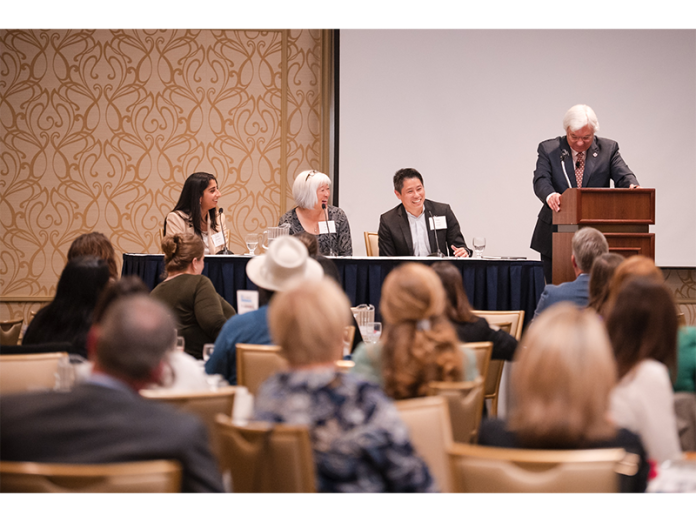
Local health care experts discussed patient and clinician benefits and the opportunities associated with artificial intelligence — as well as the need for guardrails — on Oct. 2 during the second annual In Business Madison Health Care Summit.
The event, held at the Best Western Premier Park Hotel in downtown Madison, also recognized Health Care Heroes award recipients for their service to the community.
In a discussion moderated by Dr. Frank Byrne, chief medical officer of Forward Health Group, panelists Carissa Kathuria, a software developer and research and development group lead for Epic; Dr. Ibuki Kimura, medical informatics director for SSM Health; and Frank Liao, senior director of digital health and emerging technologies for UW Health, provided a glimpse of how AI applications are currently used in health care and how they might improve future care.
Panelists said AI helps clinicians make more precise decisions and deliver better patient care, and AI can streamline hospital operations.
Liao said AI has a lot of promise and UW Health is using it widely across its system to help clinicians.
“We’re also thoughtful that it’s a new and emerging technology that has to be handled in a very responsible way,” he said, “but we see lots of opportunities for it to help with workforce efficiencies as well as our clinicians in how they practice medicine.”
Improving patient interactions
Kimura began her career as an internal medicine hospitalist and for the past 13 years, she’s had a dual role as a medical informatics director. On the information technology side, she focuses on inpatient workflows for SSM Health, a multistate organization with hospitals and clinics in Oklahoma, Missouri, Illinois and Wisconsin.
She supports all of those hospitals as well as their clinics, helping providers with workflows and collaborating with IT to optimize their electronic health records from Epic.
SSM recently began to use ambient listening, Kimura said. A clinician listens to a patient during the exam while the AI technology, which also is listening, writes the first draft of notes. Ambient AI is a timesaver for admittance, doctor’s notes of patient encounters, and other functions.
“So now when I admit a patient to the hospital, I can just bring my phone into the room, start talking to them and have a normal conversation,” Kimura said. “It’ll help me with my documentation and writing my notes, which really helps so that I don’t forget things that we might have talked about.
“I can also interact more directly with the patient and not have to be writing things down and taking notes and things like that,” she said. “So it’s been incredibly, incredibly helpful.”
Liao agreed. “I think it’s pretty amazing,” he said. “Instead of having a physician typing as they’re speaking with the patient, the physician focuses on the patient, especially for the physical exam portion.”
‘Another tool in our tool belt’
Kathuria works in Epic’s application implementations of clinical AI and in workflows from the development side.
“It’s interesting when I talk about AI, a lot of folks think AI is new, but it’s actually been around since the 1950s,” she said. “And the whole goal of any AI tool is to use a machine to complete some sort of human behavior.”
Over time, Kathuria said the technology has gotten more advanced, and clinicians can include more and more data to it.
What’s new and really emerging is generative AI, she said.
“We think of it as another tool in our tool belt, but we’ve always used it to solve the problem and then determine the workflow and then determine the (software) tool,” she said.
Asked what AI can bring to improve the health care system as a whole, Kimura reiterated the biggest benefit is time savings, resulting in “being able to spend more quality time with the patients.”
Another is that AI, because it can look at more data, can provide information a clinician may be unaware of.
“If I hadn’t looked at that part of the chart, I wouldn’t have known the patient had gone to urgent care three days ago,” she said, as an example. “If I hadn’t bothered to look, I never would have known and I wouldn’t have known it was relevant and I wouldn’t have known that they had gotten certain treatments, which would be important for caring for the patient now.”
Epic’s Kathuria joked that a computer doesn’t get tired, it doesn’t need to sleep, so it has time to review a patient chart.
“It’s interesting to think about how health care is necessarily optimized for a resource-constrained environment,” she said. “There will never be enough clinicians for the patients that need care, and as populations keep growing and aging, and our patients have lived longer until they have more complex scenarios to handle, it would be amazing if each patient had a care team only unto them and could give that amount of care, but that’s not the world we live in and it probably won’t be at any point.”
That’s where AI can really help, Kathuria said. “It can help take on a lot of the work that clinicians do today that’s administrative or can bring forward new insights that will help impact the direction of care and allow providers to have the time to think and give them a moment to breathe so they can focus on the patient.”
Streamlining and synthesizing
According to Liao, there is a progression of different benefits to AI. As it has played out at UW Health, first came administrative overhead — using AI to streamline workflows.
“One of the first uses that we had for generative AI… was helping to respond to in-basket messages from patients,” Liao said. “Since COVID occurred, we’ve seen a big rise in the number of electronic messages that physicians and nurses get from their patients. And even though we’ve continued to progress from the pandemic, that volume has continued.”
Using generative AI to write drafts that help clinicians get over what Liao called “blank screen syndrome,” and using that to reduce their cognitive burden and give them a few more minutes with patients has been a strong starting point.
Kathuria said a lot of Epic’s AI tools focus on administrative issues. A tool that helps draft responses to patient messages has been rolled out in over 300 Epic organizations, and one customer found that patients are receiving messages two hours faster than before, which can help with peace of mind.
Another promising area, Liao said, is helping to synthesize information. Liao used the example of a trauma patient about whom a clinician doesn’t have much information.
“You’re having to digest the chart, which is the same as reading ‘Moby Dick’ in 10 minutes and then trying to come up with some kind of disposition,” he said. “And so it’s not a matter of getting rid of all that rich information. It’s a matter of how we go to the next step and present this information in a way that’s synthesized and more digestible for clinicians.”
Kimura said “on the inpatient side, we’ve started to use it for a lot of data gathering to help providers not have to click 10,000 times to try to get some information, but it brings it all together for you in one screen.”
Making care more personalized for patients is another benefit, Kathuria said.
“The way that technology is evolving, it’s not just going to help with administrative documentation, it’ll bring forward information that will be really important in their care,” Kathuria said. “And then it’ll bring forward information about patients like you to help clinicians — what other patients like the one in front of them were treated with, and what were their outcomes?”
The pitfalls
Byrne asked the panelists about preventive steps being taken to avoid the potential pitfalls, and they readily acknowledged that safeguards are needed.
Possible problems include the perpetuation of false information, including the “hallucinations,” or nonsensical or inaccurate information, that can occur with AI.
The safeguards include notation from trusted sources, staff training on AI literacy, and the development of frameworks that allow clinicians to evaluate whether they can trust a patient summary.
“Creating some of these tools and frameworks is a big part of what we consider to be responsible,” Liao said. “In addition to that, we have an oversight committee that basically reviews every AI solution before it gets put into practice. It’s a multidisciplinary group that has lots of different experts on it, and that kind of oversight and governance is really important as well.”

