
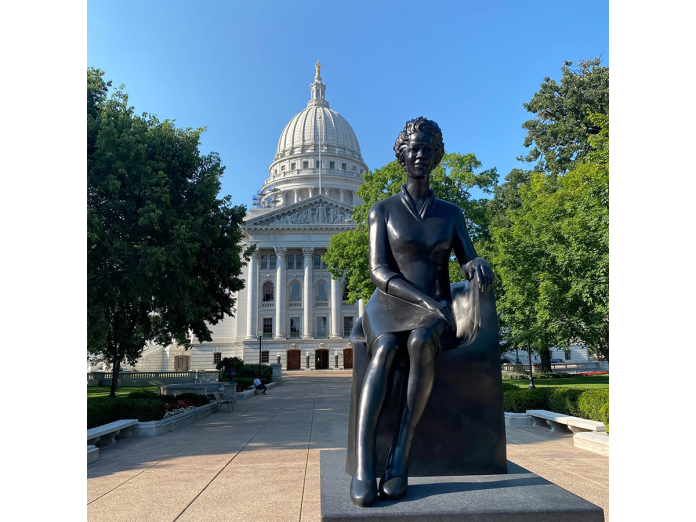

Editor’s note: The following is an excerpt from Michael Johnson’s new book, “The Audacity to Lead: From the Projects to the C-Suite: 7 Mindset Lessons on Love, Family, and Turning Adversity into Impact.” This excerpt refers to the process of installing a statue of Civil Rights icon Vel Phillips on the Capitol grounds.
There are moments in leadership when something hits you with such clarity and urgency that you can’t unsee it. For me, that moment came in 2020, standing on the Wisconsin State Capitol grounds amid the national unrest (surrounding the police-involved murder of George Floyd).
I had just met with a group of more than 1,000 activists who were passionate, vocal and unafraid. Over 500 of them signed a petition for my removal as CEO because I had spoken against tearing down statues. Their anger was heightened by the fact that just days earlier, I had raised over $200,000 to help clean up downtown Madison after a night of destruction.
To them, it seemed I was putting businesses ahead of Black lives. That was a hard accusation to hear, but it forced me to pause and listen.
After the meeting, one question stood out: “Why isn’t there a single statue of a Black person at our State Capitol?”
I went to the governor (Tony Evers). His answer confirmed it: not one statue of a Black leader stood on our Capitol grounds. Later, I discovered something even more sobering: no state capitol in the entire United States had ever installed a permanent outdoor singular statue of a Black woman, anywhere.
That absence haunted me. It wasn’t just symbolic; it revealed whose stories we celebrate and whose we let fade.

That summer, amid the protests following George Floyd’s murder, I began conversations with young activists, community leaders and elected officials. From the very beginning, the challenges were clear. First, Wisconsin had a policy that effectively prohibited adding new statutes without removing existing ones, which was a significant hurdle. To move forward, we had to request a temporary exemption before any fundraising could even begin.
Second, there was the political landscape. Vel Phillips was a Democrat, and Republicans controlled the state Legislature. Getting them, alongside a Democratic governor, to agree on anything publicly was rare. To make it happen, I built a coalition of leaders across party lines, engaging in what I called “political mapping,” identifying the decision-makers, understanding their priorities, and finding pathways for agreement.
Simultaneously, I launched a statewide public relations campaign to inform and influence lawmakers and the public, building awareness and support for Vel’s story.
Funding presented another hurdle. I took personal responsibility for raising all private funds, with the understanding that, if approved, the statue would be gifted to the state.
But having a vision was only the beginning. What followed was a four-year journey defined by patience, persistence and partnership.
We formed a task force of bipartisan lawmakers, community leaders, historians and members of Vel’s family. Together, we navigated every step of the state approval process, which was anything but simple.
At times, it felt as though the project might stall due to political pressures or budget constraints. But we refused to give up. Every challenge reminded us: this wasn’t just about a statue, it was about rewriting whose stories are centered in Wisconsin’s history.
Slowly, momentum built. Support crossed party lines. Donors stepped up. Artists submitted designs.
By 2023, we had unanimous legislative approval. And in 2024, four years after an activist’s piercing question sparked the idea, Wisconsin unveiled the statue of Vel Phillips on the Capitol grounds. On July 27, 2024, Vel took her rightful place in bronze. It was the first statue of a Black woman at the Wisconsin State Capitol, and one of the first of its kind in the nation.
For me, it was more than a monument. It was a long-overdue acknowledgment that Black women have always been at the center of history, even when their names weren’t etched in stone. The resistance was real. Some called it political. Others dismissed it as symbolic.
That’s when I learned a hard truth: courage is inconvenient. It shows up in silence, demands action when others stall, and pushes you forward when your vision makes people uncomfortable. Opposition doesn’t always mean you’re wrong; it often means you’re early.
Vel Phillips wasn’t just a pioneer; she was a powerhouse. The first Black woman to graduate from the University of Wisconsin Law School. The first woman judge in Milwaukee. The first Black person elected to statewide office.
She fought with fearless grace for civil rights, fair housing, and justice, and in doing so, she shifted entire systems. The statue is not the end of her story; it’s a new beginning in how we honor leaders like her.
And I realized something, a legacy isn’t something you wait for. It’s something you build, one bold, faithful decision at a time. That moment of clarity, of listening, reminded me of another time I had to grow. It took me back to college, to a season when I was learning who I was and who I wanted to become.
My first school felt small, confined, too much like the streets I was trying to rise above. When I transferred to a new university, it felt like I could finally breathe. More students looked like me, more room to grow, to laugh, to live. I felt lighter. And then I met (future wife) Toya.
She had a presence that made me stand straighter. Sharp, grounded and beautiful, Toya moved with quiet confidence. I noticed her right away. She made me want to raise my game. But I’ll be honest, I wasn’t ready for her. Not yet. My friends told me to let it go. They said she was too classy, too bougie, too out of reach.
But I knew better. Toya wasn’t stuck up. She was focused and I admired that. So I stayed patient. I poured my energy into music, into leadership. I stayed active in the Black Student Union. And I kept showing up. Eventually, we began to talk. And what started as a spark turned into something substantial.
Looking back, those two stories of Vel’s statue and of meeting Toya aren’t as different as they seem. Both taught me that growth doesn’t come easy. Both reminded me that leadership starts with humility. Both demanded that I show up differently with purpose, with presence and with patience.
And both showed me that when you stay rooted in your values, keep your vision clear, and walk with courage even in resistance, you can shape something that lasts, whether it’s a statue that rewrites history… or a relationship that becomes your future.
Michael Johnson is president and CEO of the Boys & Girls Clubs of Dane County.

