
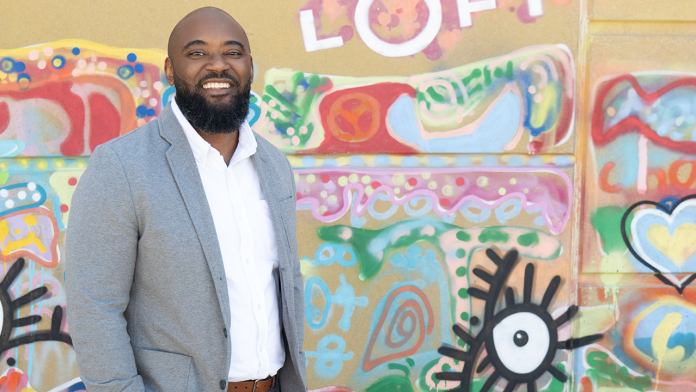
For Chris Talton, leading one of Madison’s largest community-focused organizations has brought him full circle, calling back memories of similar programs he attended growing up.
As a teenager, he volunteered for a community center through his church. Later, he spent over a decade working in nonprofits. Then in April, Talton joined Goodman Community Center as president.
Previous to Goodman, his tenure as vice president of retail at Goodwill Industries of North Central Wisconsin familiarized him with programming that prioritizes workforce development and aims to build stronger communities.
While he’s making plans to expand Goodman’s capacity and better quantify its effect on youth outcomes, Talton said he knows the center is already making a substantial difference in the community.
What drew you to Goodman Community Center?
I grew up in community centers. I moved around a lot when I was a kid, but the one (center) I am reminded of most is when I was in middle school — there was one right across the street from the school. This was in Atlanta, Georgia. At the time, it was Carver Homes Community Center.
They had formal programming in the summer, which I attended as a middle school kid, but during the school day it was largely unstructured. I’m sure that my mom didn’t sign me up for after-school programming — I kind of came and went as I pleased. It was just a place for kids to be. … What I remember most is the basketball gym.
(The center was) where I learned how to play pool, where I learned how to play ping pong, where I learned how to play foosball — all kinds of stuff. And then in the summer, they had a swimming pool, they had tennis courts (and) a competitive tennis program. I just remember those fun memories.
And then my church had a community center. We called it the Family Life Center. We did child care, we did summer programming, and in high school I worked there. … I was super active in my church, so of course I went down there every day — why wouldn’t I? … So this is my second go-around working at a community center, actually.
There’s my connection to having access to a space like this when I was a kid, and then the secondary piece of it. … From an executive level over the last 10 years or so, my career has been running different types of mission programs for Goodwill.
Goodwill is a workforce development organization that happens to serve that function in a variety of models. (Goodman) is a community center that serves that mission in a variety of ways, right? And so, my work experience kind of uniquely prepared me for it.
How do you know when you’re doing what you call ‘the maximum good?’
One of the things that I talk about is having a good high-low game, which is a sports reference, specifically basketball.
A high game would be in regard to high altitude — holistic planning, future proofing, sustainability, etc. Then the low game is, you can get lost in all of that and forget that there are humans being affected every day. … Teams that are focused on one or the other typically aren’t successful, so (it’s about) being able to split the focus.
From a leadership and from a work perspective, it’s about understanding what a kid might go through if we weren’t here. … For our after-school programming, for example, if a parent has to be home because they have to pick their kids up … that means they now have to pick a different job, which might depress their income, and all of the other downstream effects of that.
And then, we’re not just babysitting kids, right? It’s an engaging program with wraparound supports, working life skills … and we service every age group from 3 to 18 in terms of kids.
Something that the organization has already identified as a need … is to understand the long-term outcomes of our programs. We have some data, but as is the nature of research, it takes larger sample sizes.
We’d love to be able to answer questions like, if a kid spends a minimum of ‘x’ number of years in Goodman Center programming, their outcomes are more likely to be ‘x’ relative to a kid who doesn’t.
Once again, we have some of that data, but the sample sizes are so small that it would be irresponsible to share what we kind of know to be true. So as we continue to build up our muscle for tracking that data, and build our own longitudinal kind of model, then it’ll be part of how we can explain to the community … what is your money going towards?
Are there any other goals or priorities you have as you begin your work at Goodman?
Right now — and it’s a very good thing — but we’re kind of bursting at the seams. We have some opportunities in pre-K enrollment, but other than that, everywhere you look, we have waiting lists, and we have growing services and growing programs.
Our high school program is growing, our middle school program is growing, our elementary after-school program has a significant waitlist, our 4K program has a waitlist (as does) our food pantry. Everything that we’re doing is growing. We have an opportunity to figure that out, rather than just say, “Gosh darn it. Too bad. (We) wish we could help. We’ll put you on the waiting list, but you know, there’s not much we can do.”
That’s not a sustainable model. … So (we’re) doing the work of figuring out, how do we deepen our impact in the community by expanding programming? The first thing to address is physical space, so there’s some work to be done there, and I’m excited about it. … It could also be scary, but it’s also exciting.
Can you elaborate on those plans?
Because we are in the preliminary evaluation stages in considering what we “need” to do and what we would “like” to do moving forward, I don’t know that there is anything that we are ready to share at this moment.
What enriches your life outside of work?
I’m married. We have three kids, (ages) 18, 16 and 14. Most of our life for the last 18 years has been attached or adjacent to whatever the kids are doing, but we also love to travel. … We like to explore cities and regions in the United States. You think you know St. Louis, or you think you know Kansas City, or you think you know Minneapolis, or you think you know Indianapolis, but you’ve never been. … Then you go spend the week there.
When we take our summer trips, it’s not super exciting to the kids when we’re like, “We’re going to Minneapolis this summer.” They’re like, “We could go anywhere! We could go to Puerto Rico. … Why Minneapolis?” But then when we get there, they’re never disappointed. We have never taken a trip anywhere where they were like, “This was a bummer.”
We’re into plays, we’re into visual art, we’re into the outdoors, we’re into sports — a lot of stuff. We’re big readers.
You talked about your childhood and how much community centers taught you — is what you do with your own family an extension of that?
That’s the goal: exposing (the kids) to all these different things. … Exposing them to it is the idea, and then figuring out what they latch onto.
When we go to these places, we build an itinerary around … all kinds of cultural activities.

