
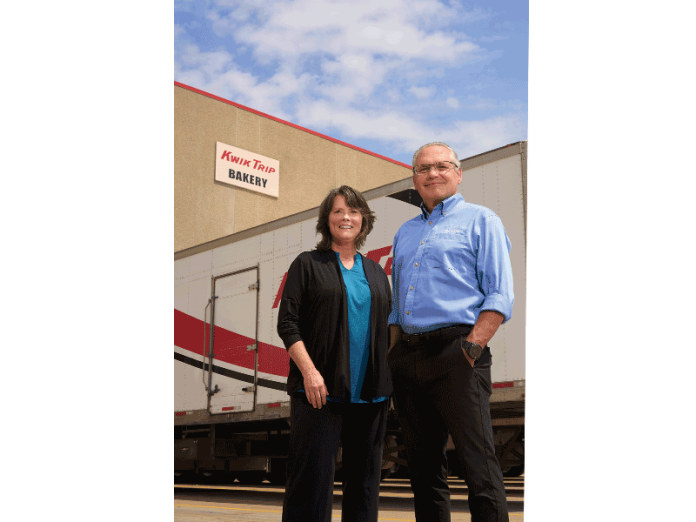

KWIK TRIP SNAPSHOT
Founded: 1965
Headquarters: La Crosse, Wisconsin
Annual Revenue: $12 billion
Chief Executive: Scott Zietlow
Employees: 39,000
Retail Stores: 900
Store growth over time
Much of Kwik Trip’s store growth has occurred in the past 10 years. The company opened its first convenience store in Eau Claire in 1965, followed by its first store in La Crosse, where the company now is headquartered, in 1967. Here’s a look at how store growth, whether organic or through acquisition, has unfolded over the years.
YEAR STORES
1965 1
1986 100
2003 309
2016 500
2019 700
2025 900*
Source: Kwik Trip | *Kwik Trip expects another 29 stores to open by year’s end.
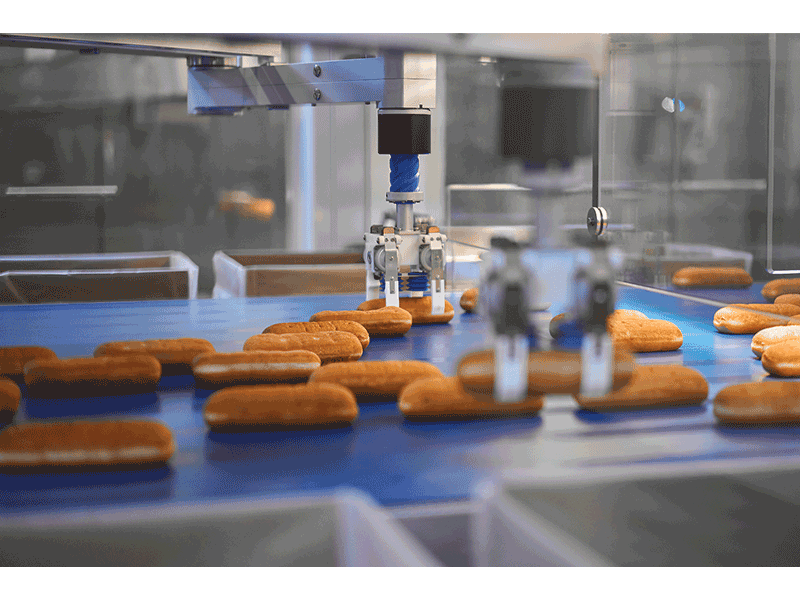
Inside Kwik Trip’s 245,000-square-foot Sweets Bakery, one of the busier facilities at its La Crosse headquarters, the first thing visitors notice is the pleasant aroma. On this day, Long Johns, which are produced at a rate of 264 per minute to satisfy the cravings of Midwestern sweet tooths, roll down a conveyor belt, ready to be plucked by robotic arms and placed in boxes for distribution.
In 2024, more than 23 million Long Johns, including the cream-filled variety (robots also inject the cream), rolled down this line. Yet when it comes to sweet treats, Long Johns aren’t even in Kwik Trip’s top three. The most produced goodies are cookies, at nearly 48 million, and two other doughnut varieties: Glazers at 44.8 million and Dunkers at 44.7 million.
With about 60 goods to offer, Sweets Bakery workers produced nearly 249 million units last year, which should give consumers an idea of the business scale Kwik Trip has reached in its 60th anniversary year.
Family-owned Kwik Trip has thrived and rapidly expanded through its mix of manufacturing and distributing its own retail products, acquisitions and growing an avid customer following.
“There’s something to be said for that (longevity), and we’re very proud of that,” said Scott Zietlow, president and CEO of the highly regarded Wisconsin-based business. “Only about 13% of family-owned businesses make it to 60 years, so it’s uncommon.”
At 900 stores and counting, Kwik Trip has more than doubled its store count in the past 10 years. Its growth has been aided by state investment. In 2023, Kwik Trip agreed to invest more than $151 million to expand in Wisconsin, and add more than 500 jobs by 2027. This would enable the company to earn an additional $15 million in performance-based Enterprise Zone tax incentives from state government.
Zietlow, a second generation chief executive, assumed command of Kwik Trip in 2023 when his father, company founder Don Zietlow, retired.
Don Zietlow helped build the business into the nation’s 11th largest convenience store chain, according to CSP Daily News’ 2025 ranking, with annual revenue of $12 billion. In the ranking, 7-Eleven leads with 12,600 stores.
At Kwik Trip’s stores across Wisconsin, Minnesota, Iowa, Illinois, Michigan and South Dakota, everything from sweet treats to take-home meals are available to shoppers. Most of its stores — more than 500 — are located in Wisconsin.
Scott Zietlow said 29 new stores will open by the end of the 2025 calendar year, as will its new distribution center in the Dane County community of DeForest, set for opening in November.
From kitchen to store shelves
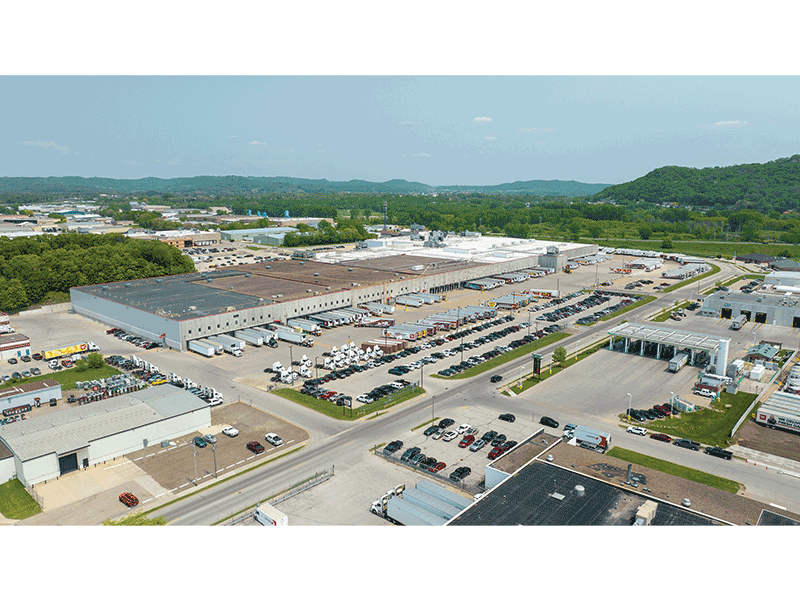
At its La Crosse headquarters, Kwik Trip’s dairy, commissary and bakery facilities prepare the food that will be delivered to each of its 900 stores daily, six days a week. Nearly 1,000 trucks are loaded each week and roll away from its 485,000-square-foot distribution center.
Zietlow estimates the company makes or distributes 80 to 90% of what’s in Kwik Trip stores. By year’s end, it will have 39,000 employees to prepare, transport and sell its bakery and fresh and frozen products.
Workers in Kwik Trip’s kitchen facility produce everything from burritos to parfaits, including the soups and sandwiches sold at the hot spots in each store — 64.5 million units in all last year.
The bread-and-bun bakery opened in 2018 and is the most automated bakery in the U.S., according to the company. The people employed there provided 15.5 million units of bread and nearly 165 million units of hot dog buns, hamburger buns and dinner rolls combined.
Then there is Kwik Trip’s dairy facility, whose employees produced more than 162 million product units, mostly milk and ice cream, last year. And they do it quickly — the company prides itself on providing milk from farm to store within 24 hours.
Among its most popular items are products of its sweet bakery, some of which Zietlow said are reverse engineered — though not identical versions — of similar treats from Krispy Kreme.
“You can’t make it exactly like somebody else’s because it’s trademark infringement, but you can reverse engineer any food, anything that’s made, and then make it yourself, improve upon it, and have your own twist on it,” he said.
The Brookie Dough flavor of its Nature’s Touch Ice Cream, a combination of brownie pieces and cookie dough, is another popular item. For hot food, its breakfast sandwiches, especially the sausage and cheese on a croissant, are top sellers.
Kwik Trip’s chocolate milk is the biggest retail seller of all. The chocolate milk is not only popular with consumers, its global appeal has been confirmed at the World Dairy Expo in Madison, where anyone from around the world can submit any dairy product for judging.
“Our chocolate milk has been recognized as the best chocolate milk on the planet,” Zietlow said proudly.
With product going to each store on a daily basis, Kwik Trip needs its own transportation company, Convenience Transportation LLC, which became a subsidiary of Kwik Trip in 1999. It has a fleet of 361 units that travel over 35 million miles annually with both perishable deliveries and petroleum transport.
“If you were to (describe the business as) a three-legged stool, it would be people, food and vertical integration,” Zietlow said. “Those are the biggest things that we feel like we can control and focus on.”
With vertical integration, owning and controlling everything from its production facilities to its retail outlets enables the company to control each stage of its supply chain.
“Because of our warehouse and our vertical integration, with our bakery, our commissary, our dairy and then our distribution center warehouse, and then what we distribute to ourselves, it takes out a middle person,” Zietlow said.
How tariffs factor in
The company’s growth continues in a period marked by more cautious consumers, Zietlow said. Their caution is caused in part by higher tariffs on imports from U.S. trading partners, which affects pricing.
Bananas, which are sourced from outside the U.S., are an example, as are ingredients mostly available outside the U.S., such as cocoa used in chocolate.
“While we produce a lot of our own products, we also sell branded products and they’re all seeing price increases,” Zietlow said. “Hershey’s is going to take a 26% increase in their costs. That will hit us. Many of these consumer packages, they will pre-price their products, so you may not have a choice insofar as what you do.
“That’s definitely true with a lot of the (snack) chip companies,” he said. “They’ll stamp on the price. You don’t have the choice as far as what you charge, and if you’re going to run some kind of special, you have to work with them very carefully because of how they market their brands nationally.”
In August, President Donald Trump increased the tariff on non-USMCA compliant goods from Canada from 25% to 35%. USMCA refers to the U.S. Mexico Canada Agreement, the existing trade agreement between the three North American nations. While energy exports and most other goods are exempted, higher tariffs such as the 50% duty on steel and aluminum continue to affect Canadian exports and supply chains.
The most expensive part of a can of beer or soda is the aluminum it comes in, so with aluminum a key part of the cost of production, higher tariffs on aluminum put upward pressure on the price of those goods.
“We are only in this country as far as our locations,” Zietlow said, “but the world is not very big, so anything that’s happening in the world affects us.”
The decision of what costs to pass onto the consumer — and to what extent — is a difficult balancing act. If the makers of consumer packaged goods decide to increase their prices, customers rarely blame them.
“It’s our co-workers (store employees) that get the brunt of that because we’re selling that product,” Zietlow said. “So that’s always a difficult decision.”
In late April, Zietlow attended the National Association of Convenience Stores CEO Summit, which draws the top consumer brand CEOs in the country, including representatives of beer, candy, chip and soda brands.
“I pointed out to them that they’re charging more for a candy bar than it costs for a gallon of gas,” Zietlow said. “That’s crazy.
“We pride ourselves in being a value proposition,” he said. “So we will fight hard with that and if we need to, we will absorb some of their costs so that we can stay competitive.”
Minding the metrics
Other than overall sales, the business metrics Zietlow pays the most attention to are same store sales, new store sales, total stores, fuel sales, customer count (directly linked to transactions) and market share — all of which are broken down, categorized and reviewed on a daily basis.
“There are engagement scores that are out there too,” he said. “We do our own as well with surveying and with our loyalty program, but consumers have choices. Where do you go? How do you decide to go to one place or another? That’s important to us.”
Armed with daily data reports, Zietlow and other executives can access as much business intelligence as they need to and react accordingly.
Artificial intelligence is used to drive efficiency in a variety of areas, including what Zietlow called “dynamic routing” of delivery trucks, which is vital with 900 store locations and pickups from 30-35 other locations on any given day. Meanwhile, predictive analytics improve inventory management.
Dynamic routing also is made possible with electronic tank monitors that reveal the fuel level on all of its gasoline tanks at every store.
“So it’s that information about where our trucks are, where is the best price … and so then what is the closest truck to get to the best fuel price, and then to deliver to what stores and what tanks? That is a very complicated process andwe use AI for that.”
Technology also is used for grocery deliveries and for automatic replenishment in its kitchens and at the stores, he said. The system helps Kwik Trip have the right products out at the right time, minimizing waste and optimizing labor.
“We have a process whereby we know what’s in the store, we know how much, how many, what’s selling and what’s trending,” Zietlow said. “It has an automatic replenishment (software) system that comes into our warehouse and replenishes what you need as opposed to somebody having to do that.”
AI isn’t applicable everywhere, and judgments have to be made about whether it’s better to use a vendor system or develop a particular business software system in-house. But whether it’s large language models, predictive analytics, or agentic AI (capable of autonomous action), Kwik Trip has found critical uses for AI.
“You have to decide if you want to be on the leading edge, bleeding edge, or you just want to be a rapid adopter of things that work well,” Zietlow said. “Sometimes it’s trial and error.”
Catering to customers
There’s always a new retail item on the horizon, often informed by feedback from focus groups.
“We have consumer groups that we use for testing,” Zietlow said. “We have a lobby store here and we bring out new things, and we have 4,000 co-workers in La Crosse and they’re an easy test bed.”
Ultimately, it’s not whether Kwik Trip can make anything, it’s about whether it can be made at scale and at a cost and at a price point that consumers will buy “so that you can have a return on investment,” Zietlow said.
Zietlow said the company has to be mindful of the fact that consumers like both consistency and variety, so it has constant limited time offers (LTOs) to gauge the market.
“They usually run for six or eight weeks, and we’ll run them if it’s a flavor of ice cream or flavor of milk, if it’s muffins, or if it’s things in the (store) hot spot,” he said.
“It is ongoing. I know for the next 12-18 months the overall schedule. Some things may move up, some things may fall off. We may introduce some new flavors to Dunkers or whatever. That’s ongoing all the time.”
The company’s social media community includes more than 157,000 members of the Wisconsin Kwik Trip Enthusiast Club on Facebook, an indication of the remarkable degree of customer loyalty it engenders.
A recent peruse of the page finds multiple posters recommending various Kwik Trip fare: “I had this strawberry cheesecake (crown) in Hudson last night and loved it,” wrote one. Another recommended “these yummy banana cake bars. They hit the spot after hiking all afternoon.” Others debated the seasoning on Kwik Trip’s taco dip.
Jacob Johnson is among the Kwik Trip enthusiasts in Madison. Johnson, who works at Badger Aquatics Club, touts the variety and quality of the selections in the bakery and the hot spot, which also features hamburgers, chicken sandwiches and the like.
“We do pop in there for those Long Johns for our kids quite a bit, and the biggest thing is just a variety of hot, take-away food,” he said. “There are so many different things they’ve got available at any time, which is not quite ‘fast food-y.’ It’s kind of impressive for a gas station to have so many food options.”
The internet, social media, influencers representing the company, and other technological enablers help explain customer loyalty to Kwik Trip, said Thomas O’Guinn, a University of Wisconsin-Madison professor emeritus in marketing. O’Guinn is impressed with the company’s ability to build a brand community.
“There are few things more important to humans than the ability to form communities,” he said. “Kwik Trip has a very strong brand community. Not only do they like Kwik Trip but they like people who go to Kwik Trip. They feel like they’re among similar people there. It feels a little bit like home.”
O’Guinn said if Kwik Trip stores had seats and booths, people would hang out there.
“It’s really easy for Starbucks to create a brand community, but for a place where you don’t even sit down, you’re just trying to get in and out quickly, they’re able to create some sense of belonging.”
O’Guinn said Kwik Trip also conducts business the right way, and that’s a big factor in its ability to build brand loyalty.
“They deliver everything fresh daily (at each store),” he said. “The truck comes in the morning with new, replenished items. They take real pride in their food.
“And their coffee, I’ve got to tell you, I drink a lot of coffee. Best damn coffee in Madison,” he said.
In addition, O’Guinn said the stores have a reputation for being safe and clean. “They keep the place immaculate. Outside, they de-ice constantly,” O’Guinn said.
Zietlow said on occasion, the customer-directed social media interaction helps inform the company’s decisions, especially on limited time offers.
“It’s very interesting, the whole social media aspect,” Zietlow said. “The (Facebook) enthusiast page is created by KT guests that really like what we do, and you do get some very interesting input from them.
“The marketing team does things all the time with that,” Zietlow said. “So, that’s where sometimes new ideas come from for limited time offers such as when they post, ‘Have you ever tried this or thought of that?’ And so, there’s a good idea in there occasionally that people bring up.”
In its marketing initiatives, Kwik Trip also leverages 25-30 social media influencers of various ages, but most of them are in the younger demographic group.
“That under 35-ish age is the biggest part of the population that is visiting C-stores and spending money,” Zietlow said. “The second largest is over age 65, so you have a very dichotomous group that want to have information delivered in profoundly different ways.”
Dane Distribution
Kwik Trip is on track to open a new 280,000-square-foot distribution center in DeForest this fall to service 370 Kwik Trip stores in southeastern Wisconsin and Illinois. It will alleviate some pressure on drivers, create efficiencies in fuel consumption and employ 400 people.
The DeForest operation is expected to service 70 truck routes per day.
Kwik Trip’s truck drivers are among its most valuable employees, Zietlow said, and the company strives to maintain a schedule that no matter how many miles they put in on a given day, they can return home at night.
Deb Brazil, convenience transportation recruiter for Kwik Trip, has her recruiting pitch to drivers with a commercial license printed on her business card: an annual salary of $92,000, four weeks paid vacation, 40% profit sharing, up to a $10,000 sign-on bonus, and $9,400 annual safety/incentive bonus for safe drivers.
Brazil said the most fun part of her job is telling candidates about Kwik Trip’s culture, which includes a referral bonus for employees who recommend someone who turns out to be a quality hire.
“Maybe you’ve got a friend and you know their work ethic — you can get yourself a $255 bonus for each one that gets hired and stays with the company,” she said.
Like the La Crosse headquarters, the DeForest distribution center will have a walk-in health clinic for employees. Zietlow, a former Mayo Clinic trauma surgeon, said Kwik Trip owns the clinic buildings and the land but their operation is outsourced to Premise Health, a direct health care company that hires local physicians, nursing staff and physical therapists.
The clinics support the company wellness program — with the convenience they offer, there’s one less excuse to miss an appointment — help control the cost of health care insurance, and help with retention in an industry known for high turnover.
Looking ahead, if Kwik Trip is to continue observing milestone anniversaries, Zietlow knows that management must evolve the business over time. The goods and services consumers want will be different years from now, but if Kwik Trip remains nimble enough to adapt, he’s confident the chain will continue to execute at the production, transportation and retail levels.

