
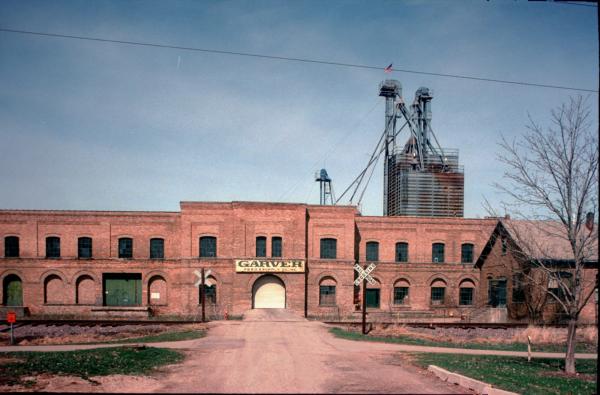

Chloe Longmire is among the dozens of vendors who sell their wares at one of roughly 30 markets Garver Feed Mill hosts each year. Her company, Chase My Creations, offers social justice-centered art and apparel, and she said Garver helps build community among the businesses there.
“You feel a strong sense of community when you’re in spaces like this that are all about thriving and seeing other people thrive,” she said in a statement. “I (have) met so many amazing people.”
Since Garver’s restoration and opening in 2019 — led by Chicago-based developer Baum Revision and local contractor Bachmann Construction — the historic building on Madison’s east side has drawn over 300,000 visitors annually, according to Garver’s first-ever economic impact analysis.
Bryant Moroder, a member of the Baum Revision development team, said Garver’s appeal stems from the variety of local businesses and community organizations it brings together — along with the close proximity of its five-acre site to Olbrich Botanical Gardens.
Baum recently completed the economic impact report — prompted by the building’s 120th anniversary — and, in Moroder’s words, “by every measure, this project has exceeded even our most optimistic expectations.”
“We have great tenants in the building … that complement each other,” he said. “(Visitors) might come for a yoga session, and then go get boba tea, or they might come for Food Truck Friday, and then they walk into the art gallery and meet the artist.”
He said the report findings are validating, affirming the building’s place as an important regional destination.
Originally built in 1906, the building was once used by the United States Sugar Co. as a sugar beet processing facility. In 1929, it became Garver Feed and Supply Co. — renamed for purchaser James Garver — and in 1997, it was purchased by the city of Madison.
The building subsequently sat vacant — with redevelopment efforts stymied in large part by the Great Recession — until Baum purchased it in 2015 with promises to reactivate the site in partnership with the city. The ensuing redevelopment saw Garver restored as a dynamic space showcasing local eats, community events, entertainment and more.
“Garver represents an important lesson in partnership and preservation,” said Eric Knepp, the city of Madison parks superintendent, in a statement. “Combined with Olbrich Botanical Gardens, it has helped create a destination that draws visitors from across the region and supports our quality of life and local economy.”
Mayor Satya Rhodes-Conway said the facility’s transformation has represented more than just a building’s repurposing.
“Garver is now a hub for entrepreneurs and a thriving community gathering spot,” she said in a statement. “This is a true success story, and I fully expect Garver to positively contribute to the city of Madison for decades to come.”
Seven-year stats
Garver Feed Mill has been a boon to the local economy and workforce, the economic impact analysis shows. Since its opening, the facility has supported 247 jobs and generated $23.7 million in annual GDP growth.
Each year, it also generates $3.43 million in tax revenue, according to the report, representing a substantial funding boost for the Madison community.
“These outcomes reflect the city’s emphasis on strengthening local businesses and ensuring that more dollars remain in and recirculate through the Madison economy,” said Matt Mikolajewski, Madison’s economic development director.
Garver has also attracted additional tourism to the area, drawing over $7 million in annual visitor spending from outside the region.
“I think it’s the combination of activities and experiences that are offered there,” said Baum’s Moroder. “People hear that we’re a good place to be, a great place to do business and a good place to visit.”
Permanent tenants at Garver include Ian’s Pizza, Ledger Coffee Roasters, Glitter Workshop, Roll Play Madison, Calliope Ice Cream, Perennial Yoga, Kosa Ayurvedic Spa, NessAlla Kombucha, Grow Greenhouse, beaut. Studios, Sitka Seafood Market, REAP Food Group and Twig & Olive Photography.
In addition, Garver has directed $5.3 million to market vendors in the last seven years, supporting a number of local businesses in the process.
“One of the most meaningful outcomes has been the financial independence some of the vendors have gained, earning enough from markets hosted at Garver to support themselves without a second job,” Moroder said. “Their stories speak for themselves.”
The Dane County Farmers’ Market-Winter Farmers’ Market and Femmestival are just a couple of the markets hosted at Garver each year.
Jamie Bugel, DCFM’s market manager, said these markets have allowed participating businesses to remain more viable throughout the year, as opposed to just during the growing season.
“This space has allowed us to expand the number of vendors who can be at the market and expand the number of customers who can shop with our farmers,” she said in a statement. “We’ve had farmers really expand their winter operations.”
Jesse Brookstein, the Wisconsin author of “A Perfect Pair: The History of Landjaeger in Green County, Wisconsin,” said in terms of the crowds and revenue Garver helps generate, it’s “one of the best” markets at which he’s ever worked, selling his books.
“Seeing what the building looked like before and what it looks like now … it’s incredible,” he added. “It’s come so far.”
Gauri Bansal of Prettyful Creations, which sells wood burned art pieces inspired by Bansal’s Indian culture, said it has been fulfilling to conduct her business out of Garver.
“To be in a city which I call home, and to be a small business here, and to be able to support other businesses, and to be able to be in the midst of other creatives — I can’t ask for anything better,” Bansal said in a statement.
A Garver-Gardens gathering
Coming off of the release of the economic impact report, Moroder said the team at Garver is looking forward to deepening its local partnerships and community engagement.
This Friday and Saturday from 4-8 p.m., it will host a Summer Breeze Block Party in partnership with Olbrich Botanical Gardens, transforming Sugar Avenue — the bike/pedestrian pathway connecting the two sites — into a neighborhood block party.
There will be picnic tables, pop-up artmaking activities, lawn games, dancing, live music and a variety of food carts. The event will look to gather the community as well as help support the public garden and featured artists and musicians.