

Whether a business has two vehicles or hundreds, it engages in some form of fleet management in an attempt to operate the least necessary number of vehicles in the most efficient manner possible. Some do it themselves and some rely on others, but given the cost of operation and maintenance, it’s not something that can be left to chance.
“Fleet management can be multiple different things,” says Chuck Ebbs, a fleet and commercial specialist and sales consultant with Zimbrick Chevrolet. “A lot of places will manage their own fleets in some way, shape, or form.”
To learn some best practices, we spoke to a variety of businesses involved in fleet management. Some manage their fleet internally and some provide fleet-management services for others. In addition to Ebbs, our sources are Matt Severson, CEO, Premier Cooperative; Greg Jones, president and CEO, Dave Jones Inc.; and John O’Connor, president, Velcor Leasing Corp.
For perspective on managing all-electric fleets, we also questioned Shree Kalluri, founder and chairman of Zerology; Bob Frick, general manager, Green Cab; and Jake Gallagher, fleet manager of Zerology and Green Cab.
Managing internally
With commercial, residential, and agricultural lines of business, Premier Cooperative has about 420 licensed units in its fleet, including tractor trailers, feed delivery trucks, fuel delivery trucks, passenger pickup trucks, and half-ton pickup trucks. The co-op has 33 locations throughout Wisconsin and its vehicles travel to all of them.
Asked when companies should create a department, complete with a full-time fleet manager, for the purpose of fleet management, Severson acknowledges that he doesn’t have a great answer. “We do not have a department for it, and we have 400-plus units,” he notes. “The reason being is that whether you decide it’s five vehicles or 100 vehicles, five is manageable for one person, but 100 is not really manageable for one person.”
Each of Premier Cooperative’s business units maintain the fleet assigned to it. Some units are as small as five to 10 vehicles, while others have 50–70. The co-op’s main office is responsible for licensing and renewals, procuring bulk rate auto insurance, and assigning new vehicles. It shares the same software with business units that may request a new vehicle or monitor routine maintenance. “The bigger units, they definitely need software to keep track of mileage and maintenance and repairs … We offer it through GM [General Motors]. Enterprise Fleet Management offers some of their own. LeasePlan Corp. offers some. It makes it easier to keep track of things.”
According to Ebbs, most businesses that procure vehicles from a fleet management company probably use that company’s software. Many who get vehicles from a procurement service like Ebbs’ at Zimbrick Chevrolet will build an internal system. Others will use third parties. “It really depends on what your fleet manager can handle,” Ebbs notes. “If it’s five or six vehicles, software is not going to be as necessary. You start getting into dozens of vehicles, you might start needing some software to keep track of things.”
Fleet management software also can include services such as GPS tracking and route optimization, but Premier prefers to use Excel spreadsheets. Severson has looked into a software vendor for fleet management, and he has heard pitches from several vendors, but they have come up short in the cost-benefit analysis. “In my mind, the cost — the annual expense and the upfront cost — have been greater than what we feel the return on investment would be,” he explains. “It’s been a couple of years. It could be different today, but we have a pretty good feel on our operating expense, and I have a hard time believing somebody can improve it to the level that they say they can.”
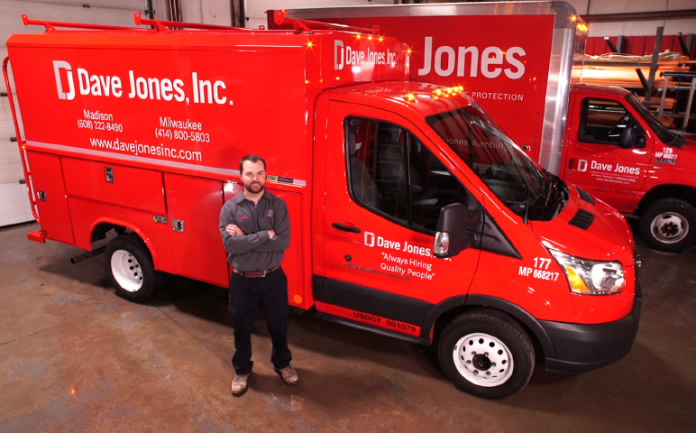
Another local company that manages its own fleet is Dave Jones Inc., which provides plumbing, HVAC, fire protection, and electrical products and services. Based in Madison with an office in Milwaukee, it has 210–220 vehicles, mostly vans and pickup trucks, plus a few small SUVs for project managers, heavier trucks for pulling equipment, and some box trucks for deliveries. It recently acquired Steg Plumbing in Indianapolis, which has 20–25 vehicles, but it mostly serves southern Wisconsin with occasional jobs in the Fox Valley.
The company has two full-time mechanics and ever since it reached 75 vehicles, it has handled its own maintenance in a repair shop with two truck lifts. “We do not have full-time person, other than mechanics, who manage the fleet,” says Greg Jones. “We have an operations manager, and pieces of her job are to manage the fleet, plan for purchases, acquire vehicles, and oversee the mechanics.”
Given the labor shortage, especially in construction, Jones’ service personnel must be as efficient and productive as possible. Each crew takes a truck home at night and drives directly to the first job the next day because Dave Jones can’t afford to have them go in for vehicle maintenance during the business day. The company has spare vehicles to use when trucks are scheduled for service. “That way, our guys just keep working on plumbing, heating, electrical, or fire protection, and they are not spending their time on anything else.”
Costs associated with fleet management start with acquisition but extend to operational costs such as fuel, which vary and are more difficult to budget than routine, regularly scheduled maintenance. At Premier Cooperative, “We tend to be on the newer end of the vehicles, so we trade off lower maintenance costs for potentially higher depreciation,” Severson explains. “We might replace a pickup truck every five to seven years. A large feed delivery truck that gets much more hours of use, not so much in terms of miles, it may be replaced every four years. A fuel delivery truck may be on a 12-year schedule.”
Communications capabilities can be integrated with fleet management software, but other technology can suffice. Drivers for Premier’s propane division have laptops in their delivery trucks, and they use them to get updates from the office. Most drivers also carry smartphones but some of its agronomy units, which operate seasonally and in much closer proximity, still use a two-way radio.
Dave Jones Inc. uses Fleetmatics, a web-based, software as a service platform, for its GPS system. “We can pull up, on the screen at any time, where each of our vehicles are, we can pull up driving reports, we can monitor idling, and we can monitor how many miles they have on them,” says Greg Jones. “It’s really nice if we get a call, a service call, and if we want to find out which truck is closest, we can pull it up and determine that.”
On an Excel spreadsheet, segment leaders put together annual budgets to determine fleet growth needs. A mechanic monitors the care of the fleet and puts together replacement charts, which informs the timing of new-vehicle purchases.
Another cost is insurance, which is typically based on a bulk rate and influenced by a number of factors. At Premier Cooperative, factors include the number of power units versus trailers, but when judging insurance premiums on a bulk rate, “you can look at it and know that you pay the same annual expense for a pickup truck as you do for an 18-wheeler,” Severson says.
There also are indirect costs, including wasted trips or incorrect deliveries, that fleet owners strive to limit. “It’s harder to put an exact number on that,” Severson notes, “but where we do measure that is in the number of same-day deliveries that are required or the number of emergency deliveries or shipments that are needed. To me, those are the indirect costs where you can measure the frequency of how often you had to change your plans during the day.”
Depreciation also is part of your financial consideration. When is it warranted to purchase a new vehicle? What is the rate of return? How does your appreciation expense factor into that? Both Premier and Dave Jones accelerate depreciation when the tax code permits.
Like every business, companies that need drivers are having a tough a time meeting their workforce needs. Long before the COVID-19 pandemic, the demand for drivers with a commercial driver’s license (CDL) was very strong, and neither Jones nor Severson believe that will change anytime soon. There are now stronger requirements to get or maintain a CDL, which isn’t necessarily a bad thing, but it does limit the labor pool, and both agree that the most effective thing an employer can do is make driving an attractive profession with strong pay, benefits, and work-life balance.
Dave Jones Inc. is training people from the ground up, and its primary source of workforce growth is hiring people that don’t have experience in the trades and putting them through an apprenticeship program. Greg Jones notes that trade jobs pay well, and they don’t require a four-year degree or massive student debt, which is an increasingly appealing pitch to the high school juniors and seniors who work for Dave Jones Inc. to gauge whether they want to forge a career in the trades when they graduate.
“Our No. 1 challenge is finding enough quality people to keep up with demand,” Jones says. “That’s why managing our fleet is important, too, because we have to manage it in a very efficient way. Having a newer fleet, a more updated fleet helps us recruit quality people.”
For Premiere Cooperative, there are plenty of regulatory compliance issues pertaining to the vehicles themselves. Federal emission standards have risen for large trucks and diesel engines, adding to the cost of maintenance and acquisition.
Shared use
At Velcor Leasing Corp., John O’Connor runs a privately held company that leases and manages about 7,000 vehicles throughout the United States and Canada. Velcor Leasing specializes in small to mid-sized vehicle fleets of 50–300 vehicles. When a client needs a new vehicle, Velcor factory orders one through a dealer group — it uses Kayser Automotive Group in Madison for Ford and Chrysler orders — and those vehicles don’t come to Madison, they get drop shipped to wherever the client is.
With vehicles becoming more computerized, electronic, and complex, even companies with small fleets would rather have someone else handle their fleet management. “Most of our customers, even the big ones, don’t have a designated fleet manager,” O’Connor notes. “Typically, it’s a controller, a CFO, or a VP of sales. Sometimes, it’s the owner … They might have an administrative assistant who pushes some of the paperwork, but most of them don’t have a full-time fleet manager. That’s what they hire us to do.”
Velcor tracks vehicle maintenance and repair history with the help of an internal website portal called Fleetworks, and individual repairs are recorded in great detail. “Every time there is a repair on a vehicle, that goes into our systems,” O’Connor explains. “So, there is a history file for that vehicle, and it not only says there was an oil change done, it also breaks down the oil change to how many quarts of oil, what kind of oil, and was there a disposition fee for the old oil?”
The ability to track expenses can inform vehicle purchases and it’s important even for mid-size fleets. “If you have 50 or more vehicles in your fleet,” O’Connor notes, “the cost of operating vehicles is going to be a top 10 expense for your company.”
Velcor’s clients use open-ended monthly leases with no mileage restrictions. Most sedans are replaced at close to 100,000 miles, while pickups and vans are being pushed out to 125,000 to 150,000 miles, and that translates into somewhere between 33 and 39 months of usage. There is a monthly payment to lease a vehicle, and the client takes all the risk in terms of when it’s sold, what it sells for, and whether there is any residual value.
“Some customers like to accelerate depreciation, so three years down the road when they want to replace it, there is a small residual value,” O’Connor notes. “If a vehicle sells for $15,000 and there is a $4,000 residual value, they are going to get the $11,000 of equity back. That goes back to our client. We don’t keep that.”
In transportation, the future is electric
Shree Kalluri launched a new company with the express purpose of reducing emissions and congestion through shared rides and shared cars — electric cars. Kalluri is learning a great deal about managing a fleet of electric vehicles, and what he’s learning is hardly dampening his enthusiasm for “EVs.”
Zerology and Green Cab are owned by the same parent company, Mobility Transportation Inc., and both feature an all-electric fleet. Fleet support and maintenance is done by the parent company, and Mobile22 is an internally developed technology platform used to manage everything from driver assignments to regular maintenance. “You can automate it to the extent your heart desires,” Kalluri notes.
The fleet includes 42 Tesla Model 3s, one Tesla Model X, and four Chevrolet Bolts. Bob Frick, general manager of Green Cab, explains how managing an all-electric fleet is different than managing a gasoline-powered fleet. First, it’s helpful to have similarity in the type of vehicle, which is the case here. Second, neither Zerology or Green Cab is maintaining internal combustion powered cars, which have more moving parts — up to 2,000, compared to about 20 for EVs — and require more maintenance.
“If you’re dealing with a fleet of internal combustion engines, there is a lot more of the regular maintenance such as oil changes,” Frick notes. “We don’t have oil changes with the Teslas, so it’s a little different.”
The ability of software to track what needs to be done and when is “extremely important for whatever kind of maintenance you’re dealing with,” Frick adds. That’s true even with features such as regenerative braking, which is easier on brake pads and helps keep the car’s battery charged.
Jake Gallagher, fleet manager for Green Cab and Zerology, says the fleet’s most-used Tesla has about 120,000 miles and adds, “They are pretty care-free, really. It’s just about rotating the tires and keeping them charged. Other than that, we haven’t had to do much maintenance on them.”
While it’s still a bit early to make a definitive judgment, the potential for electric vehicles to have a lower cost of ownership over their lifetimes, even though they are likely to have considerably longer lifetimes, is real. Kalluri predicts that each EV will last at least 500,000 miles. “Teslas could last 1 million miles,” he states. “Volkswagen and others, too, but everyone is guaranteeing at least a half million miles.”
Click here to sign up for the free IB Ezine — your twice-weekly resource for local business news, analysis, voices, and the names you need to know. If you are not already a subscriber to In Business magazine, be sure to sign up for our monthly print edition here.