

When people read historical accounts of 2020, perhaps they will reveal more than the pandemic that roiled the global economy and challenged public health like few events ever have. Maybe, just maybe, there will be room in these accounts for the many acts of kindness that small businesses showed others — especially other small businesses.
Originally, this space was going to be devoted to our second annual Businessperson of the Year, but given everything that transpired, we couldn’t name just one. Instead, we celebrate small business heroes whose compassionate acts came in reaction to the COVID-19 pandemic and racial unrest. These certainly aren’t the only examples, but since we’ll be living with this pandemic and the aftershocks of George Floyd’s police-involved murder and the police shooting of Jacob Blake in Kenosha for some time to come, they might inspire others to follow suit.
In this brief look at 2020 small business heroes, we profile the following Dane County businesspeople:
- Blaine Neupert, president, and Tina Neupert, vice president, Don’s Home Furniture;
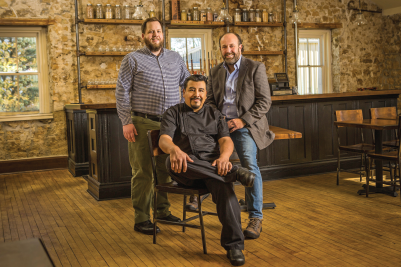
- Troy Rost, managing owner, 1847 at the Stamm House restaurant, and president, Lake Effect Properties; and
- Renee Zaman, owner, Mazo Hardware & Rental.
Throughout 2020, Madisonians learned of the philanthropic creativity of local businesspeople, and this article is more than an homage to the people profiled. It also salutes everyone who embodied the spirit of “We’re all in this together.”
ONE GOOD TURN
A local furniture company gives a philanthropic gift to one of Madison’s most philanthropic retailers.
Humility, sorrow over the cause of unrest, and thankfulness prevailed after May 30, when demonstrators damaged and looted Goodman’s Jewelers, at 220 State St., and many sympathetic segments of the community responded with reassuring good wishes and offers to help. About the last thing Blaine and Tina Neupert of Don’s Home Furniture wanted was to have their resulting generosity receive saturation news coverage, but when you offer to restore and replace antique, nearly 100-year-old jewelry cases — and do so for free — someone was bound to nominate you as a small business hero.
That someone was Peggy Gunderson, CEO of Strategic Brand Marketing, who stated when describing their compassionate response, “That is my Madison.”
It’s also Blaine and Tina Neupert’s Madison because when looters took over the downtown area and ransacked the jewelry store, they reached out to John Hayes, owner of Goodman’s since 1998, and offered to repair and replace the antique jewelry cases. Although one case was damaged beyond repair, Blaine and Tina paid for all repairs and replacement costs.
As Blaine explains, it wasn’t only a gesture of solidarity from one business to another, it was something he was compelled to do as a furniture retailer, especially one known for Amish craftsmanship. “The reason for us reaching out was when I saw the story on the news about him [John Hayes] talking about the cabinets and the cases being smashed and destroyed, and these cases being almost 100 years old, that was what really caught my attention more than anything else,” Blaine recalls. “It was really because of the fact those cabinets were as old as they were that sparked our interest. It’s because those cabinets are basically irreplaceable, and there are very few people that would have had the capability to repair them the correct way.”
While that was about 90% of Blaine’s motivation, the flip side was the extent to which Goodman’s has given back to the community — more than most people realize. Blaine and Tina did not really know Hayes, but they had met him when he donated items for a silent auction to raise money for a nonprofit devoted to depression awareness and suicide prevention. When Tina heard about what happened on the night of May 30, including how Hayes found himself in a dangerous situation when trying to protect his store, she understood why Blaine broached the idea of reaching out.
“In a situation like this, people want to help, but maybe they don’t know how to help,” she notes. “Blaine heard about this story, and it’s like, ‘Hey, we know wood. We know furniture. Maybe we can help.’ We’ve had experiences when people broke into our store, and we know what that feels like. You’ve worked so hard for something and it feels personal. So, knowing how badly the Goodman’s family probably felt was part of it too.”
Bringing the damaged cases back to life is a story in itself, and it includes a willingness of Ohio-based Amish furniture shops to do their part. “Believe it or not, that’s where those cabinets all went to,” Blaine notes. “We picked those cabinets up in June and sent them down to our Amish shops in Ohio, where they wound up going between different places. It took quite an army, actually, to do this. It took a lot more than what I originally anticipated, and that was my shortsightedness. It actually took the efforts of six different shops down there between glass and finishing and wood shops. There was an incredible amount of effort that went into it.”
“All the lining had to be relined because it was embedded with glass,” Tina interjects.
When the Amish craftsmen heard what Blaine and Tina were doing, every single one of them, plus the truck drivers that took the cabinets down to Ohio, began to chip in. “A lot of them are doing it at cost,” Blaine notes, “and some of them are even doing it for free, which is nice.”
Some of the restoration work was free, but it was not free of challenges. The damaged cabinets were made out of big leaf mahogany, a difficult-to-get, old-growth mahogany. It’s a threatened wood species that’s banned for import into the United States, so finding replacement parts was a matter of locating mahogany that’s not banned. “There are other types of mahogany in the world, and we had to do the best we could to match it up,” Blaine explains. “But that took quite a bit of running around and looking for the correct wood species.”
Another challenge was glass because the glass on some of these cabinets was curved, and while curved glass itself is not a big deal, there are very few glass companies in North America that make the type of curved glass that Blaine Neupert was looking for. It took some detective work to find these suppliers, and the glass pieces cost $1,500 each, which came as quite a sticker shock. Still another potential barrier was that because of all of the looting and the rioting nationwide, glass companies themselves were overburdened in trying to replace glass for all of the businesses that have had broken and damaged glass. So, the glass part of the restoration took considerable time and expense.
In Blaine’s view, the total cost of replacing the cases is unimportant, a point he made to an insurance agent he met when he first walked into Goodman’s Jewelers to inspect the damaged cases. The agent, who was handling the jeweler’s insurance claims, said to Neupert, “You need to make sure you send us a bill for all this.” Blaine replied that he wasn’t getting a bill — not one single bill — because he felt it was time to give something back to Goodman’s. “This is about all the community and everything they [Goodman’s] have done,” he states. “It needs to come down to somebody else doing something good for this company and this [Goodman’s] family for once.”
Goodman’s John Hayes is certainly appreciative of Blaine and Tina and their Ohio craftsmen. “They did a phenomenal job of taking damaged cases that were 85 years old,” Hayes says admiringly, “and making them look like new.”
GATHERING APART, HANGING TOGETHER
Marrying business with philanthropy, a Middleton restaurant and nonprofit keep the kitchen open.
Generosity and compassion are the two words used to describe the actions of Troy Rost, managing owner of 1847 at the Stamm House restaurant, during the COVID-19 pandemic. Thanks to that generosity and compassion, those who rely on housing and food pantry services, not to mention a hard-working restaurant staff, had a little bit more to be thankful for during the pandemic.
These words were used by the woman who nominated Rost for this honor — Patricia Eldred, development director of Middleton Outreach Ministries, or MOM as it’s more affectionately known. This MOM is a 40-year-old, nonprofit organization that exists to prevent homelessness and hunger, so perhaps it was a natural inclination to team up with a fine-dining restaurant during a pandemic. 1847 at the Stamm House also is a historic Middleton landmark, one that Rost and his partner spent two years restoring after acquiring it in 2013.
According to Eldred, Middleton Outreach Ministry originally partnered with the restaurant in May 2019 to host an event that came to be known as “Gather,” a fundraising dinner to support MOM’s food pantry and housing stability programs. The event was a success and the organization planned to hold it again in May 2020, but the COVID-19 pandemic struck and it looked as though
MOM would have to forego this year’s event as well as the potential funds it hoped to raise.
That’s when Rost stepped in. He proposed holding a curbside, drive-through dinner with the proceeds split between MOM and the restaurant, which was struggling to keep its business going and its staff working. “This generous act became ‘Gather Apart,’ a way for MOM donors to enjoy a delicious dinner, help the Stamm House stay in business, and support MOM at the same time,” Eldred notes.
Due in large measure to the hard work of the restaurant’s staff, this drive-through model was extended to become a once-a-month gourmet dinner event that will run through this month. Through September, the event had earned $17,568 to support food security and housing stability.
Rost credits Ellen Carlson, executive director of Middleton Outreach Ministry, and Darren Fortney, a board member, for “figuring this out.” When he was approached with the idea to marry business and philanthropy in this particular manner, Rost was still in a state of shock and rather despondent over having to close his doors because of the pandemic. The restaurant had a good year in 2019 that carried over into January and February, and then the boom was lowered.
“We’ve worked super hard to get the restaurant working and we’ve had more than our share of struggles,” Rost says. “A lot of them were our fault, but we still …”
His voice trails off for a moment, but he could have added: “This one wasn’t our fault.”
Among Rost’s COVID-19 worries was whether he could keep his staff together because, as any business operator knows, once you have developed a good staff, you want to keep it intact. He characterized his workforce as a scrappy, creative crew that simply knuckled down, worked harder, and turned what started out as a “super scary” time into an exercise in survival. “We wanted to keep our staff together because we’ve got a good staff, and this [Gather Apart] program was a real opportunity to work on that, knuckle down, and be creative,” Rost states. “Everybody felt good about it because, let’s be honest, there are staff members that would be going to MOM for meals if we had to let them go.”
Interviewed in October, Rost says he’s fortunate to have a large outdoor patio that helped to sustain the restaurant during the summer, but he has a new set of worries as winter approaches. Expenses have gone up, not down, during the pandemic, which combined with continuing restrictions on indoor dining makes it even trickier to figure out what the future holds. “Some people are a little more comfortable going into restaurants. Some people aren’t,” he notes. “We’ll just have to see. It sure would be nice if there was a second stimulus.”
With the uncertainty surrounding that question, Rost was contemplating ways to scale up philanthropic efforts — perhaps for a variety of worthy causes — and he has applied for a state of Wisconsin “We’re All Innovating” grant that will provide financial awards for innovative ideas to fight COVID-19. “Our parking lot is big, so we can have lines and set different price points, depending on what different people want, for different menu items,” Rost says. “There is a certain amount of fatigue out there right now for just giving, and this program feels like you’re getting something in return.”
Rost worries that if restaurants don’t soon get another round of paycheck protection, consumers might be left with nothing but chain and fast-food options. Meanwhile, his other business, Lake Effect Properties, suffered two commercial vacancies that “really hurt,” and replacements don’t start paying rent until March.
“I’m a cancer survivor, and that plays into how I look at the world,” he acknowledges. “Every day, you just get up and decide to fight through it and not dwell on the negative stuff, and every day you just take another bite of the apple. Otherwise, this stuff would be overwhelming right now.”
HARDWARE QUEEN REIGNS OVER COVID-19
A little handy work allowed voters and poll workers to feel safer this election year.
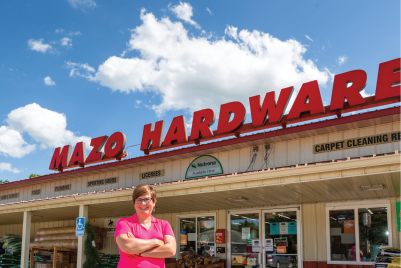
Renee Zaman’s unofficial title at Mazo Hardware & Rental is “Hardware Queen,” and many voters and poll workers in the uncertain spring 2020 election believe her to be hardware royalty after she and her staff made in-person voting safer as the COVID-19 pandemic reached a deadly phase.
Zaman’s official title is owner of the independent hardware store in Mazomanie, and some believe Zaman and her employees owned this year’s COVID-19 emergency response when the store came to the rescue at various polling locations. On March 25, less than two weeks prior to the April 7 spring election, Gov. Tony Evers had issued his safer-at-home order, classifying hardware stores as essential businesses that could remain open with recommended precautions for social distancing and the like.
Then there was the little matter of how the votes would be cast, as Wisconsin Democrats wanted to either extend the absentee voting deadline or postpone the election, only to have Republicans block both alternatives in the courts. Many voters felt they were being expected to risk their health in order to perform their civic duty.
While there is partisan disagreement about whether in-person voting contributed to a spike in positive COVID-19 tests, voter anxiety was real. And this was no ordinary spring election because it included Wisconsin’s presidential primary and a hotly contested state Supreme Court race.
Thanks to some staff ingenuity, Mazo Hardware got busy producing plexiglass shields, then sold them at cost to eight polling locations so that poll workers could feel safe while they worked the election and voters could feel safe while they got their ballots and cast their votes.
Actually, the store did not start out making the shields for polling locations. Employees Joe Kliebenstein and Andy Schneider came up with the idea of making plexiglass shields for the store. Their reasoning was that another layer of protection couldn’t hurt, and at the time, it was widely believed that every retailer would have them at various checkout points once the safer-at-home order expired. It only takes about four screws to hold the plexiglass in place, so they were not overly complicated to assemble, and the store offered free labor with the purchase of the materials used.
“We saw that voting was coming up and the pandemic was going on, and the wife of Joe [Kliebenstein] sent a message off to WKOW, a local TV station, and said, ‘Hey, Mazo Hardware is making shields to protect people when they are voting’ because we must have done one for a local place. And then the TV station came out and did a piece on us, and then we got quite a few more calls, so our plan was to build them just for the cost of plexiglass and then we donated the lumber and the labor.”
In addition to the polling locations served last spring, three others came forward in the fall asking for shields. Mazomanie and communities such as Lodi, Black Earth, and Reedsburg all made requests for the shields. With material from the store, staffers also designed a face shield that could lift up or down for a local doctor’s office and a financial planner. It also donated masks, gloves, rain suits, and sanitizing cleaner to a local hospital.
“We were deemed an essential business, so we had to figure out ways that we would be able to keep our doors open and keep people safe,” Zaman notes. “Joe and Andy came up with a real simple plexiglass shield to have by the cash register because that’s where we knew we would have the closest contact, typically, with a customer. And so, we wanted to protect ourselves because the mask requirement hadn’t yet come out at that point. We were just trying to figure out how can we make it through and hopefully not get everybody sick and not get sick ourselves.”
Curbside pickup served a few customers, but Zaman was amazed with how many people were coming out to shop. The store tried to enforce six feet of separation, it had arrows through its garden center so that traffic flowed in one direction, and then people started wearing masks. Customers purchased more flowers and potting soil and did more gardening than ever before, and paint sales soared as home-bound people tried to improve their residential cocoons, but it was difficult to secure all the supplies people wanted.
It wasn’t the first time Zaman had stepped up in an emergency. Two years ago, when the area was hit with a major flooding event, a bridge between Mazomanie and Madison was out, and there wasn’t an easy way for people to get to the Capital City to buy what they needed. So, she rented a 26-foot-long U-Haul truck and drove to South Dakota to pick up supplies and bring them back. “I definitely look to what my community needs and do what I can to support people because yes, we’re definitely all in this together,” she states.
As a result of the its 2020 heroics, Mazo Hardware & Rental was recently named as a recipient of the Community Service Beacon Award from The Hardware Connection, an industry publication. The award was given to retailers that went above and beyond to serve their communities during the COVID-19 pandemic.
Along the way, sales have been healthy even though at times the store was operating with a reduced staff and not only dealing with customers, but also with people struggling with a sense of isolation. According to Zaman, Mazo Hardware employees had people on the phone for prolonged periods of time, and it was poignant because they were lonely. “So, not only were they calling to place an order,” she recalls, “but then it would be a 15-minute phone call because they were talking with somebody because they had somebody to talk to.”
Click here to sign up for the free IB ezine — your twice-weekly resource for local business news, analysis, voices, and the names you need to know. If you are not already a subscriber to In Business magazine, be sure to sign up for our monthly print edition here.