

From the pages of In Business magazine.
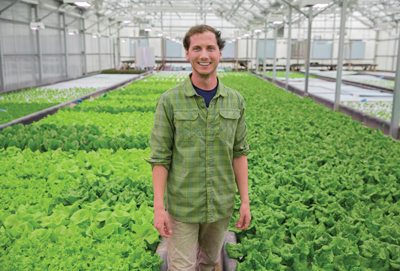
Tucked in the hillsides around Belleville, Wis., Clean Fresh Food is growing leafy greens in a way most farms don’t … without dirt. The business practices aquaponics, a method of growing nutritious food without soil.
Associate Scientist Zak Buell, 25, explains. “Aquaponics combines aquaculture and hydroponics (growing plants without soil) in a way that eliminates the downsides of the practices separately. It’s a brilliant innovation, really.”
Hydroponics, he says, is completely reliant on chemical fertilizers and is not self-sustaining, while the most common complaint in aquaculture centers is the amount of waste leftover from fish.
Yes, fish.
At Clean Fresh Food, aquaponics is the key to growing delicious, leafy greens using nutrients derived from fish waste.
Here, a small staff attends to thousands of tilapia raised from young fry to maturity in a system where healthy bacteria break down fish waste. The result is a nutrient-rich liquid perfect for growing varieties of lettuce, herbs, and micro greens year round.
Mike Knight and his wife, Dagny, launched the operation in 2012 and celebrated its first harvest in the summer of 2013. [If the name sounds familiar, Knight founded and later sold Third Wave Technology Group.]
Buell joined the operation less than a year ago. “Our goal is to produce food environmentally in a healthy, clean way using no chemical additives,” he says. “We take great pride in providing fresh food to our clients.”
It’s a fascinating, natural process.
Hardy and healthy
|
Above, lettuce roots thrive under floating rafts until harvest. |
Inside the bio-secure fish house, 12 1,200-gallon water tanks bubble from aeration. Each tank contains between 100 and 150 tilapia purchased as small fry from fish farms. They will grow to adults weighing five to seven pounds, on average.
“We like tilapia because they’re hardy, they grow quickly, and they can handle Ph changes,” Buell says. The downside is that Clean Fresh Food does not have the certification or staff to clean and filet fish prior to selling to restaurants or stores. For that reason, it is considering switching to bluegills or yellow perch because of their popularity and marketability. “We may test the waters this summer,” he adds. “There are plenty of people willing to filet a bluegill.”
As the fish live and grow in the tanks, the excreted waste gets filtered out, leaving behind a nutrient-rich cocktail of nitrogen, phosphorus, and calcium. Buell adds potassium carbonate and agricultural lime to boost the mix.
The aquaponics system is gravity-fed. Well water from the property moves through the fish tanks into a mechanical filter where bio media resembling macaroni noodles are churned a couple times a week to physically break down the waste.
“The mechanical filters, and essentially every other submerged surface, acts as a home to our beneficial bacteria,” Buell notes. “They are essential in converting toxic components of fish waste — primarily ammonia — into an inert form that is more useful to the plants.” Excess wastewater is diverted to a retention pond on the property and used to fertilize crops during the warmer months, but the payoff is in the greenhouse next door.
It’s an ah-ha moment.
Floating ecosystem
Inside the brightly lit space, varieties of green, leafy lettuce, herbs, and micro greens thrive in contrast to the gray landscape outside. Filtered water flows through six long, rectangular troughs, each about 150 feet long and 10 feet wide. Plants float in Styrofoam rafts poked with holes for root growth.
Many varieties of seeds are germinated in the fish house before being moved to the greenhouse. When they’re ready to transplant, Buell puts them in a spongy substance called Rockwool and plugs them into a raft hole where they will continue to grow until harvest. It could take as few as two weeks or as many as seven.
The water meanwhile, recirculates to the fish house.
“We do our best to maintain a completely circulating system and only add about 2,000 gallons of water a week,” Buell notes. The system is remarkably efficient, with electricity needed only to power a sump pump and a few grow lights above. Meanwhile, heat piped in from an outside wood burner warms the well water as necessary.
Buell regularly monitors Ph and checks levels of ammonia and dissolved oxygen. “Checking the water chemistry alone could be a full-time job,” he admits.
(Continued)
At peak, Clean Fresh Food produces about 12,000 head of lettuce a month including five different varieties of specialty lettuce. It is experimenting with a new butter-head variety, but Buell says romaine and crisp lettuce are the most popular.
|
Top, at Clean Fresh Food in Belleville, Zak Buell flings high-protein fish food into 1,200-gallon tanks. Middle, twice a week Buell churns mechanical filters resembling macaroni noodles to breakdown fish waste. Bottom, seedlings encased in Rockwool grow in the floating rafts. |
Micro greens, or young plants that provide a nutritional wallop, tend to be more profitable than lettuce and can be ready to harvest in just a couple of weeks. Buell displays a tray of Ruby Streak mustard, followed by a red-veined sorrel variety that produces a delicious lemon-zest flavor with a bit of a bite.
UW–Madison and Metcalfe’s Markets are among the company’s largest clients, but the company also sells to restaurants and delivers to food pantries.
A good day, Buell remarks, “is when I walk in, feed and check the fish, harvest the plants, plant new plants, and feed the fish again.”
Of course, things don’t always go perfectly. “We’ve had fish die-offs and algae blooms that require excessive cleaning and water quality testing to make sure the plant nutrients are adequate and not harmful to the fish,” he relates.
But it’s a job he feels perfectly suited for, having held a lifelong interest in biology and the life sciences. Not long ago, in fact, he was on a pre-med track at Lawrence University in Appleton.
One day, he heard a bio-naturalist share her observations about the changing world. “It just hit hard with me,” Buell admits. At the same time, Houston and the Florida Keys were being devastated by hurricanes. It was a sea-change moment that led him to refocus his career from medicine to agriculture, and he couldn’t be happier with his decision.
“I used to volunteer at local gardens in my spare time while in med school. That should have been an indication that that’s where my heart really was,” he admits.
While the practice is right in Buell’s wheelhouse, aquaponics also is an especially viable option for geographic areas where water and soil quality are lacking.
“An aquaponics system is its own ecosystem,” Buell explains. “In a way, it models an ideal society because everything is working together and helping each other. I think that’s very powerful.
“It’s not a silver bullet, but it’s definitely part of the recycling puzzle.”
Buell understands that some people may find the idea of consuming vegetables grown from fish waste hard to stomach.
“Hopefully we get to a place where recycling organic waste is more appealing than using chemical fertilizers. If any place is going to be on board with that, it will be a progressive place like Madison.”
Click here to sign up for the free IB ezine — your twice-weekly resource for local business news, analysis, voices, and the names you need to know. If you are not already a subscriber to In Business magazine, be sure to sign up for our monthly print edition here.

