
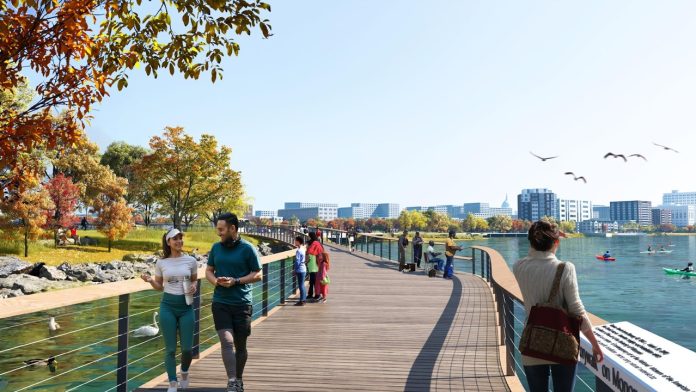

Leading a Tuesday update on the Madison LakeWay project, Alan Fish, a Madison LakeWay Partners executive committee member, expressed bewilderment at the underutilization of the isthmus’ shoreline.
He also touted the project’s potential to increase community activities and environmental sustainability along the Lake Monona waterfront.
“Here we are in a city with a quarter-of-a-million people,” he said. “We have a hard time finding places where we can go (to be) next to the water; there are not very many restaurants on the water; there are not many places where you can drive a boat and connect to the water.
“We’re beginning to think about how we develop those connections so that people of all ages and with all abilities can start engaging (with) the lake in a really, fundamentally different way.”
The Madison LakeWay “will create a gateway to the city like we’ve never seen before,” he said.

Madison LakeWay Partners is the nonprofit organization leading the LakeWay redevelopment in partnership with the city. The group held its April 21 community update at the Madison Parks facility at 330 E. Lakeside St.
During the meeting, Fish gave an overview of the coming transformation of the Lake Monona shoreline, spanning 1.7 miles of publicly owned land from Law Park to Olin Park.
The project seeks to increase safe public access to the water, enhance water quality and pay homage to the area’s cultural history. It will address four main lakefront areas — creating the Law Park Ledge, the Lake Lounge, the Skyline and the Olin Overlook — to effectively bridge south Madison with the city’s downtown in what Fish called a new, unified “district.”
“With all the elements that are being built on the South Park Street corridor … a new BRT (bus rapid transit) line coming through, a whole variety of investments and infrastructure and activity (are) making south Madison a new renaissance area,” Fish said. “At the same time, the county is looking at the Alliant Energy Center … and (saying), let’s remodel the Coliseum, make it a vibrant entertainment spot.
“The conversations will move into how to make this something like the Deer District in Milwaukee, where you have hotels, restaurants, residences, all part of that. So now you’re looking at creating in south Madison developments that need a lakefront. We’re looking at these things all happening together.”

The vision for the LakeWay redevelopment comes from the Denver-based design firm Sasaki, whose master plan was approved by the City Council two years ago.
Phase one of the LakeWay project, the Skyline, will occur in tandem with the John Nolen Drive Reconstruction Project, led by City Engineering, and cost around $14.5 million to complete.
The roadway will become a four-lane city boulevard, Fish said, widening the greenspace between the pavement and Lake Monona by an additional 15-20 feet — increasing the total area of shoreline greenspace by roughly 100,000 square feet.
The Skyline phase will focus on the development of a long, linear park along the lakeshore that includes:
-
The construction of two new boardwalks;
-
The planting of roughly 130 new trees;
-
Enhanced stormwater management and water quality improvement, which the city will test for use elsewhere;
-
The paving of a 10-foot-wide biking path and a separate six-foot-wide walking path, as well as the creation of an unpaved running path; and
-
The installation of cohesive signage and public art that creates a “story walk” to recognize the history of Madison as well as the area’s Indigenous populations.
This will be “a way to thread all of our history from the glacier to today,” said Mark Schmitz of the Madison design agency Zebradog, which is developing the Madison LakeWay brand and signage.
He referred to a portion of the Laurentide Ice Sheet, which thousands of years ago advanced over Wisconsin and ultimately created the Madison lakes.
Schmitz said the LakeWay will be dotted with district banners, light beacons and informational panels to attract, direct and educate visitors.
Fish added that Madison LakeWay partners has received around 70 worldwide applicants for the public art installations.
He said the Skyline phase of the LakeWay project will benefit the environment by expanding native vegetation, natural drainage, the use of sustainable transportation and even the physical activity levels of the immediate community.
He noted that the project’s capacity to increase safety along the shoreline — especially when it comes to transportation — and access to the water will reach underserved community members in neighborhoods that have historically been overlooked.
There are fifty thousand people within walking or biking distance of the Skyline, and one-third of them are people of color, he said, and make an average of $60,000 annually.

Madison LakeWay Partners has so far raised around $11.5 million toward the Skyline phase, including roughly $9 million from the city of Madison and around $2 million from Dane County. Fish said the goal is to wrap up fundraising by the end of 2026 and launch construction in early 2027.
Early financial supporters of the project have included the Alliant Energy Foundation, Capitol Neighborhoods, Clean Lakes Alliance, Destination Madison, Evjue Foundation, J.H. Findorff & Son, Fortune Family Foundation, John J. Frautschi Family Foundation, Ho-Chunk Gaming Madison, M3 Insurance, Madison Community Foundation, Madison Gas & Electric Foundation, Madison Parks Foundation, Martin Family Foundation, Olin Trust, PRL Keystone Foundation and UW Health.
Pavement imbeds along the Skyline will recognize philanthropic donors like these.
Community members are encouraged to make a gift supporting the project, Fish said, as well as attend tours happening at Madison Parks on May 14 at 2 p.m. or May 19 at 11 a.m.
Looking ahead, he said the Madison LakeWay’s second phase, Olin Overlook, will build a “destination park” connecting Olin Park to the Skyline, and include a concert pavilion, multigenerational playground and boat docks.
Fundraising for that phase will begin in 2027, with construction planned to begin in 2028 and conclude the following year.
Editor’s note: A statement regarding the number of people of color within walking or biking distance of the Skyline has been corrected.

