

With the approach of Wisconsin’s first open gubernatorial election in 16 years this November, Democratic Gov. Tony Evers had a blunt message for his possible successors: “We have a strong economy. Don’t screw it up.”
That means leveraging the state’s strengths, he said — touting successful industries like dairy and tourism along with a massive, anticipated budget surplus — and prioritizing areas where there is still high-stakes work to be done.
Wisconsin’s 46th governor, Evers has served two consecutive terms since his election in 2018. He previously was elected state superintendent of public instruction in 2009, 2013 and 2017. His career includes over 30 years working in public education, beginning as a science teacher in Baraboo.
When announcing he would not run again, Evers said he wanted to spend more time with his wife, Kathy, and the rest of his family. “Here’s the truth,” he said in a video message released last summer. “Wisconsin, the only thing I love more than being your governor is being a husband, a dad and a grandpa.”
With the end of his term looming, Evers sat down with In Business Madison for a wide-ranging interview on his accomplishments and challenges, and what he sees as Wisconsin’s key priorities going forward, like funding education, reducing property taxes and supporting vital statewide businesses. He’s also bullish on burgeoning industries like fusion and is optimistic on what data centers can bring to local communities, despite controversy the developments have drawn.
For Wisconsinites and the statewide economy to thrive, Evers said, it is critical that the new governor address these issues collectively because industries and communities across the state rely on one another.
Madison is a clear example of this, Evers said. Industries like tourism — with growth driven by attractions like farmers’ markets and football games — are largely reliant on the stability of multiple sectors of the economy.
“We have to make sure that continues,” he said. “All those things depend on all sorts of other things, like health care, affordable housing, education. It’s all connected, and (Wisconsin’s next governor) better be able to address every one of those in some fashion.”
Evers’ remarks come as, ahead of the Aug. 11 primary election, U.S. Rep.Tom Tiffany maintains a commanding lead over medical service technician Andy Manske on the Republican side.
The field is more open among Democrats vying for the nomination, including Lt. Gov. Sara Rodriguez, state Sen. Kelda Roys, state Rep. Francesca Hong, former Lt. Gov. Mandela Barnes, Milwaukee County Executive David Crowley and former Department of Administration head Joel Brennan. Missy Hughes, former CEO of the Wisconsin Economic Development Corp., has dropped out.
And Evers is leaving office at a pivotal time, when changes to the state’s legislative maps — and some key retirements — could upend GOP dominance in the Legislature, which stonewalled Evers’ ability to make progress on some of his priorities, especially early in his tenure.
Failed budget deal
While Evers is ending his gubernatorial term as a relatively popular office holder, said Barry Burden, a professor of political science at the University of Wisconsin-Madison and director of the Elections Research Center, he has a “much less favorable image among his Democratic colleagues” who have been frustrated with some agreements he has cut with Republicans, “often (while) excluding legislative Democrats from the policymaking process.”
That was the scenario in May, when the state Senate rejected an Assembly-approved bipartisan bill that would have used Wisconsin’s projected budget surplus to cut property taxes, increase special education funding and provide taxpayer rebates.
All 15 Senate Democrats rejected the bill, an agreement worked out among Evers, Republican Assembly Speaker Robin Vos and Republican Senate Majority leader Devin LeMahieu (both of whom are also retiring). Three Republicans also voted no, while 15 Republicans voted in favor.
A May analysis from the nonpartisan Legislative Fiscal Bureau projected Wisconsin’s general fund gross ending balance in fiscal year 2027 to be $2.37 billion. The budget stabilization (or “rainy day”) fund, meanwhile, had a balance of roughly $2.07 billion as of June.
Republican Tiffany opposed the bill as a “backroom relief deal” that he said failed to provide lasting taxpayer relief, while some Democrats said the measure lacked the long-term structural changes necessary for education.
Still, a Marquette Law School Poll found that 80% of Wisconsin adults supported the surplus bill, with rare agreement across party lines: 77% of Republicans, 81% of independents and 82% of Democrats in the poll said the Legislature should have passed the surplus bill.
When asked why legislators rejected a deal which appeared to have overwhelming support from voters, Evers responded, “Good question,” but noted he is still investigating other ways to pursue what he considers important steps to strengthen Wisconsin communities.
“We’ll have to take a look at whether it’s a possibility to do something different before I leave office,” he said. “But it’s still a thing. We have the resources. … It puzzles me that we didn’t get (the bill passed), but we’ll see if there’s any additional interest now.”

photo: Tim Fitch / Kingdom Filmworks
The ripple effects of education
As a former educator, Evers said strengthening education — particularly K-12 — has been a top priority during his tenure.
“(With) K-12, I think that’s where the rubber does hit the road, and kids become good citizens and good leaders in their communities by doing well,” he said.
Evers said dollars directed toward Wisconsin’s schools also have broader economic ripple effects in statewide communities that must otherwise shoulder education-related expenses — and other costs — on their own.
“The business community is concerned about property taxes, as we are, and if we can modify that and make it less stressful, we should do that,” he said. “But we also need to have good health care, good transportation systems, all those things that impact businesses … and education.
“So, I try to bring all those things together so that we’re not just providing money for kids. … We have to do all those things in order to continue a good economy in the state.”
UW-Madison’s Burden noted that Evers was never quite able to obtain the funding he would have liked for public schools and the UW system.
“At times he found ways to increase education spending in omnibus budget packages, but never to the degree he and fellow Democrats sought,” said Burden.
The issue proved a significant roadblock for Evers as the GOP-controlled Legislature repeatedly rejected the education funding increases he proposed. Evers’ 400-year school funding veto — a move which extended a temporary per-pupil funding increase of $325 through 2425 and was upheld by the Wisconsin Supreme Court — created additional tension with GOP lawmakers, who have continued to push for its repeal.
When public schools lack the necessary funds to support facilities and student needs — which Evers said are “more severe … than ever before” — they must rely on referendums, which exacerbates taxpayer burden.
“I was (recently) at a school district nearby,” he said, “and the superintendent was talking about needing that (surplus) money just to pay bills. As a result of what happened (to the budget deal) in the Legislature, they’re going to have to go to referendum this fall.
“Doesn’t make sense,” Evers said.
Bob Soldner, assistant superintendent of financial services for the Madison Metropolitan School District, said MMSD’s board has historically sought voters’ approval to increase the district’s revenue limit to help meet district needs through a combination of state aid and local property taxes.
“(In) the May proposed budget, we’re proposing a (nearly) $40 million increase,” Soldner said. “This surplus bill would have provided $10.1 million in general aid, which would have resulted in the (local tax) levy going down to $30 million, a 25% reduction.
“That $10 million that would have been provided in general school aids is not spendable new money — it can only be used to change how our costs are funded. It goes from property taxes to state aid. That’s a huge impact. … That’s a big deal for taxpayers.
”Evers pointed out that by increasing state funding for schools, particularly in support of special education, his proposal would have released some federal or local money that could in turn have been channeled toward wages or other expenses.
He also said Wisconsin’s lower school funding compared to other states may contribute to its property taxes being among the top 15 highest nationwide.
“If we provide more money for schools, they will have less need for property taxes,” he said. “The legislative leaders on the Republican side and I worked together to provide money for our schools for special education (in the budget deal), but that also was money to moderate property taxes in the state, maybe actually lower them in some areas.”
Evers said he “felt good about that part of it, and we worked with the legislative leaders on issues of affordability … by sending some tax money back to people. I still think it’s a good idea.”
Addressing workforce needs
Another contributor toward Wisconsin’s higher property taxes is funding for its technical college system, but Evers stressed these institutions also increase young people’s workforce preparedness, which helps sustain key statewide industries like health care.
“We’re not getting the help we had been in the past from the federal government, especially with the presidential regime there,” he said, in reference to federal funding related to health care. “We’re fighting at both ends, but we’re in control of this end.”
Tech schools, he said, are helping combat worker shortages and growing young people’s preparedness to enter health care fields.
“We’ve got a lot more kids going into the workforce better trained than ever before, and the tech colleges have done a great job of moving that needle,” he said. “And collaboration that’s happening in the public sector … has been a really good way to move the state forward.”
He highlighted a collaboration in Stevens Point geared toward growing the nursing workforce. The University of Wisconsin-Stevens Point, rather than offering a four-year nursing degree, provides pre-nursing courses and partners with local technical colleges, which in turn offer hands-on clinical training. The program allows students to earn an associate degree in nursing along with a Bachelor of Science in nursing over four years.
To have “a healthy Wisconsin, we need to have people to do the work,” Evers said.
Closer to home, a partnership between Madison College and UW Health led to the first registered nurse apprenticeship program in the U.S. in 2023, and the nation’s first respiratory therapist apprenticeship program.
And just last year, the technical college and health system developed a surgical technology associate degree registered apprenticeship in collaboration with the state Department of Workforce Development and the Workforce Development Board of South Central Wisconsin.
Jennifer Berne, president of Madison College, said state funding is “essential” for Wisconsin’s technical colleges to address their communities’ workforce needs.
“At Madison College, the issue is not a lack of student interest or employer demand,” she said in a statement. “It is whether we have the resources to responsibly grow capacity in the programs Wisconsin needs most, including advanced manufacturing, health care and the trades.”
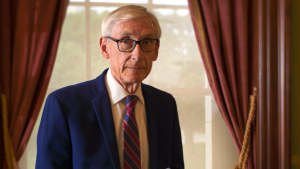
photo: Tim Fitch / Kingdom Filmworks
A future built on innovative tech
A longtime clean energy advocate, Evers said continuing to invest in Wisconsin’s renewable future is not only environmentally responsible but economically lucrative — and it’s another arena in which state and federal policies have recently clashed.
In 2019, Evers established a statewide goal for Wisconsin to consume 100% carbon-free electricity by 2050, and while he said progress is happening, it’s happening too slowly.
“It sure would be some help from (Washington) D.C. if we had someone that believed in it, which we don’t,” he said. “The good news is we’re seeing continued increases in solar power. I have great hope that we’ll be able to ramp up nuclear energy — fusion or fission.
“I think we’re in a good place, considering. … We can get there, and nuclear (energy) is one of those ways. I’ve been really happy with the continued interest in solar and wind, considering the wind and solar activities from the federal government (are) headed in the opposite direction. Once that changes, I feel confident that we’ll be in even better shape.”
He said the Public Service Commission’s approvals for solar projects from companies such as Madison Gas and Electric have helped shift the dial in recent years.
MGE spokesperson Steve Schultz said by 2030, the company’s current plans will have yielded over 40 renewable generation and battery storage projects since 2015.
“Utility-scale solar generation plays a role in that transition because it provides cost-effective, carbon-free energy,” he said in a statement. “By continuing to invest in solar — both locally and across Wisconsin — we are able to reduce carbon emissions, diversify our generation mix, enhance reliability and advance new technologies.
“When paired with battery storage — as we’re doing at a number of projects, including at the Sunnyside Solar Energy Center project under construction in Fitchburg — solar can help provide capacity, flexibility and reliability to the electric grid.”
Evers said Wisconsin’s 12 Native nations are also furthering the clean energy agenda.
“They all have the same goal — to be energy sovereign,” he said. “We have a couple that (have) spent almost all the … money that they have available on solar. We have a couple that will be energy free.”
Nations making progress in this regard include the Menominee and Bad River, among others, Evers said.
On the nuclear energy front, Evers said Wisconsin is well-positioned for leadership, especially given UW-Madison’s legacy in nuclear research.
Nuclear fission splits atomic nuclei in an energy-producing process that has historically drawn criticism due to catastrophic reactor incidents and the generation of radioactive waste. Nevertheless, Evers said fission is “better than what we have now,” (referring to non-renewable sources like fossil fuels).
Nuclear fusion, by comparison, combines atomic nuclei in a manner advocates say provides safe, renewable energy without releasing such waste. The technology has the potential to provide the world with an inexhaustible, carbon-free energy supply by as soon as the mid-2030s.
Evers defined fusion as a top statewide priority in his State of the State address this year and announced that the PSC, in partnership with UW-Madison’s Department of Nuclear Engineering and Engineering Physics, would conduct a nuclear siting study.
He also signed Wisconsin Act 165 in April to create a sales and use tax exemption for materials, equipment and other items used exclusively in fusion technology projects.
Evers said not only is continued support of nuclear research at the university level more important than ever, but so is taking steps to mobilize Wisconsin manufacturers.
“As nuclear (energy) becomes more important, it will make a difference in businesses all across the state,” Evers said. “It’s cheaper, and it’s renewable, and I would anticipate that using nuclear (power) will lower — or at least mitigate against — huge increases in costs for our companies.”
When asked if there are risks in the event that Wisconsin lags other states or countries in preparing for the commercialization of nuclear energy, the governor answered, “Hell yes.”
He said it will be important to continue to find ways to attract nuclear research and companies to the state. In February, WEDC awarded an Ignite Wisconsin grant totaling $778,000 to the Wisconsin Fusion Energy Coalition to help establish Wisconsin as a national fusion
energy commercialization hub.
Companies like Realta Fusion and Shine Technologies, both spun out of UW-Madison, are leading advancements in the field.
“Continued state investment (supporting fusion) matters,” said Cary Forest, a UW-Madison professor of experimental physics and Realta Fusion co-founder. “It is not only about supporting one company or one project. … The states that lead in fusion will be the ones that invest in both commercialization and the basic science ecosystem underneath it.”
The data center debate
Another big economic opportunity for Wisconsin, Evers said, lies in data centers, a source of contention among residents and the companies seeking to build such facilities.
Earlier this year, plans for a $12 billion data center proposed by QTS were killed after the Village Board in DeForest deemed the project “not feasible,” with residents’ chief concerns arising from its potential to raise their utility bills, perceived threats to the environment, the loss of rural farmland and a lack of transparency about the project.
Meanwhile, proponents of data centers, like Evers himself, contend that openness and responsible practices on the part of companies and municipalities can largely amend these issues.
“I know there are ways to mitigate environmental (risks) and have clean energy and have these data systems in operation,” said Evers.
He cited Microsoft’s AI data center campus in Mount Pleasant, part of a major regional investment whose first facility is anticipated to be fully operational this year.
“(The company) was not as open, and because of that, I think people became skeptical. … And that still lives, and I think companies have learned the lesson that if they’re going to be active in an area, they have to lay all the cards on the table right away.
“To some extent it didn’t happen in Port Washington (with the Vantage Data Centers project) either. But the good news … is that both companies have committed in those areas to essentially pay for whatever electricity they need. … If they’re going to do that, it’s not going to impact ratepayers.”
He pointed out that concerns about data centers’ water usage are being addressed as companies adopt innovative methods of cooling down their facilities.
“They’re going to cool it mainly with air and with some water, but not much,” he said, adding, “In fact, the water that they use in Mount Pleasant probably is the same amount that a restaurant would use in a year.”
He also doesn’t see data center projects as a threat to farmland.
“Farmers are in the best position to make the decision whether they sell or not,” he said. “I know farmers in the Port Washington area. They’re paid, and they should have that opportunity. If they’re landowners, they should be able to sell their land, and if they don’t want to, they won’t.”
Like many new frontiers, Evers said he thinks data centers are drawing public skepticism simply because they are unfamiliar, so garnering Wisconsinites’ widespread support may take time and proof-of-concept. At this point, he is not advocating additional legislation at the state level to govern data center development.
“Let’s put it this way — anything I’ve seen on (the legislative front) looks exactly like what (companies) are doing now,” he said. “It maybe took too long and maybe took (away) an opportunity to make people more in favor of them, than if they would have done some things differently up front.”
On the flip side, he said building data centers across the state will be an economic boon to municipalities and create jobs — a viewpoint shared by Maggie Brickerman, president of the Wisconsin Technology Council, the independent, nonprofit science and technology adviser to the governor and Legislature.
“Data centers are foundational infrastructure for the modern economy,” she said in a statement. “These developments can bring jobs, property tax relief and investment to our state. Each community has to determine if a development is right for them, and that conversation shouldn’t begin with ‘yes’ or ‘no,’ but ‘how.’”
Political transitions
Evers said he still has a bit of unfinished business in office. He mentioned food insecurity in Wisconsin is one of the issues that “still piss(es) me off,” and ensuring every city or town has a food pantry is paramount — especially in a state with such a strong agricultural legacy.
“We’ve got to make sure that we have a system in place to get this food that our farmers are … creating every day into the lives of people, so that they’re not having bad health results because they don’t eat the right food or have the right food,” he said.
For the most part, however, Evers feels the state is in a solid position to continue growing its economy and to support its communities. Since he became governor, he has visited all 72 Wisconsin counties each year, a goal he is on track to meet this year as well.
“It’s one thing (to) spend time in Madison, in this building, in this room, talking to people,” he said, but another to meet and hear people where they live and work.
“We have a good economy in Wisconsin. … Think about where tourism is … and just a couple bad decisions will make it go away. We’ve built it up to a level that I would never have guessed, and it continues to this day to be a multibillion-dollar … industry, and that’s not peanuts.
“Whether it’s dairy, whether it’s manufacturing, the state’s doing pretty well. … We have such a diverse group of folks that are businesspeople in the state and businesses that do great things. … I think it’s really important for (Wisconsin’s next governor) to think about how our economy has been good.”
He added that, in the event the projected surplus is not used while he is still governor, it will still offer opportunities down the road “to
make sure that things are affordable.”
As the election approaches, Evers said “a lot” is at stake if the governor’s office flips to Republican control, in particular under Tiffany, who advocates ending the 400-year property tax increase, reducing PSC-approved utility rate hikes and ending subsidies for data centers and industrial wind and solar projects.
“He is not a fan of public education, and he’s with (President Donald) Trump every step of the way,” said Evers. “So, what we’re experiencing from Washington, D.C. will be brought to Wisconsin. That’s bad.”
And with his remaining months in office, Evers said he’s still focused on key issues.
“There’s all sorts of things I’d like to have finished … (like) getting money to schools and also sending some money back to people,” he said.

