
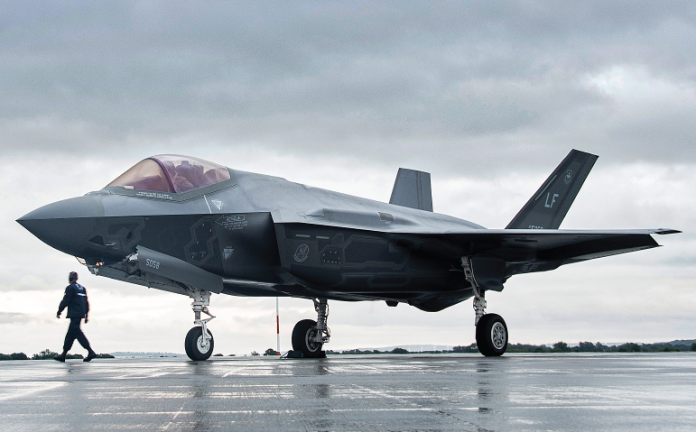

Now that the debate is over and the dust has settled, and the only argument that remains is the possibility of a longshot lawsuit, the Air National Guard’s 115th Fighter Wing can look forward to preparing its Truax Field base for a squadron of next-generation F-35 jets, which are scheduled to arrive in 2023.
Following several years of studies and debate that divided the community, Air Force Secretary Barbara M. Barrett last week formally approved the 115th Fighter Wing and Truax Field as the next Air National Guard F-35 operational “bed-down” location. The decision ensures the local presence of the 115th Fighter Wing and the 1,200 jobs and estimated $100 million in annual economic benefits that come with it.
Now that he’s had several days to digest the positive basing decision, Chris Arenz, executive director of the Badger Air Community Council, which advocated for the F-35s, notes the long road required to get to this point. “It will also be a long road before we get the aircraft here in Madison,” he states, “but everybody is very excited and happy about the process and that it led to a positive decision for us.”
IB also spoke to Lt. Col. Charles Merkel, who is a current F-16 pilot at the wing and is the pilot representative from the fighter wing for the F-35 conversion, and Lt. Col. Daniel Statz, who is in the deputy commander of the 115th Fighter Wing’s Mission Support Group.
|
Chris Arenz |
|
Lt. Col. Charles Merkel |
|
Lt. Col. Daniel Statz |
Noting the F-35 is the new “platform of choice” for the Air Force, Merkel called the basing decision a major milestone for the fighter wing. The new jets are replacing aging F-16 jets that have been based at the wing for decades. “Short of getting the airplane itself, this is as big a milestone as there is,” he states. “We’ve been waiting a long time for this. A lot of people have done a lot of work to get here. Obviously, it’s good for the fighter wing, but it’s really good for the country. It’s good for our national defense strategy to have this airplane.”
Statz characterized the decision as a pat on the back for the 115th, which at times took a public-relations beating — undeserved, according to supporters — during the contentious debate. “It’s an affirmation of all of the hard work that has gone into this and, with the F-16 and prior platforms, our record of excellence here,” he says. “It’s just another recognition of how well our base does and the hard work that we do.”
According to Statz and Merkel, the F-35 is a high-caliber airplane because of its stealth capability, its enhanced ability to identify targets, and improved information it provides to pilots. A squadron of 18 PAA (primary aircraft assigned), with two spares, will arrive three years from now, and both men have a keen sense of anticipation.
“This is an airplane that makes every other airplane around it better because of the information that it provides,” Statz explains. “So, it’s stealth, it’s sensors, and it’s information. That’s really what it comes down to. People that don’t fly fighter jets tend to think in terms of how fast it goes or how many Gs [G force] it pulls. Those are metrics of a bygone era.”
Base building blueprint
With an affirmative decision in hand, roughly $90 to $120 million in construction will be part of base preparations for the new jets. The 115th Fighter Wing has 19 projects to complete that are associated with the F-35s, and while much of the work will modify existing buildings rather than bulldoze them, work will begin this fall on a new simulator building that will contain four, high-fidelity F-35 simulators for pilot training. New shelters will be constructed on the flight line for covered parking for the new jets, and maintenance hangers will be modified to make them suitable for F-35s.
Many of the new facility designs have already been done. “We’ll be ready to put those on street for local contractors to bid on to participate,” Statz says. “General contractors will use subs [subcontractors] that are in the local area, as well. We’re preparing for that construction to begin and the fall is when we’ll kick off some keystone projects to get going. We’ll be doing construction through 2024, even after F-35 arrivals.”
Some facilities date back to the 1940s, and while they have been well maintained, Statz notes that updating them will help the fighter wing bring them up to today’s environmental and safety standards. Among the points of contention during the public date over the basing decision was the fighter wing’s alleged role in environmental contamination from the spread of PFAs (per- and polyfluoroalkyl substances) in firefighting foam, which the unit contends would have been used regardless of whether jets are based here. Dane County Regional Airport is mandated by the Federal Aviation Administration to use film forming foam that contains PFAs.
“One thing that is also slightly lost, but with the mount of construction that we’re doing, I know there has been some negativity that it will disturb soil and cause additional contamination,” Statz says. “These projects actually provide us the opportunity to use construction funds to deal with contamination. So, in my mind, the F-35 construction is actually going to get us ahead of defining and mapping where any PFAs may be on the installation and maybe do some mitigation as the construction begins, well ahead of the normal process of how it would play out.”
Noise abatement
Perhaps the most contentious issue related to the basing of F-35s is how noise from the jets will impact residential neighborhoods near Truax, which is located near the airport on Madison’s east side. While it was easy for the secretary of the Air Force to dismiss false claims that the F-35s are four times louder than the F-16s, or that Truax would be used to house nuclear arms, sound mapping will take place and funds will have to be allocated for noise mitigation measures. Dane County Regional Airport will be involved in those studies, but there are things the fighter wing has done and will continue to do in the way of noise mitigation.
According to Merkel, pilot try to fly predictable flight paths that affect potentially high-impact areas the least. “That’s what we’ve been doing for years with the F-16s, flying over those areas to minimize the number of noise complaints,” Merkel says. “So, wherever the noise complaints are the highest, we try to fly in other areas. We’ve been doing that for years, and we work in conjunction with Dane County Regional Airport on the [Part 150] noise abatement program. We’re part of that process.”
In addition, pilots use the lowest power setting possible to get in and out of the airfield, and Merkel says the unit is confident that pilots will not have to use afterburners for takeoffs even in the worst-case scenario, which is a hot and humid day in Madison. The unit can also minimize the number of takeoffs and landings in Madison by executing multiple missions made possible by “tankings,” or off-base refueling.
Good neighbor policy
Had the basing decision gone the other way, what would have happened to the 115th Fighter Wing? The Air Force considers the base-closure process completely separate from the F-35 basing process, but the viability of an Air National Guard base without the addition of F-35s to replace aging F-16s would have been in question. A base without a flying mission cannot bring families and economic benefits, not to mention help with emergency management.
That’s why the criticism that most rubbed Merkel the wrong way is one that questioned whether the 115th Fighter Wing is a good neighbor. “We do a lot of emergency responses like we’re doing right now in the COVID-19 crisis that are too many to list right now,” he states, “and then all the people that we employ, the young airmen that we send through college that join up when they are 18 and six years later, they have a college degree and they are debt-free because of the Air National Guard. We bring so many benefits to the community and to hear somebody say that the 115th Fighter Wing is not a good neighbor, I thought that was disingenuous. Over the years, we have proven to be just the opposite.”
Click here to sign up for the free IB ezine — your twice-weekly resource for local business news, analysis, voices, and the names you need to know. If you are not already a subscriber to In Business magazine, be sure to sign up for our monthly print edition here.

