

From the pages of In Business magazine.
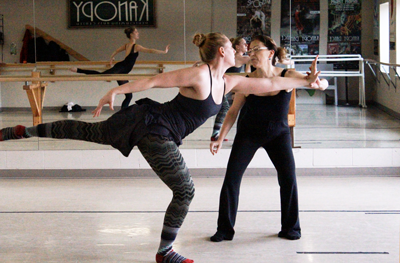
Inside the Kanopy Dance studios overlooking State Street, co-artistic director Lisa Thurrell, 54, instructs just over a dozen dancers in the Martha Graham modern dance technique. Comprised of mostly professional dancers, the group listens and reacts accordingly.
“I think we can be bolder with those spirals,” Thurrell coaches. “Feel the spiral of the spine. It all lengthens and turns, it isn’t just shoulder blades, it has to come from all the way around. I want a whomp!”
she demonstrates.
The group tries it again. “Elongate those forearms,” she corrects. “Turn the back a little more. Nice!”
With the touch of her iPod, the room is immersed in a staccato rhythm of drums specific to the Martha Graham dance technique, which Thurrell explains is codified and pedagogic. “Basically, it’s comparable to practicing scales,” she says.
To a layperson, her instructions seem foreign: “Center on two. Spiral on one. Spiral on one. All four developments.”
She approaches a young dancer. “Be careful not to over-spiral. Hang from the elbows, don’t punch your ribs forward.”
Grabbing a nearby jacket, Thurrell places it between her legs and pulls up to illustrate the body position she needs them to achieve. “Remember when you wore diapers,” she says. They snicker.
The dancers line up at one end of the studio. On her count, everyone is suddenly in sync as the dancers hop and skim across the floor. “Fly, fly, fly!” Thurrell yells out.
Kanopy Dance Co. is a nonprofit arts organization and a resident company of Overture Center for the Arts. Thurrell and her husband Robert Cleary took the reins in 1995. “We’ve never been in the red,” she states, “and we’re proud of it. That’s usually pretty rare for a group like ours.”
Having trained at the Martha Graham Dance Co. in New York City, Thurrell feels privileged to teach the technique here in Madison, her hometown, and speaks of Martha Graham, who died in 1991, with reverence and awe. “She was one of our founders of American modern dance,” Thurrell notes. “It is an aesthetic and philosophy and a way of dance that is very, very different. It’s rebellious and a way of moving forward. ‘We are strong. We have expressive, individualistic things to say that are very physical and may or may not have a story form.’ It’s very, very different from ballet.”
Members of the public often approach modern dance cautiously, afraid they will not understand, Thurrell explains. “They just need to experience it.”
All encompassing
Kanopy Dance has three primary facets: a professional dance group and a second company; a studio space for classes, rehearsals, and available for rent; and an academy for ongoing classes and workshops for dancers ages three and up. Thurrell and Cleary handle every aspect of the operation, from teaching and choreography to making sure there’s toilet paper in the restrooms.
|
Lisa Thurrell [with glasses,] coaches Kanopy dancers at a recent practice. |
“In a light week, we might work 60 hours but typically it’s more like 80,” Thurrell admits. “Luckily, we’re married, so we can deal with it.”
They see dance not as a job, but as a need. “It’s all encompassing,” Thurrell impassions. “I see things as one big canvas. There’s a sharing, a communication when you perform or teach or direct or choreograph.”
This morning, male dancers are outnumbered three to one by females. Evidently, that’s a common problem. “We’re really fortunate that we have so many great dancers here,” Thurrell notes, “but it’s unfortunate that we don’t have more male dancers.”
She blames that on a certain stigma that exists in this country. “Years ago, Sports Illustrated featured Mikhail Baryshnikov on its cover and that started a movement of more men in dance because they were deemed athletic and masculine.” But it didn’t last.
“Ironically, dance started off as a purely male activity, so it’s a real conundrum for me and it makes me sad because dance is such a physical, athletic, artistic, and aesthetic thing.”
Kanopy Dance has 10 professional dancers and a pre-professional group called Company 2, which includes 14 promising students who serve as understudies or perform in a handful of shows throughout the year. Rehearsals are about to intensify as the group prepares for its upcoming eight-performance February show titled “Baba Yaga: A Portrait of the Wickedest Witch.”
Dance is demanding, but making a living as a dancer can be even more difficult, Thurrell notes. “A dancer never stops dancing. They can’t. Just like an athlete.”
The Kanopy Dance professionals practice 10 to 12 hours a week, but that ramps up to weeklong, six-hour days as performances near. They get paid per performance, but not for rehearsal time. “Honestly, these dancers are fabulous and we do amazing things, but if we were salarying them, we could do that much more,” Thurrell explains. “Our goal is to get to the point where we’re paying the dancers for rehearsal time and have some salaried contracts, but at this point for us, especially because of modern dance, it’s very difficult to build and raise funds.”
With about 40 weeks of available work, a Kanopy dancer might earn around $6,000 a year between performances and teaching. That can increase or decrease depending on the size of the company. “They’re not putting many pennies in the bank by doing this,” Thurrell admits, “but this is their profession, and to them, dancing is the most important thing. Any other job they may have just allows them to be able to dance. It is not a hobby.”
(Continued)
Master plans
Thurrell’s typical day begins with a morning class followed by a two-hour rehearsal, a midday break, administrative work, and evening classes. Tuesdays are lighter days but Saturdays can last 12 or more hours, starting with classes for students as young as three years old.
|
Kanopy dancers Zada Cheeks, Jessica Hoyt, Brad Orego, Juan Carlos Diaz Velez, Sierra Powell, and Sarah Wolf perform in “Wien” (2016). |
Because she and her husband are also composers and choreographers, they can create their own dances, or reset or restage another composer’s rendition. The organization brings in local, national, and international guest artists, and can also perform masterworks. “So you might hear Beethoven’s ‘Moonlight Sonata’ or Martha Graham’s ‘Heretic,’” Thurrell explains. “With masterworks, we have to be approved and vetted to perform. We negotiate which masterwork to stage and then I want really elite talent to be sure we perform it correctly.”
What determines a professional dancer? “It comes down to the artistry, the commitment, how good they are as performers or teachers, and creativity,” Thurrell explains. “When we bring dancers in, we expect a professional caliber even though we don’t salary them. But we offer such a strong company so we’re not bashful about that. We are disappointed that we haven’t been able to grow economically large enough to be in a different tier, but we’re still demanding excellence in terms of commitment and artistry. And frankly, they demand that of us,” she notes.
As Kanopy’s third set of artistic directors since the group started in 1976, Thurrell and Cleary have achieved growing success. The company’s performances at Overture’s 200-seat Promenade Hall average 80% to 85% in ticket sales. “Many companies only get about
45%,” Thurrell remarks.
She earned a master’s degree in dance and Asian theater history from UW–Madison and has taught both nationally and internationally. Quite simply, dance is her raison d’être, so returning to Madison to run Kanopy was the perfect opportunity. “Dance, to me, is giving of myself as deeply as I can to those around me,” she states. “It isn’t about being famous. It’s not about me. There’s something bigger. When I’m on stage performing, that is real.
“There’s an openness that you have as a performer. It’s like tapping into something bigger than you that must be expressed about our humanity. It isn’t about the person on the TV dance show that will make a million if they make it to the end.
“My job is to do something so honestly and deeply that I can move people, make them think more, enjoy more, and see beauty more. It’s kind of
a big deal.”
Click here to sign up for the free IB ezine — your twice-weekly resource for local business news, analysis, voices, and the names you need to know. If you are not already a subscriber to In Business magazine, be sure to sign up for our monthly print edition here.

