

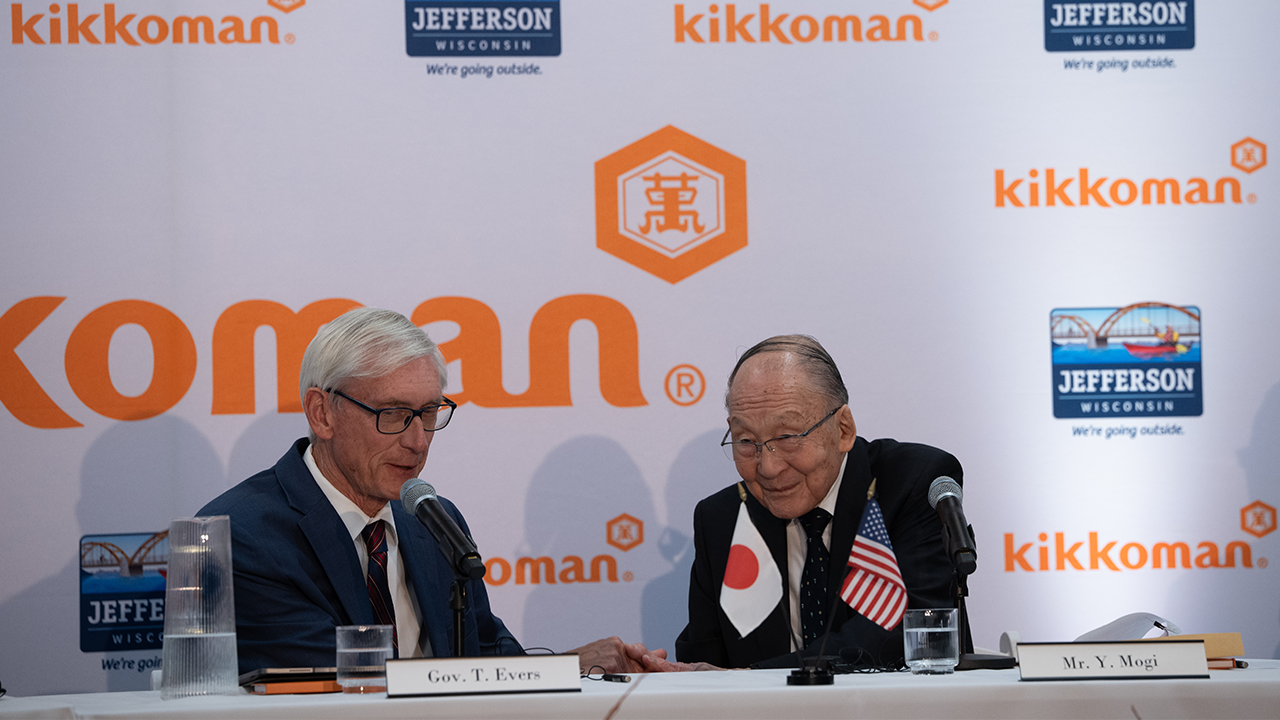
Yuzaburo Mogi, honorary CEO and chairman of the board of Kikkoman Corp.
Photo: Beau Meyer
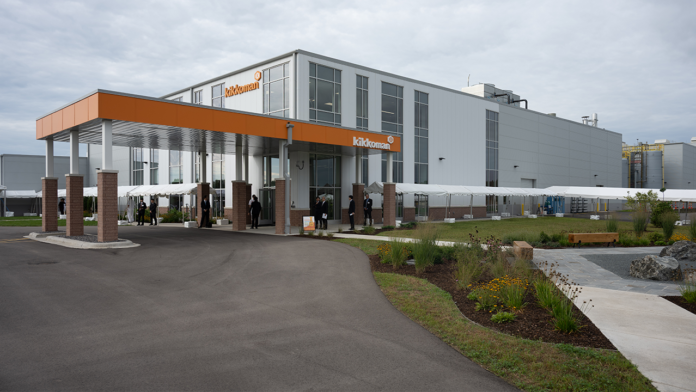
JEFFERSON — The first bottles of the tangy, savory, umami-rich soy sauce Kikkoman is known for rolled off of the new bottling line at its manufacturing facility here on Sept. 18.
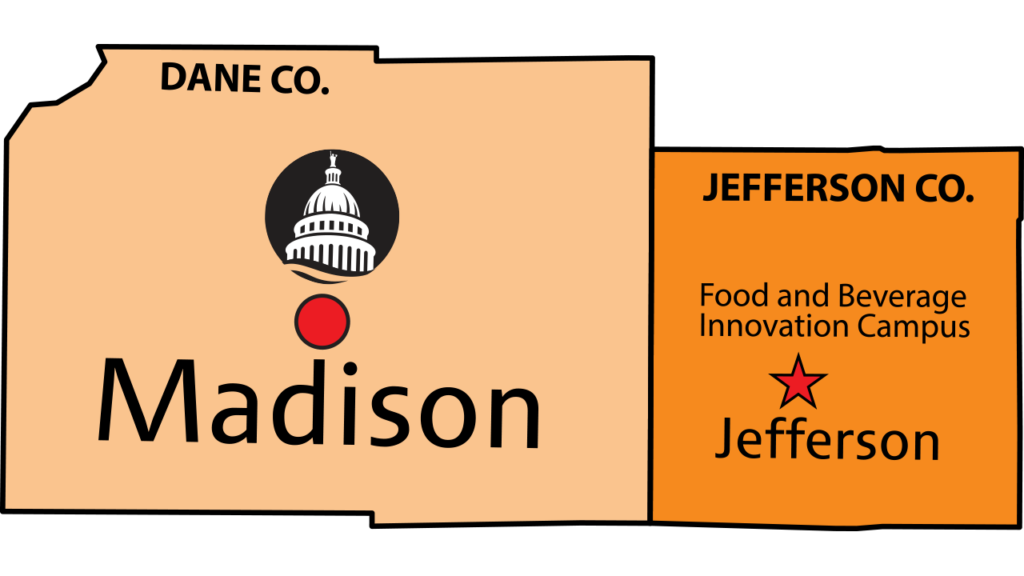
Jefferson, just over 30 miles east of Madison, is now home to the third Kikkoman manufacturing plant in the U.S. The Japanese company’s $560 million investment over 10 years is poised to create over 80 jobs, and is its second facility in Wisconsin.
Kikkoman Foods Inc. is the U.S. manufacturing arm of the soy sauce powerhouse. It is the first business to open at Jefferson County’s new Food and Beverage Innovation Campus, a 165-acre industrial park set up specifically for food and beverage manufacturing. Two other food processing facilities will join the brand in the months and years ahead.
V&V Supremo, a popular Mexican cheesemaker based in Chicago, and Onego Bio, a Finland- and U.S.-based food company that produces Bioalbumen, an animal-free, egg-white protein, have signed on to the site as well.
“This new manufacturing facility is advanced, highly automated, flexible and designed with sustainability in mind,” Gov. Tony Evers said at the Sept. 18 opening. “It will strengthen Kikkoman’s North American production network while creating new family-supporting jobs and economic opportunities here in Jefferson County.”
It is “the first such industrial park of its kind in our state,” Evers said, “and a testament to the importance of this sector of our economy.”
Jefferson County announced the creation of the FAB campus in April 2024 with Kikkoman as its first tenant. There is about $10 million worth of infrastructure on the campus. The city created a Tax Incremental District to support the investment that helps pay for infrastructure development, site improvements and more. And the city plans to keep improving the site, with plans for a new wastewater treatment facility by 2030.
FAB adds to Jefferson County’s reputation as being a food, beverage and manufacturing hotspot. Others in the area include Palermo’s Pizza, which began its operation in 2023; Jones Dairy Farm meat processing company in Fort Atkinson; Aztalan Bio, a biorefinery that turns corn into ethanol, food-level corn oil and animal feed; and Nestle Purina pet food. Plus, each new business is poised to add jobs, which is significant after Tyson’s pepperoni plant closed and laid off 400 people in 2016.
The city and county worked with Thrive Economic Development, a public-private nonprofit created to promote the economic competitiveness of Greater Jefferson County to create the FAB campus.
Kikkoman’s launch, and the forthcoming openings of Onego Bio and V&V Supremo, is a promising renewal of manufacturing in Jefferson and is in line with the county’s vision to bring in new jobs and take advantage of local resources like agriculture and an educated workforce.
An eye on job creation
When Ben Wehmeier, Jefferson County’s county administrator from July 2013 to December 2024, first started in the role, he learned this parcel of land — historically a county-owned farming site — may become the FAB campus.
Local officials had pondered a use for the property since 1994, and then Highway 26 had a major expansion through Jefferson from 2009-2013. The farmland in the south of town was seen as an opportunity, thanks to its access to 26 and Interstate 94. Ideas considered included space for residential, hospital or institutional use.
Talks between him, the County Board and other partners focused on one thing: What was the best use of the property?
“We began to envision what could be a fit there that created employment-based opportunities and investments in the region to go forward,” said Wehmeier, now president and CEO of Greater Watertown Community Health Foundation. “And that’s when it kind of evolved into more of this campus setting of what could be unique.”
The idea was to create something that could draw in businesses to help uplift the community with high-paying jobs.
“That’s when the conversations really began, saying, could we get this prepared for something that would bring in a larger development that also would support jobs, and can be something different than the other communities might have?” Wehmeier said.
Part of the reason a food and beverage park was considered was thanks to work done with nearby University of Wisconsin-Whitewater’s Fiscal and Economic Research Center. The center is part of its College of Business and Economics and is home to students and faculty who conduct economic impact analyses, feasibility studies and more.
FERC helped look at the strengths of the region from a cluster standpoint.
“That really validated and reinforced that the agriculture history is very strong and that connection with advanced manufacturing, higher learning and education,” Wehmeier said.
Deb Reinbold, president of Thrive Economic Development, said there were many other positive factors to having a food and beverage campus.
“As we look at the concentrations of food and beverage manufacturers that we already have here, it made sense that we could take advantage of that labor force and the education that’s in place to support this,” Reinbold said.
Other components like water and wastewater capacity, a municipal-owned electric utility and similar strengths all made the land favorable for companies like Kikkoman, Onego Bio and V&V Supremo.
“Typically, those are some primary things that they’re looking for in order to select a site,” Reinbold said. “We just tried to make it as easy as possible for them to make an investment.”
Jefferson’s leaders also looked at the potential of companies that could bring new products to market.
“That really is part of why we ended up going on a path of looking at opportunities like this,” Wehmeier said. “And so that’s when Kikkoman (signed on), and eventually Onego was the next big one.”
Showcasing shoyu
Kikkoman, officially incorporated in 1917 but founded in 1661 in Japan, has been making soy sauce for over 350 years. And now it makes soy sauce in Jefferson on Kikkoman Way.
The new 240,000 square-foot Jefferson facility will produce soy sauce, teriyaki sauce and non-soy sauce-related seasonings.
The manufacturing facility itself is able to handle multiple products, viscosities and packaging formats including glass and BPA-free plastic, in both industrial and bulk sizing.
In addition to the TID-supported land, the Wisconsin Economic Development Corp. is offering up to $15.5 million in performance-based tax incentives to the company. While the Jefferson plant is an investment of about $560 million over 10 years, WEDC said combined with Kikkoman’s other facility in Walworth, which is also being expanded, the company’s total investment is over $800 million.
Evers said Kikkoman has shown other Japanese companies that Wisconsin is a great place to do business. And with the support of WEDC to ensure success, he expects the new plant to be an important one in Wisconsin’s portfolio.
At the September opening of the Kikkoman facility, WEDC CEO and Secretary John Miller joked that his son might be keeping the company in business with the amount of soy sauce he devours. But joking aside, he called the partnership a great one for the state.
“It’s really, really impressive that Kikkoman has decided to reinvest in Wisconsin,” he said. “Not only after the time they’ve been here, but they had the opportunity to travel around the United States and look at other sites.
“And they came back to Wisconsin.”
He credited Wisconsin’s skilled workforce, abundant resources like water, soybeans and wheat, and that the state is one “that makes things.”
And while other parts of the country focus on data centers and AI, this is something tangible.
“This is not AI, this is not quantum computing — this is our bread and butter,” Miller said. “This is what we do in this state. We manufacture things for the public to consume and Kikkoman continues that tradition.”
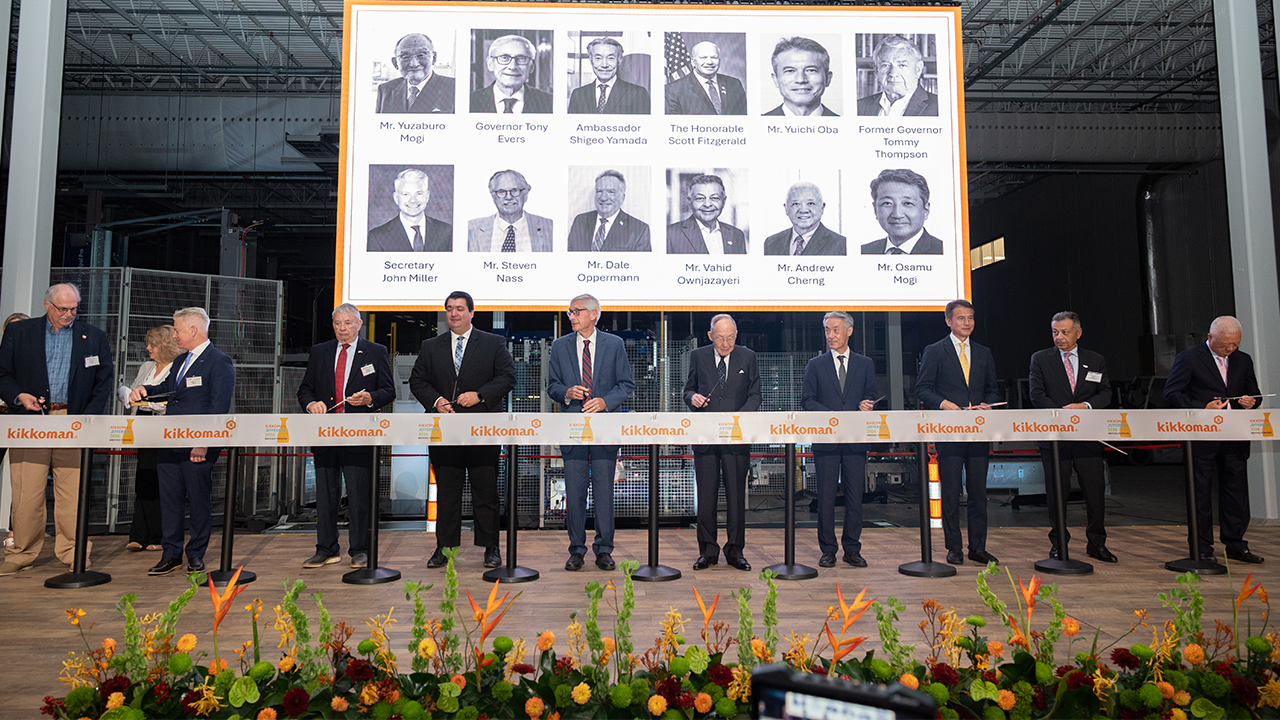
Photo: Beau Meyer
At the event, Kikkoman officials talked about how Wisconsin has worked for the company, citing the advantages Miller highlighted.
“We came back home to Wisconsin, and this time we chose the community of Jefferson,” said Yuzaburo Mogi, honorary CEO and chairman of the board of Kikkoman Corp.
“We chose Jefferson for all of the same reasons that led us to Walworth over half a century ago: astounding workforce, ready access to soybeans, wheat and pure water.
“And for the open-hearted spirit of partnership with the local community. The Jefferson plant represents our confidence in the future.”
In addition to its manufacturing facility, Kikkoman is also investing in the area.
The company donated $250,000 to Jefferson County to support native prairie restoration and hosted an event filled with Japanese cultural activities like the booming of taiko drums in September.
Kikkoman has also provided sponsorships to the high school, earning naming rights to its athletics field, now known as Kikkoman Stadium.
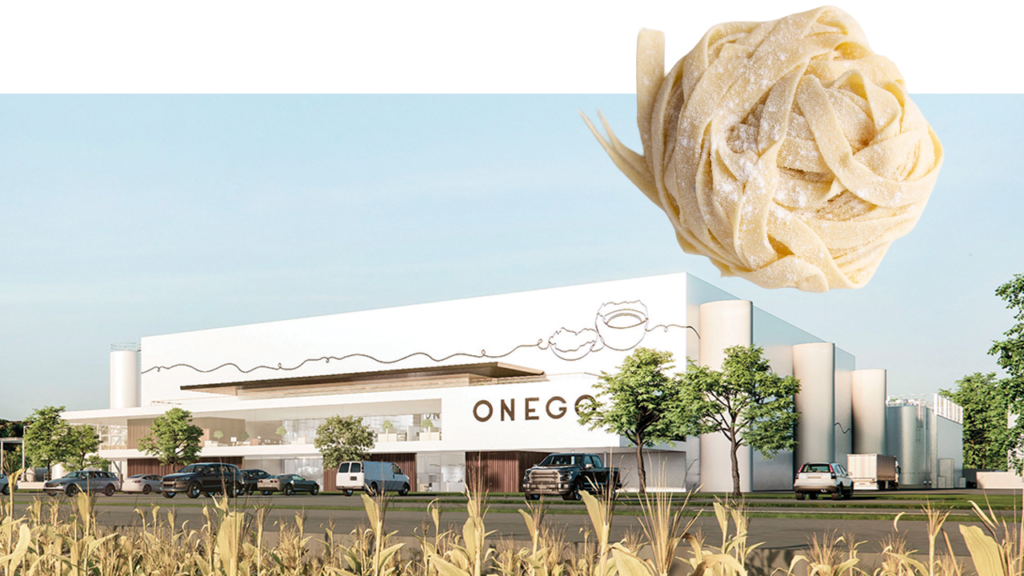
Protein-packed Onego Bio
The amount of fermentation at the FAB campus would make any brewery jealous. Both the soy sauce and Onego Bio’s egg protein product, Bioalbumen, are made by using fermentation.
Onego Bio’s product uses protein-producing fungi, Trichoderma reesei, to produce ovalbumin, the protein in egg whites, in a process called precision fermentation. The process, where the microbe is fed corn-based sugar and grown in a controlled environment, is similar to brewing beer.
The protein is then separated and dried into a shelf-stable powder called Bioalbumen, which other food manufacturers can use in products that normally require eggs, or if they are making a protein-packed food item — like waffles, pasta, bread and more.
This method to produce protein will yield about two million liters at the future FAB plant, about the equivalent of two million hens laying eggs.
Like Kikkoman, Onego Bio, a Finnish and Wisconsin company, looked at multiple sites across the U.S., mainly in the Midwest, before selecting Jefferson.
A location rich in corn — Onego uses corn-derived sugar to feed the fungus during the process, with corn starch purchased locally — was important to the company. It also needed a place with plenty of manufacturing space. Plus, with UW-Madison nearby, which excels in biotechnology, food technology and hard science undergraduate and graduate programs, Jefferson made sense. Onego leadership sees the plant as a way to tap into local talent, something co-founder and CTO Chris Landowski knows well as a UW-Madison graduate.
Landowski has built a career trailblazing precision fermentation and working in cellular agriculture. Before founding Onego Bio, he developed precision fermentation platforms at VTT Technical Research Centre of Finland.
Landowski said he knew Wisconsin as one of the best food producing regions in the country and world, and said the team at Jefferson County, and especially Thrive, were great partners from day one.
“The Midwest is the heart of the U.S. food and agriculture industry, so it’s a natural place for us to build,” Landowski said. “Jefferson gives us access to the infrastructure, talent and partners we need, while putting us close to many of the food manufacturers we ultimately want to serve.”
The plant in Jefferson will be Onego’s flagship factory, after working with other manufacturers across the globe to create the product thus far. The company’s commercial headquarters is in San Diego and it also has offices in Finland.
The plant is expected to create over 80 jobs within one to three years of opening. The goal is to open the facility between 2028 or 2030.
The company is using a mix of private dollars, investors, government funds and loans to open a plant that will cost between $250-$350 million. Onego was awarded $2 million in funding from the United States Department of Defense’s Distributed Bioindustrial Manufacturing Program.
As the product grows, the site also provides Onego with the option of expanding production and fermentation capacity. Landowski believes there will be an increase in demand as issues like avian flu affect eggs’ availability.
“Eggs are essential to the food industry, but outbreaks like avian flu and global logistical challenges put tremendous pressure on pricing and threaten an already vulnerable supply,” Landowski said. “Because Bioalbumen is produced through precision fermentation, it can provide food manufacturers with a more dependable source of egg protein, helping supplement traditional supply and make our food system more resilient.”
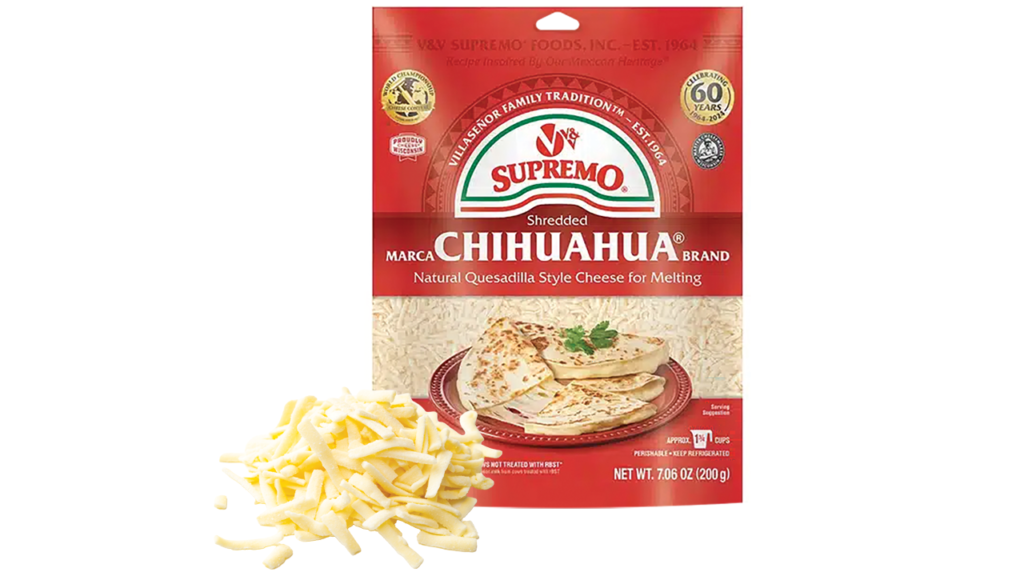
Quintessential queso
The facility that will manufacture V&V Supremo Mexican cheese is expected to break ground yet this year.
The Jefferson County Board of Supervisors approved a resolution to sell 40 remaining acres in the FAB campus to Supremo in November 2025.
County Administrator Michael Luckey said each business represents a win for the county, city, Thrive and the Jefferson County Economic Development Consortium, which all worked together to make it happen.
“They really struck gold when they set out to focus on four key industries to play to our strengths as a region and as a county, which would be agribusiness, food and beverage manufacturing, advanced manufacturing and biohealth,” Luckey said.
He said V&V Supremo “will be a wonderful addition to the Jefferson community,” as well as Kikkoman and Onego.
Initially, Supremo will build a 50,000 square-foot facility, with the goal of expanding to 150,000 square feet in the five years after it opens.
Supremo did not respond to multiple emails and phone calls for comment on its plans for the plant.
In a press release from December 2025, Supremo said the site “provides the perfect backdrop for expansion. Its thriving community, central location and access to major transportation corridors will enable V&V Supremo Foods to better serve retail and foodservice partners nationwide.”
Supremo also operates facilities in Arena and Browntown, both in Wisconsin. The Jefferson investment is valued at about $1.2 million.
“Jefferson is the perfect place for our next chapter,” Philip Villaseñor, chief integrator at V&V Supremo Foods, said in the statement.
“This expansion reflects our confidence in the future and commitment to serving our consumers, retail, foodservice and industrial partners and strengthening our ties with the communities where we operate,” Supremo Chief Visionary Officer Gilberto Villaseñor II said in the press release.
The company could open in 2027 or 2028, with the goal of producing 20-30 million pounds of cheese annually.
Tim Freitag, administrator for the city of Jefferson, has worked with the community for about 20 years, and said the three companies using agriculture are a boon for farmland preservation and a nod to Jefferson’s farming roots.
“I can’t think of many better things than to have something like this where you can locally source a product that helps preserve agriculture and farms,” Freitag said.
Supremo looked at 30 sites before choosing Jefferson. With the TID district incentives, the city will reimburse about 56% of tax increment generated by the project pertaining to development costs, with the incentive capped at $2.5 million.
Supremo, which makes most of its cheese by hand, also visited local schools, like Kikkoman did, to show kids how to make the cheese and talk about the job possibilities the facility will provide.
“They really want to be involved. They want to make sure they’re part of the community,” Reinbold said of the companies selected.
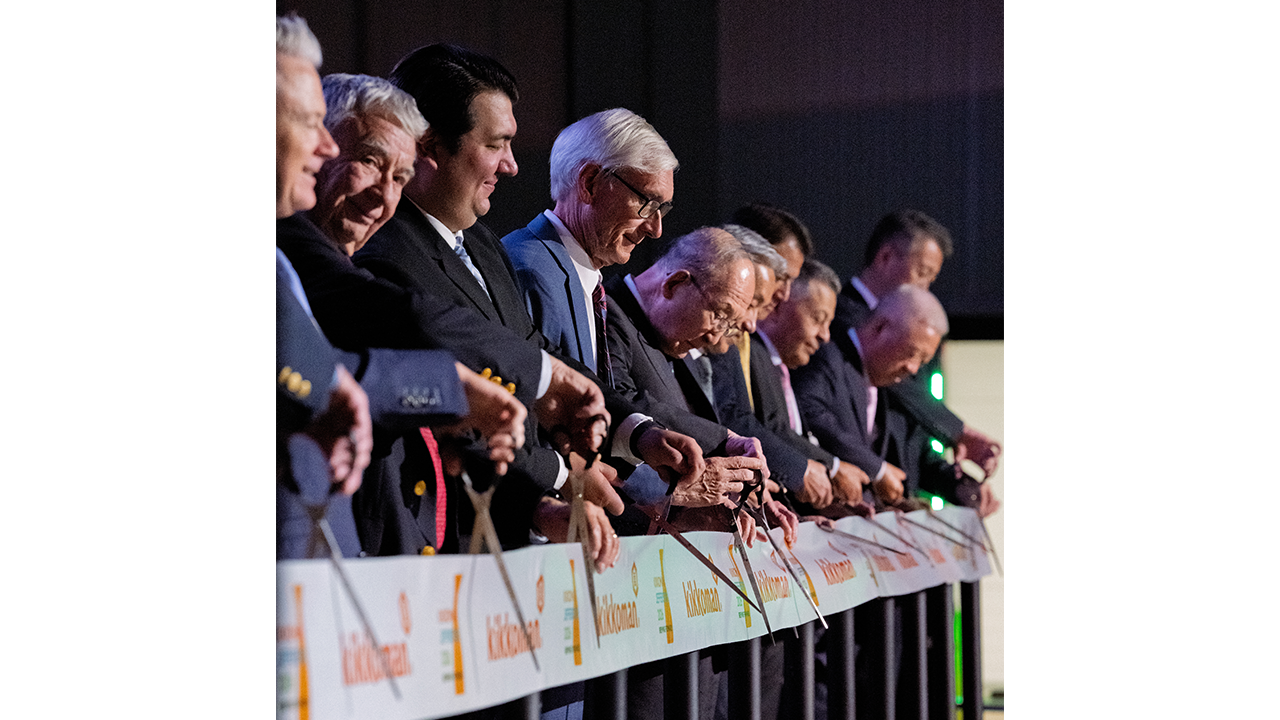
Photo: Beau Meyer
Condiment kudos
When Kikkoman opened its doors in this fall, the joy and appreciation from the community was palpable. Evers said Kikkoman is more than just a business choosing a plot of land.
“Kikkoman has not simply invested in Wisconsin — it has become part of Wisconsin,” Evers said.
And for his part, while still in office, he’ll continue to drizzle the shoyu at mealtime.
“Indeed, we do have soy sauce at the executive residence, and we use it regularly,” Evers said. “We add it to all sorts of foods.”
At the event, Jefferson County Board Chair Steve Nass shared a story from his wife.
When she was a UW-Madison student 50 years ago, she lived near Japanese immigrants, Nass said. One day she asked her neighbor what soy sauce to buy.
“She poked her finger into my wife’s shoulder and said, ‘You only buy Kikkoman,’” Nass said.
Nass said he is proud to have so many international companies producing their products in Jefferson County, especially Kikkoman.
“I’m so happy to welcome such a venerable, world-renowned, socially responsible company into our neighborhood,” he said. “And stable, they really are stable. They’ve been around making good products for nearly 400 years.
“I wager they’ll continue to be visionary and viable for a long time into the future.”
View the full photo gallery here.