
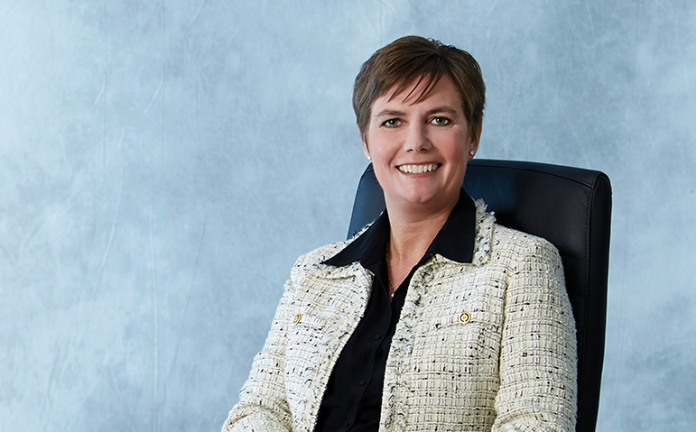

Addressing the unique needs of a fast-growing startup bank is a bit different than doing the same for a traditional bank growing at a normal pace, and the ability to find that new path has earned Settlers bank’s Heather Longhenry the CFO of the Year Award.
Longhenry has been in her current position with Settlers bank for nine years and she is credited with shrewd financial oversight that has produced a clean balance sheet, resulted in innovative (and paperless) problem solving, and enabled the bank to be strategically proactive rather than reactive.
“Last year was kind of a whirlwind,” Longhenry notes. “We employed new technology to help streamline processes and become more efficient. There are a few items that I’m proud we were able to accomplish and we continue to work on. One of those is that given our fast-paced growth, we must be more proactive in monitoring the numbers that we in the banking industry need to pay attention to.”
Faster forecasting
Settlers bank, which employs 33 people and has $250 million in assets, primarily serves the Dane County and Wisconsin markets. With $10 million in annual revenue, it has grown at an average annual rate of 20%. Most banks grow at a slower, more traditional pace of less than 10% and therefore can afford to use a traditional asset-liability approach in which quarterly data is analyzed for trigger points to and determine whether capital must be raised for banking operations. When a bank is growing at a 20% clip, it doesn’t have that much time to make capital-raise decisions.
Using the established technology of spreadsheets and embedding new technology tools within them, Longhenry was able to turn economic forecasting into an actual forward-looking process. Rather than using quarterly data to conduct an analysis and make projections off of that, she examines financials on a weekly basis to more quickly identify where growth will occur and when funding needs will materialize. She also was able to automate everything so that forecasting is a very quick process, and now she is more efficient — producing the necessary data in just a few clicks — in how she obtains information and processes it.
| Come celebrate with Heather Longhenry and our other winners at the Executive of the Year Awards on February 15. |
In the regulatory space of a growing bank, there is concern as to whether growth is too fast, and the more intuitive process Longhenry created ensures that capital is not being outpaced by loan volume. This ensures that loans, deposits, and capital are all at the desired equilibrium and gives Settlers bank at least a 30-day notice to respond to changes that can occur more quickly in a fast-growing institution. “I get all the numbers I need for the next 30 days,” she explains, “so that we know how to manage our growth.”
Since this practice is a departure from the traditional asset-liability approach of most banks, other banking institutions interested in deploying this system have approached Settlers bank. “Doing it that old way, doing it on a monthly or quarterly basis, using historical data, just isn’t sufficient,” Longhenry states. “So we developed a way to do what we call a 30-day look-ahead and take this information, project forward so that we’re not a deer in the headlights when we grow, and realize that we didn’t pay attention when this number or another number went too far outside the limit of where we wanted it to be. It’s more of a forward way of thinking than a lot of banks do from a historical perspective.”
(Continued)
In becoming increasingly paperless, the bank is starting to build workflows where it takes electronic documents, sends them to people or corporate clients, and otherwise automates everything in electronic rather than in paper forms. “We also did that in accounts payable,” Longhenry explains. “We were able to reduce the amount of time it takes to do our weekly billing from one day down to about two hours, and when you can cut that much time out of your workflows, that’s a tremendous boost to the bottom line. It allows you to free up time for other things.”
A largely paperless approach has other advantages, as well, and Longhenry touts the workforce benefits of electronic operations from personal experience. “One of the reasons I’m here is because of the technology and innovation we have,” she notes. “Because we are 100% paperless, I work from all over the world. In Aruba, I could check in and work from there. I worked from Arizona the whole month of March last year. When we had an employee who had to resign, we retained him and he works from Michigan.
“Our model really helps us attract workforce not just from our immediate area, but also from other areas. I have an hour commute to work, so I work two days from home. So by having that flexibility because of our innovation, we move that workforce out a little bit more.”
Breaking through the glass vault
In helping to lead the way at Settlers bank, Longhenry is part of a growing number of female banking executives in Greater Madison. “I’m very honored to be the only female honored this year,” she notes. “Banking is a very traditional institution in which a lot of the executives are men. In our local peer group of 28 community banks, women are 27% of the CEOs and CFOs, so to hold one of those positions, break through that glass ceiling, and be part of that group is a big honor for me.”
Click here to sign up for the free IB ezine — your twice-weekly resource for local business news, analysis, voices, and the names you need to know. If you are not already a subscriber to In Business magazine, be sure to sign up for our monthly print edition here.

