
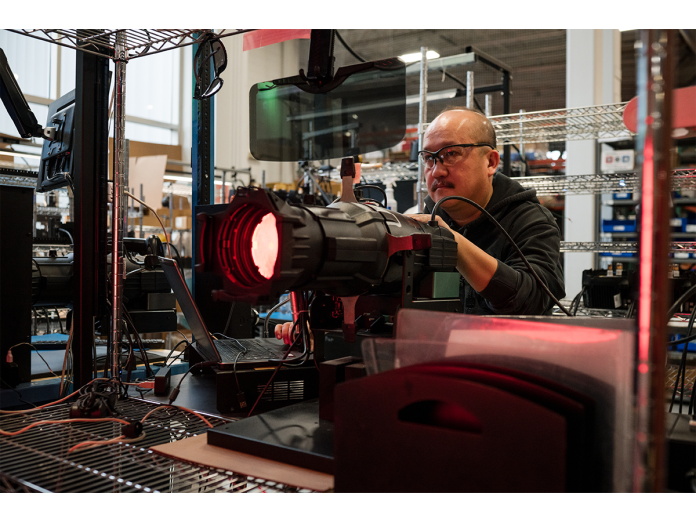

When people think of the most iconic companies in Wisconsin’s Capital Region, the names Epic, Exact Sciences and American Family immediately come to mind. Operating (literally) behind the scenes but no less impressive is Middleton’s Electronic Theatre Controls, a manufacturer of lighting and rigging technology that has earned a global reputation.
From traditional venues like Radio City Music Hall in New York to state-of-the-art sports facilities like SoFi Stadium in Los Angeles, the world’s most famous entertainment and sporting venues have turned to ETC when it comes time to shed some light. Every Broadway theater currently uses its products and the company counts Disney (and its theme parks) as a longstanding customer. Wisconsinites enjoying Summerfest and the Overture Center for the Arts have also seen entertainment produced with the help of ETC’s products.
With 1,000 employees in the Madison area, ETC employs nearly 1,500 people in 15 corporate offices around the world and reports $475 million in annual revenue.
The company, which goes by ETC rather than Electronic Theatre Controls because it has expanded into venues beyond theaters, is an international manufacturer of entertainment lighting consoles, architectural lighting and fixtures, rigging hoists and programmable control systems. In addition to individual components, ETC designs and sells integrated systems. It is one of the largest fully integrated entertainment lighting control manufacturers in North America.

Just over 50 years ago, Fred Foster, who was interested in the technical side of theater, and other company founders first pitched their conceptual lighting console. The company’s relentless approach to innovation now produces consoles (literally the computer brain of a control system) with 24,000 channels to control moving lights and nearly 40 circuit boards to serve as the central nervous system that routes power between components.
It has set such high industry standards that lighting designers, directors and production managers collaborate with the company to develop new products, and high schools and universities use its gear to train students on industry-standard equipment.
CEO Dick Titus, who carries on Foster’s “show must go on” edict, leads the executive team that took over following Foster’s death in 2019.
“We’re continuing to grow in the markets we serve today, while also exploring new opportunities through innovation and strong partnerships,” Titus said in an email. “As technology evolves, we’re committed to keeping things simple and supportive for our customers.
“Systems may be getting more complex, but we’re staying grounded in what matters most: our customers who use them,” Titus said.

Stepping into the spotlight
Company lore has it that during a Christmas Eve celebration in 1975, Foster, then an 18-year-old college student, pitched the idea of a state-of-the-art lighting console to his college professor, stating, “We’re going to make a lighting console and sell it to The Met!”
With this statement of determination, ETC was born, and within 20 years, it had indeed sold a lighting console to the Metropolitan Opera House (aka The Met) in New York City.
It’s the kind of bold vision that has enabled ETC to grow into an international leader in events lighting technology. Its products can be found in venues of varying sizes, ranging from Broadway theaters to hotels, television studios, casinos, theme parks, stadiums and opera houses.
ETC’s original lighting console prototype, called the Mega Cue, was developed by founders Fred and brother Bill Foster and two friends, James Bradley and Gary Bewick. By 1982, the first ETC branded console, called Concept, was launched; a variation was eventually chosen by Disney to control its parade lighting.
Some of the world’s most prestigious entertainment venues rely on ETC’s control systems, from Soho Theatre in London to Teatro La Fenice Opera House in Venice, Italy.
The historic Opera Garnier in Paris, known for its impressive ceiling painted by artist Marc Chagall, upgraded its lighting consoles in 2017 with a selection of four of ETC’s Eos family consoles.
They were a unanimous choice by Jacques Giovanangeli, head of the lighting department, and his team of 42 lighting professionals. Giovanangeli had witnessed ETC’s quality and technical capabilities in many other venues in France and internationally, according to the company.
Opera Garnier’s first production with ETC’s technology came off without a hitch, an example of what Dennis Varian, ETC’s vice president of product, knows about great lighting design — it is exceptional because it is not noticed.

Culture of innovation
At the company’s Middleton headquarters, the first clue that it’s a creative enterprise is the Town Square entrance, which evokes a 1940s New York street scene (or a Broadway set) and serves as a gathering space for employees. A theater marquee towers overhead with a welcome message for guests, and a receptionist sits behind the counter in a life-size replica of Edward Hopper’s painting, “Nighthawks.”
Offices made from large shipping containers line the mezzanine above and storefront facades add to the theatrical environment, doubling as entrances to company departments. The finance department is located in the bank, the entrance to human resources is an insurance building, and a hardware storefront introduces the purchasing department.
If the Town Square was meant to be a whimsical selling point for would-be customers, it has become much more, according to Bill McGivern, ETC’s vice president of manufacturing.
“They were just completely in awe,” McGivern said, describing one prospective customer’s reaction to Town Square. “Their next stop was at a competitor, and they said the competitor doesn’t do this.
“It’s a (deal) closer,” McGivern said. “When people come in, especially if this is the first time they see ETC, they get a feel for how serious we are about it.”
On another occasion, representatives of the theater department of Ohio State University visited ETC only to be greeted by the marching band of Foster’s alma mater — and OSU Big Ten rival — UW-Madison. It’s all in good fun of course, but that’s the point.
Since its founding, ETC has kept a close eye on technology trends, growing with the help of organic innovation and the acquisition of both technology and companies.
Much of it occurs in its 350,000 square-foot Pleasant View Road manufacturing headquarters, which opened in 2004.
The company has a similar-sized production facility in Mazomanie, which it acquired in 2013 and renovated into a modern facility that produces rigging products used at NBA arenas to hoist their scoreboards.
In addition to its Dane County facilities, ETC has several domestic offices, led by ETC Northeast in New York City, ETC West in Burbank, California, and ETC Austin, which was added when it acquired High End Systems of Austin in 2017 and entered the live events market.
ETC also has international offices in London, Hong Kong, Paris, Rome and other cities.
Over the years, it has acquired companies including Lighting Methods Inc., a Rochester, New York manufacturer of entertainment lighting systems; Ecoflex Solutions, a manufacturer of wireless control products for commercial lighting; and RAYN Growing Systems for indoor farming (including greenhouse systems) and horticultural research.
Part of the fun of being employed at ETC is the opportunity to innovate. Across the hall from a New York-style low-cost deli for employees is ETC’s Innovation Alley, where virtually everyone — not just engineers — is encouraged to spend time developing fresh, out-of-the-box ideas.
The company takes submissions all year long and votes on the best ideas.Winners get a plaque on the wall and a cash prize.
“For some of the things we do, you have got to have an engineering degree, but what about the wizards?” McGivern said. “Fred used to call them wizards — the kids who learn on computers and they just know more than anybody else about it, but they don’t have a degree.”
Two years ago, a manufacturing engineer in ETC’s Austin facility won a prize for developing a way to etch gobos — stencils placed in front of a light source to project a design — in glass “and it’s a phenomenal process,” McGivern said.
“One of the things that we try and do is give everybody part of their week to work on what they want, and some of this (innovation) comes from that kind of effort,” he said.
The creative spark is enhanced during its busy summer months, when local high school and college students are needed to augment ETC’s staff. The influx of youth not only adds energy to the office, but it’s essential in a metropolitan area with low unemployment and fierce competition for labor.
“We bring 100 students into manufacturing, and that’s great for us because we have 444 direct labor employees that build products in the factory,” McGivern said. “We are 25% busier in the summer and so 100 students gives us 25% more people. We couldn’t do it without them.”
Some students go on to have long careers at ETC, including former intern Hawkin Zukowski, who is the company’s international manufacturing manager, McGivern said.
“I can’t staff for July and August year-round, and that’s why the students help out so much,” McGivern said. “They invigorate the whole area.”

From high school theater to Broadway
Lighting designer Don Holder has worked in theater, opera, film, television and architectural lighting. He has been nominated for 14 Tony awards, winning for best lighting design for “The Lion King” in 1998 and for the 2008 revival of “South Pacific.”
He used ETC products — including consoles, moving lights and dimmers — on both Tony award-winning productions. For “South Pacific,” Holder used a debut generation of ETC lighting consoles on Broadway, “so I feel like I’ve played my own small role in helping introduce some of the ETC products to the world,” he said.
He cited their superb performance and reliability, continual product improvement, and impeccable product support, crucial on long-running shows. In one instance, he called tech support from China at 1 a.m. to address a complicated network issue. ETC offers 24-hour tech support from its Middleton headquarters.
“I connected him with my programmer and they worked it out over maybe 2-3 hours,” Holder said.
On another occasion, ETC put a technician and the necessary parts on a plane to Brazil to address a problem during a production of “The Lion King.”
“Very few companies invest in their customers in that way, which is why I’m very loyal to the company and I’m constantly using their stuff,” Holder said.
Jason Gay, head of capital for the Columbus (Ohio) Association for the Performing Arts, is implementing ETC systems in CAPA’s renovation of a historic church into a performance hall.
CAPA uses ETC products and systems in various venues around the city and its relationship with the company dates to the 1990s. Gay is one of the company’s strongest evangelists because of the relationships he’s built with ETC employees, its industry-standard consoles, fixtures and rigging, and its customer support.
“We’re really engaged with the company at a high level and we enjoy their products — not necessarily just because of the products but because of the people,” Gay said. “The people really make a difference for us. It’s a very personalized experience where we know the technicians and we know the design team.”
Varian, the vice president of product, said ETC also works to bring the capabilities of equipment used by premier venues to students just starting out with such technology.
While rigging products used in high schools don’t have to lift quite as much as NBA arenas do, Mark Penisten, theater technical manager at Madison East High School, appreciates the motorized rigging system that ETC installed during a renovation of the school’s 100-year-old theater eight years ago.
That includes safety features such as logins and passwords to control access, and sets of permissions so the equipment can only do what’s needed.
“There’s a lot of sensors built in to indicate whether it’s lifting the right way, it’s moving in the right way and whether it is doing everything I expect,” Penisten said. “There’s a lot of built-in intelligence that helps prevent people from making mistakes.”
Penisten also praised the quality of ETC’s lighting products, especially their ability to fade light gradually and smoothly rather than in the jarring, abrupt way of inferior products.
He also said ETC is a good community partner with its tours and educational outreach for students.
“Student groups will go see what domestic manufacturing looks like and learn about some of the career opportunities and pathways there,” Penisten said. “They’re always very enthusiastic to provide those opportunities for students to come out and see something they may not realize is an option for them.”
Creativity in the age of AI
With each new challenge, ETC keeps employees and customers top of mind. The company took pains not to lay off staff during the pandemic, when venues that use its products were closed.
A backlog of orders helped keep manufacturing employees busy during COVID — the subsequent parts shortage caused by supply chain disruptions was a bit more challenging — but as a data-driven organization that is 100% employee owned, ETC values employees who in turn value customers.
With such a culture, Bob Tollefson, vice president of business technology, said ETC is constantly looking for ways to improve. For instance, with AI, he views it as a tool to leverage improvements in processes and products.
“When we talk about AI, we always want to put it in that context,” Tollefson said. “We also believe that accountability, responsibility and ownership are human traits.
“With that said, we look at AI as just another tool in the toolbox,” Tollefson said. “We look at AI through the lens of, can this help speed up what we’re doing? Can this improve our quality?”
That aligns with how the theater world, as an artistic endeavor, in general views AI.
“Particularly our professional customers who make their career in lighting,” said Varian, a former rock ‘n roll roadie who set up stages for the likes of U2. “They view their design as their intellectual property, so they’re hesitant.
“Just like our software engineers are afraid of losing their jobs to AI, lighting designers have some fear of losing their jobs to AI,” Varian said. “But they also are pressed for time, so as we respect that our customers are artists, we want to provide tools that use AI and specifically computer vision as ways to give them more time to create art.”
Thus, the focus is on automating some of the setup and configuration and repetitive tasks, as well as automating the maintenance and monitoring of systems, Varian said. Or using AI to quickly get young engineers up to speed.
Continual LED (light emitting diode) refinement is another area where AI could help yield dividends.
In 1992, ETC introduced the award-winning Source 4 ellipsoidal stage spotlight, and more than 3 million have been sold since. The original was recognized as the 1992 Product of the Year by Live Design International. Source 4WRD, the LED version, was honored as the Debut Product of the Year in 2012.
Since introducing its original Source 4, an incandescent source of light, ETC has had a continuous commitment to energy efficiency and quality of the light fixture. Source 4 is transformed into Source 4WRD with a simple retrofit in which an incandescent/tungsten cap is removed and replaced with an LED version.
“When we released the original incandescent Source 4 in 1992, it was a 575-watt fixture … and it generated more light than the 1,000-watt fixture that had been used for 50 years before that,” Varian said.
With LED technology, the drive to produce more light with less energy continues. With the help of equally innovative LED manufacturers, it can mix light to change colors — all while improving energy efficiency and eliminating the need to have someone on a ladder changing a piece of gel to change the color, Varian said.
Ironically, LED lighting, which now represents about one-third of ETC’s business, according to McGivern, was not initially favored by Foster. David Lincecum, now vice president of international operations, fought for the LEDs but McGivern said he was swimming upstream because it was viewed as inferior to incandescent.
ETC eventually brought in representatives of a company called Selador, which ETC purchased in 2008, and they sold Foster on the technology with a demonstration.
With that, ETC entered the LED lighting market.

Autonomous automation
On the factory floor at its Middleton headquarters, innovation is paired with automation in the form of modern manufacturing equipment. One of ETC’s newer machines, located in a metal shop where welding is done, is a laser punch. As McGivern explained, it cuts things, it punches them, it picks out the tool that’s needed, and it installs the tool. If the tool is used a lot, it examines the tool and knows that it needs to be sharpened.
“It sharpens the tool, then it goes in to adjust the drawings that now need to be adjusted because the tool is four/1,000th of an inch smaller,” McGivern said. “None of this has cost anybody their jobs. We still have programming. We have all that stuff but it’s a lot more efficient.”
The programmable laser punch will even run without anyone present.
“Now it runs on the weekends,” McGivern said. “It will run without anybody here. It’ll send us an email when it’s unhappy and says, ‘I’ve got a problem.’”
The efficiency also is evident in its SMT (surface mount technology) line, which produces 5,000 circuit boards per day, translating into more than one million per year.
Some parts must be hand-soldered by employees, but robotic machines will install software into them because “that was the most boring job that anybody had here, and so that’s one that we automated,” McGivern said.
Bobblehead Fred
ETC is not a publicly traded company; it is a privately held company that became 100% employee-owned through an Employee Stock Ownership Plan in 2024 after establishing a partial ESOP in 2015.
“One of Fred’s big goals when he was alive was keeping people until retirement,” said Sarah Danke, vice president of marketing, who has been with the company for 35 years. “With every employee he hired, he wanted them to stay until retirement and the ESOP helps with that because people feel really committed.”
In Foster’s own words, “creative disrespect” joined the company’s other creative endeavors several years ago when Fred’s wife Susan, who still works there, and a group of employees had hundreds of Bobblehead Fred dolls made and distributed them to all employees to celebrate his 50th birthday.
The bobbleheads still populate the manufacturing floor, private offices and common spaces to remind employees of his vision and legacy.
Foster’s office is still maintained with the same clear, garage door entrance that calls back to the setting of his inventive roots. As the company continues to innovate over the next 50 years, expect new technology to replace what we now view as high tech. Expect many employees to remain there for their entire careers. And expect ETC to benefit from Foster’s innovative and cultural guidance for years to come.
“Fred was ridiculously brilliant,” Danke said. “I always maintain that he could have had 30 different careers and been incredibly successful.”
Titus said Foster’s legacy is the company’s people‑first mindset.
“He started ETC around solving problems for people,” Titus said. “Doing something that hadn’t been done before. As ETC grew, he encouraged prioritizing employees and customers and giving them the best solutio possible.
“That culture is why we focus on service and innovate with purpose,” Titus said. “It is the culture that makes ETC what it is today.
“In short, our culture of service, innovation and independence is Fred’s legacy in action.”
Company ETC (Electronic Theatre Controls) Founded 1975 Founders Fred and Bill Foster, James Bradley, Gary Berwick Headquarters 3031 Pleasant View Road, Middleton CEO Dick Titus Annual global revenue $475 million Global employees 1,475;
Dane County: 1,000Business
classificationS-Corp. Industry Manufacturing

