
If hyperscale data centers pose a competitive threat to smaller data centers, one local operator of the latter version does not appear too worried.
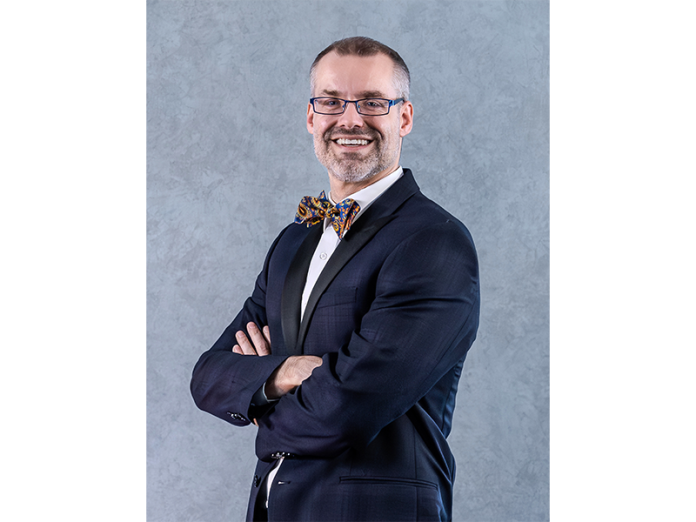
Bryan Schenker, president of 5NINES Data, a local internet service provider offering colocation to dozens of customers from its 4,000 square foot data center, is among those who don’t see much overlap between big and small.
And even though it’s now part of a larger operation, 5NINES would be in the small but scrappy category.
Schenker also is the president of ResTech Services, an internet service provider for multiple tenant properties (about 20,000 apartment units in the Madison area use the service). ResTech acquired 5NINES, located in the Network222 building, at 222 W. Washington Ave., in October 2023. ResTech also acquired LiteWire, a rural wireless ISP based in Evansville, at that time.
With that combination of internet service and data storage, the company addresses the technical needs of small- and medium-sized businesses, municipalities and others.
Focus on connectivity
Heavy power draw and cooling requirements are important for every data center, but the focus of 5NINES is connectivity. Its name refers to 99.999% availability or “uptime.”
Schenker said ISPs and data centers go together very well, and that’s a selling point when the company offers its internet services to business customers.
“The data center is very well put together,” he said in early September. “A couple weekends ago when there was a fire under the street near 222 W. Washington, the data center maintained power due to the redundant generators and UPS (uninterruptible power supply) despite the building losing power.”
Schenker said Network222, a 10-story office building, couldn’t scale up for those hyperscale types of services which are typically linked to AI and cloud computing applications.
“Where 5Nines really sits in that market space is really to facilitate communications,” he said.
Schenker said a somewhat dated observation about the internet is that it’s “just a bunch of tubes,” but in reality, it’s a bunch of connections at key points around the country.
“Data centers exist where large service providers interconnect with each other,” he said.
As one goes up the food chain to larger and larger companies, they interconnect with each other in a manner referred to as “settlement free,” meaning they don’t pay each other to interconnect, Schenker said.
“Smaller service providers pay a fee for that connection,” he said, “and it’s really all those connections that internet providers make with each other that make the internet work — and the magic of routing protocols and figuring out how to find the most efficient path amongst all of those connections from point A to point B.”
In Madison, the 5Nines Data Center does that for the city. The Network222 building is a major connection point for networks, not just in Madison, but in the region, Schenker said.
The business model
At 5NINES, dozens of businesses lease racks of servers for a monthly fee, and the company provides independent feeds of power — lots of redundant power. Those with more significant space needs can lease an entire cage space with whatever configuration of racks or other equipment they require.
“For those who need less, we offer the ability to lease a portion of a rack, so if it’s a smaller customer … they may not need a whole rack of equipment,” Schenker said. “They can lease a partial rack and we go all the way down to individual rack units depending on their needs.
“If they need dual power, we provide that — and all the power is paid for separately on an as-used basis,” he said. “We meter that for the customer so they pay for what they use.”
Schenker said downtown Madison is very fortunate to have two major power grids.
“MGE (Madison Gas & Electric) operates for sustainability for the government with the state Capitol being there, but with Network222 and its history, previously being a headquarters for Alliant Energy in its former life, it was a pretty important building.
“It has continued in a different role to be important because of this internet connectivity that Madison and the region rely on.”
According to Schenker, what’s happened in the data center space is a lot of businesses have moved to the cloud. That’s where you see part of the interest in these large-scale data centers “because basically it’s for companies who are selling these managed IT services as a monthly service, as opposed to something that they install on their own gear,” he said. “So our customers tend to have fairly specialized needs for whom cloud computing doesn’t work.”
Some 5NINES customers perform research. They have computers and equipment that run simulations and calculations, and they need a place with the power and conditioning to keep that equipment secure, safe, well-powered and cooled.
“That’s a common application for customers of ours,” Schenker said. “The typical small business is probably moving away from wanting to colocate equipment in smaller data centers like 5NINES.
“But as I say, the two niches where we’re really stable and solid are the connectivity piece and some of these special use cases where they can’t just go to the cloud and say, ‘Hey Amazon, I need to run this simulation for this research project that I’m doing.’ You can’t do that. That’s too specialized.”
Effects of AI
Asked how much artificial intelligence applications are taxing the data center power-wise, Schenker said its power needs are driven by other factors.
“I don’t know that this is AI in particular, but it’s generally true that the density of equipment and processing capacity that can be put into one rack unit has skyrocketed,” he said. “So the amount of power that a single rack will potentially use, depending on the application, has gone through the roof when it’s not just a simple router.
“For those customers who are doing those specialty applications, where they’re doing computer modeling and such, those power needs are very high, orders of magnitude higher — like 10 to 20 times more than the typical rack that just has routing and switching equipment in it.”
Schenker said AI is in the hands of the large companies that develop it, and at least in the near term, they are going to rely on large data centers because “you can’t do what AI does in a small footprint. And so, they’re going to rely on those larger data centers and new facilities that are being constructed.”
Larger data centers reportedly will need massive amounts of fresh water to cool their facilities, resulting in concerns about the loss and condition of fresh water. 5NINES does not use water for that purpose.
“In our space, 4,000 square feet, we can use traditional HVAC (heating, ventilation and air conditioning) equipment, certainly high-end and high-capacity,” Schenker said. “There’s a lot of cooling in such a small space and it’s necessary, but a larger data center is going to need significantly more cooling than that (HVAC system) can supply.”
As for any competitive threat posed by hyperscale data centers, Schenker said different facilities serve different needs.
“I see there being almost zero overlap between us and those facilities in terms of who’s going to buy from us versus who’s going to buy from them,” he said.
Spotlight on 5NINES Data
Chief executive: Bryan Schenker
Year founded: 2004
Employees: 28
Annual revenue: $7 million
Industry: Technology
Business classification: LLC

