
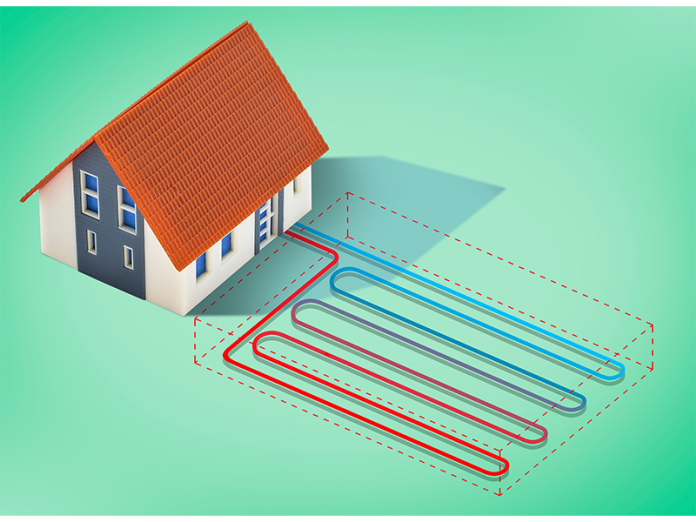

While the term “hyperscale” is used to describe the large data campuses that power artificial intelligence applications — and concern environmentalists to a great degree — Derek Schnabel, a facility engineer for Epic, uses the term “district scale” to describe the geothermal system that helps cool buildings on the electronic medical records company’s expanding Verona campus.

Could such a green energy alternative help cool the energy-intensive, hyperscale data centers that are popping up throughout southern Wisconsin — and save energy in the process? Given the energy requirements of these large data centers, environmentalists would like data center operators to explore this and other sustainable possibilities.
These centers, which house thousands of servers in multiple buildings, are designed to meet the massive computational and storage demands of major cloud and AI providers. They require more powerful chips and intense cooling systems due to the heat they generate, so their energy demands are much greater than a conventional data center.
They require so much energy that the U.S. Department of Energy, in its “2024 Report on U.S. Data Center Energy Use,” found that data centers consumed about 4.4% of total U.S. electricity in 2023 and are expected to consume approximately 6.7% to 12% of total U.S. electricity by 2028.
Some believe geothermal might be able to help cool these facilities more efficiently.

“We haven’t heard many of the (proposed) facilities in Wisconsin entertain that, but we think it’s a fantastic opportunity,” said Ciaran Gallagher, energy and air manager for Clean Wisconsin. “We know that’s something that Epic Systems just outside of Madison uses to cool their campus and it’s a great opportunity for facilities in Wisconsin to reduce their energy demand.”
Epic solution?
Epic’s experience could shed some light on the question of whether geothermal can mitigate the energy use of large data centers.
Schnabel said Epic has about 8.82 million square feet of commercial buildings, 4.96 million square feet of which is conditioned by its geothermal system.
The campus also includes a small data center with 3.5 megawatts of computing power, but the geothermal system is used to help heat and cool most of Epic’s campus buildings.
The term geothermal literally means “earth heat” because it uses energy contained underground. Wells are drilled into the earth to tap this energy in the form of naturally occurring steam and hot water, which can be drawn to the surface to generate electricity or provide direct heat to buildings.
“Our system is pretty unique,” Schnabel said.“So rather than one building being connected to one geothermal borefield — like you might expect with a high school or a smaller setting — we have all of our buildings interconnected to a piping network.”
Schnabel said Epic has four borefields, an underground network of pipes that function as the heat-exchange component of a geothermal heat pump system. Also for geothermal use, it has two existing lake systems — one built for storm water management, the other a quarry lake already present on the property — where coils of pipe are submerged that send water to all of its buildings.
The system is used for building heating and cooling, and for water heating and cooling.
“It’s district scale, and as far as comparables, there’s not much out there scale-wise that is doing what we’re doing,” he said.
Schnabel said when people think of geothermal, they probably think of it in the traditional sense — a pipe goes down deep into the earth and comes back up, and the water comes back warmer or cooler.
He said most homes have air conditioners that “reject” heat to the air, referring to the process where a cooling system transfers excess heat from a warm substance to the surrounding air. These systems have a small condenser with a fan, and on the hottest days, “you’re rejecting heat to a very hot air sync — maybe it’s 90 degrees outside,” he said.
“With a geothermal system, you’re rejecting that heat to a water system, but not the outside air, and that water might be 65 degrees rather than 90. So the work, if you want to call it that from an engineering perspective, is much lower to transfer that heat from the building to a water system. That’s a much lower temperature and that’s why it saves energy.”
Energy savings
In terms of electricity savings attributable to geothermal alone, Schnabel said it has resulted in 54.6% savings compared to traditional mechanical systems.
That represents the bulk of the 72-73% savings attributable to energy efficiency measures in Epic’s overall portfolio, he said, which also includes improvements to lighting, controls and insulation.
“The geo system is the biggest contributor to our energy savings, but not the only one,” Schnabel said.
So can a geothermal system realistically cool a hyperscale data center?
“Here’s why it’s interesting and here’s why we’re unique,” Schnabel said. “The data center is one of many components that we have that we’re heating and cooling with (geothermal). … They (buildings) all have different load profiles. What I mean by that is some are over the course of an entire year, net consumers of heat. They need heat more than they need to reject it.”
Other buildings, such as a data center, are net rejectors of heat year round. “Even on a 0-degree day here in February, we’re rejecting heat from our data center,” Schnabel said.
If Schnabel were an operator of a data center without loads that offset heat injection into the ground, he would be skeptical of geothermal because the ground would heat up too much. That doesn’t bode well for geothermal and large data centers.
Think of the ground as a battery, Schnabel said. “If you put 10 units in every year but only take five units out, eventually you’re going to have five units of energy stored within that ground,” he said. “And year over year, if you continue that trend, the ground can get so warm that the water coming back from the system can be too hot for the refrigeration equipment to effectively turn into energy, so they can actually trip out equipment.”
Schnabel said there are other factors that play, including return on investment, and that calculation depends on the type of data center. If a data center is a primary business and the owner is selling colocated space to a customer, the owner wants to make money and the reality is a geothermal system is a long-term investment.
“When we built in Verona, we said we’re going to be there for 100 years,” Schnabel said. “And so for us, a 15-year payback is a great idea and it’s already paid back because we’ve been out there 20-plus years now.
“If your primary business is a data center, you’re selling that energy,” he said. “I would presume that most developers wouldn’t like such a long payback.”
For Epic, the data center is a utility — a support function to serve its health care customers.
“It’s not a profit center,” Schnabel said. “So for those who look at data centers as a profit center, they might have a harder time signing up for the technology given that the paybacks are longer than traditional technologies.”
Green efficiency
If Microsoft’s Wisconsin data center proposal is any indication, its hyperscale size is getting larger.
As construction continues on the company’s 4.4 million-square-foot AI data center in the Racine County village of Mount Pleasant, Microsoft in September announced it would spend $4 billion on a second data center of similar size on the same campus, raising the company’s total investment in Mount Pleasant to more than $7 billion.
Wherever the answer lies on the geothermal question, environmentalists contend the massive amounts of energy that hyperscale data centers use should make energy-saving innovation a priority.
“It’s not the default way you build something,” Clean Wisconsin’s Cairan Gallagher said of geothermal systems, “but this moment in the energy space is going to force these data centers and these engineers to think about more alternative, creative design solutions to be able to build these as fast as they would like them to be built.”

