
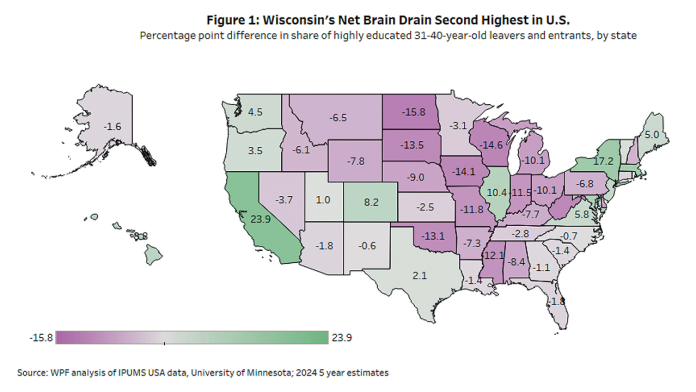

Using a measure of “brain drain” that compares state-to-state migration among highly educated people, a new report from the Wisconsin Policy Forum says Wisconsin-born adults who have moved to other states are more likely to be college educated than those born in other states who have moved into Wisconsin, producing a net brain drain rate of 14.6% that is second worst in the nation.
This migratory pattern limits economic growth in Wisconsin, but there are mitigating factors that suggest the situation isn’t as dire as the topline data would suggest.
The report, “Brain drain erodes state’s talent potential,” is based on the policy forum’s analysis of highly educated adults aged 31 to 40 from the U.S. Census Bureau’s 2024 American Community Survey.
WPF estimates that 59.8% of Wisconsin-born adults who now live in another state have a bachelor’s degree or higher.
In contrast, an estimated 45.2% of adults in that age group who were born in another state but now live in Wisconsin hold a bachelor’s degree or higher, which produces a net brain drain that ranks behind only North Dakota’s 15.8%.
The report also said people born in Wisconsin are more highly educated than Americans overall, and since 2020, the state has added more residents overall than it has lost through domestic migration.
As a result, educational attainment among current Wisconsin residents remains close to the national average.

“That overlying finding is indeed alarming, but it was somewhat less alarming to look at some of the dynamics of brain drain,” said Andy Tisdel, a researcher with the Wisconsin Policy Forum.
According to Tisdel, once one gets past the topline number that indicates Wisconsin has the second worst brain drain rate in the nation, the fact that it started with a stronger-than-average educational baseline for people born in Wisconsin means “we’re a little better positioned to absorb the brain drain than we otherwise would be.”
“I think that was kind of the silver lining of this analysis,” he said.
In one mitigating example, the report said Wisconsin actually had a “brain gain” from Illinois, as the Badger State drew 1.51 highly educated entrants from Illinois for every highly educated Wisconsinite that moved to its southern neighbor.
Michigan is the only other state among the top destinations for which Wisconsin has a positive ratio of entrants-to-leavers, or brain gain. Wisconsin gained 1.65 highly educated residents for each one who moved to Michigan. Only 3.1% of Wisconsin’s leavers moved to Michigan, while 7% of its entrants came from that state.
Wisconsin has seen the most dramatic net brain drain to Minnesota — the top destination for leavers (17.8%). Wisconsin gained only 0.56 highly educated adults from Minnesota for every highly educated Wisconsin-born person who moved to Minnesota.
The report also looked at overall population migration numbers that include all people entering and leaving the state, not just highly educated people.
“This was from a different data set and we found that Wisconsin was, all told, experiencing a slightly positive rate of in-migration,” Tisdel said. “Between 2020 and 2024, we saw a modest gain of 0.5 residents per 1,000, which is not the highest, but it’s not negative.”

