
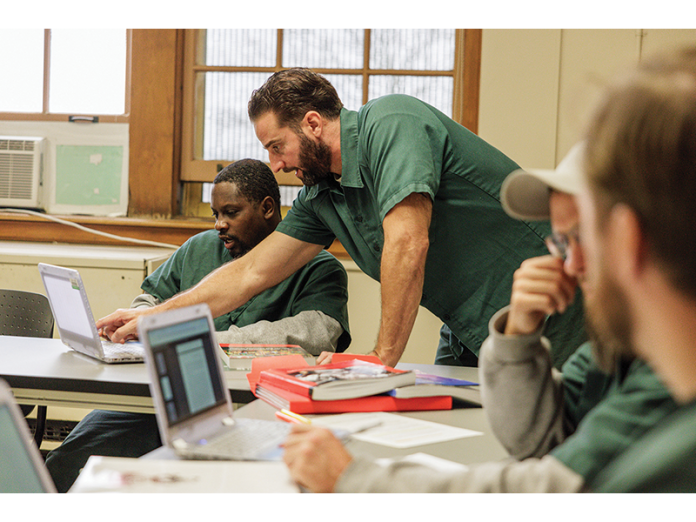

For the 15 people who in May exchanged their prison garb for graduation gowns at Oakhill Correctional Institution in the Dane County village of Oregon, a higher education initiative for willing Wisconsin inmates means they have a legitimate chance to join the workforce as they reenter the community.
The Oakhill graduates are among the first cohorts to earn Associate of Arts and Sciences degrees from UW-Green Bay through the Universities of Wisconsin Coalition for Higher Education in Prison. UW CHEP is a collaborative initiative delivering college courses, certificates and degree pathways to students in seven state correctional institutions.
Critical to supporting such prison education programs has been data that shows they are effective.
Peter Moreno, director of the Prison Education Initiative at the University of Wisconsin–Madison, points to a RAND Corp. analysis that he said is cited by virtually every program director trying to provide inmates marketable skills, reduce recidivism and boost workforce development.
“The RAND study really was the first meta-analysis of what works in prisons to keep people from coming back,” Moreno said. “It was the first time any organization had really synthesized all of the data that came from previous studies, and it communicated to the public that higher education in prison is useful at reducing recidivism.”
RAND’s 2013 analysis of 18 prior studies conducted from 1980-2011 said for inmates who participate in correctional education programs, the odds of obtaining employment post-release was 13% higher than those who did not.
The study also said those who participate in prison education programs are 43% less likely to return to prison, and every $1 invested in prison education saves $4 to $5 in reincarceration costs.
In 2018, RAND updated its meta-analysis to include a larger and more recent set of studies, and it said those who participate in a correctional education program had a 28% lower chance of re-offending. This represented a 9-percentage point reduction in the risk of being reincarcerated within three years of release.
Since beginning in 2023 through Gov. Tony Evers’ Workforce Innovation Grant program, the Coalition for Higher Education in Prison has helped 19students earn an associate degree from UW-Green Bay.
In addition, more than 150 students have earned badges, which are micro-credentials showing their workforce ready skills, from a Universities of Wisconsin school.
The momentum continues this fall, as nearly 170 incarcerated students in Wisconsin are enrolled in credit-bearing Universities of Wisconsin courses.
Statewide partnership
UW CHEP is coordinated by UW–Madison through its Prison Education Initiative, in partnership with the Wisconsin Department of Corrections, UW-Green Bay, UW-Stout, UW-Eau Claire and UW-Milwaukee — all of which work with state correctional institutions.
Through its Odyssey Beyond Bars program, UW–Madison delivers college jump-start courses at the Oakhill, Racine, Columbia and Taycheedah institutions.
Moreno said UW CHEP collaborates with employers and staffing firms to ensure relevant curriculum, and he said employers want employees who are ready to learn, ready to work in a group and who communicate well.
To aid a smooth transition, he said a career adviser and reentry support coordinator connects student inmates to job opportunities and community resources.
Moreno said he looks forward to building the higher educational program and other prison education efforts, but private fundraising will be necessary.
“We’re coming off a Department of Workforce Development grant now, and we’re moving under private philanthropic funding later this year, but that will also have a strong workforce focus,” he said. “Everything we’re doing prepares people to reenter the workforce.”