
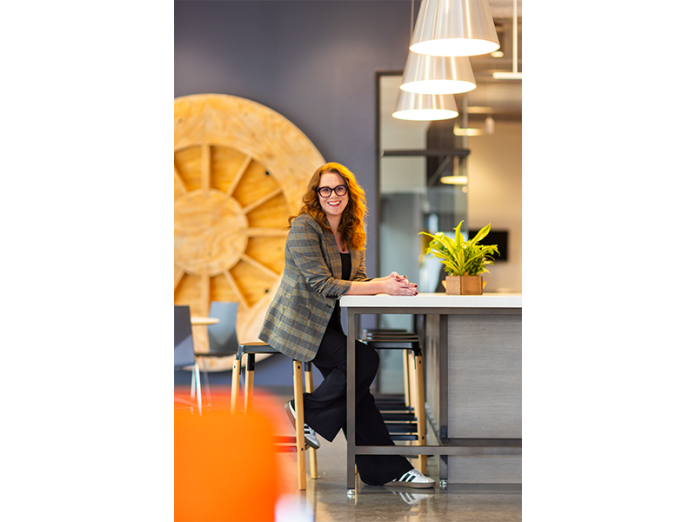
Erica Mullins’ ascension to the top spot at Madison architecture firm Strang Inc. didn’t happen by chance.
In fact, throughout her career, the company’s first woman CEO — and the first from an interior design background — has made decisions rooted in a determination to learn, grow and rise up.
Mullins said the trials she’s encountered over the past decade-and-a-half — ranging from a tricky job landscape, to challenging clients, the demands of an executive role and more — have helped her build essential skills and grit.
Looking to Strang’s “next 90,” she shared plans to reinvigorate the company’s historically creative approach while promoting inclusive workplace policies and opportunities for employees to flourish.
How has your career evolved over time?
I actually graduated during the recession. Going into the architectural and construction industry at the time — it wasn’t a great time to start your journey.
I ended up finding a position doing internal senior living design for a company in Milwaukee, Brookdale Senior Living.
It was a lot of hard work — working at that lower intern level even though I had my professional degree — for a couple of years. I really took it upon myself to move up, and keep doing more, and keep taking on more responsibility and making the best of it.
Going into these senior living communities that hadn’t been touched in 20-some years and giving them a fresh space was really rewarding. Also, (they are) the toughest clients you’ll ever get.
I was once putting some pillows out, and some older gentleman shuffled up to me and told me it was the worst design he’d ever seen, and where was his old chair?
His old chair was pretty dilapidated and falling apart and stained and ripped. But you just kind of have to take it, and (say) “Oh, I’m sorry, I’m sorry you feel that way.” It really helped me grow some thick skin.
After that journey… I ended up at Strang and have been here for about 12 years. I came in as a designer and just worked myself up.
I led the interior design department for a number of years, became a shareholder, became a partner as well. And the first year that I became a partner, I also went back to school.
I was never a school person. Once I got my undergrad (degree), I was like, “I’m done.” But then I decided that just having some additional knowledge in terms of business operations was really important to take on the responsibility of being part of the leadership team of this company.
So maybe two or three years ago, I went back to get my MBA at UW-Milwaukee. It was an executive MBA, so it was really catered toward working professionals. That was just a really great experience of being able to real-time learn things and then come back on Monday and immediately apply it.
I’d known for a while that Larry (Barton) would be stepping down from the role (of CEO), and I think I waited until the very last day … and I decided to throw my name in the hat.
How did your interior design background help prepare you for your current role?
One thing about interior design, which I think has been really helpful, is just the client conversations that I’ve had over the years.
It’s very common on a project that the interior designer is a little more front-and-center with the client, hearing what’s their vision, extracting their vision and coming up with a solution for it.
And I think leadership is kind of the same way. On a daily basis, I hear opinions from a lot of people, their thoughts on the business and where they want to go. They’re my clients, in a way. It’s taking that information and kind of designing what the solution is, and instead of designing a space, I’m designing a business.
On projects, there’s always conflict. There’s always, one person wants one thing and another wants the other, and you have to help get them toward a shared vision and a shared solution.
What has your experience been like as the company’s first woman CEO?
When I started here, it was very common that I’d be the only woman in the room. Even with our project teams, as an interior designer, you’d be the only woman.
I’m happy to say that we have more equal representation now. There was a time in 2018, I was sitting in a room as the project manager, and the electrical engineer was a woman, and the low-voltage engineer was a woman and the architect was a woman.
It was funny because we all kept talking over one another, and then we all stopped like, “Oh, hey, this is an all-female group.”
(We could) take that step back and be a little more gracious because you’re not always fighting to have your voice heard.
Everyone at Strang has been great and very receptive to any kind of conversation about empowering women. Over the years, it has changed a lot. I don’t feel like I’m treated any differently, at least to my face!
What other areas of focus have you prioritized during your leadership?
One of the things I’m most proud of was implementing a parental leave policy. That was one of the first things I did after I became a partner.
Making the emotional and a data-informed case is really important to communicate and move something forward. I put together a presentation about really looking at the gender breakdown in our office.
In the 10 years I had been here at the time, only, I think, two people had had a baby and gone on leave. One of them ended up leaving, searching for a little bit more flexibility in their schedule — she’s back now, which is great — but (I heard) their struggles.
So I put together a policy that supports the emotional case but then also talks about how costly it would be to replace someone. Giving someone enough time off and paying for it — there’s a better business case to be made there than being really tight with it, and then you potentially lose them, and then you have to replace them.
What’s next on the agenda for you and for Strang?
For the company, we’re actually celebrating our 90th (anniversary) … so I keep saying “the next 90” … but maintaining the legacy of the company.
In the ’30s, our founders were doing international-style design — glazed corners, flat roofs — they were really pushing the bounds of what it means to
do design, which is really cool.
As we’ve been preparing for the 90th, we’ve been pulling a lot of the historical data and looking at it, and I just want to reinvigorate that spirit. Why not break things a little bit, in the right way?
We’re at the forefront of how AI is going to change things, too. We’re starting to look at the integration of AI in terms of processes, and some of the non-design things. But there will be a point where I think we’ll have to embrace AI from a design side as that continues to evolve, so (I’m) just trying to stay on top of that.
I’ve felt like I’ve grown a ton professionally while I’ve been here. I’ve had the opportunity to do that, and the company has really challenged me and pushed me outside of my comfort zone.
I want to give that back to other people, too, because I know how rewarding that is.

