

With the state unemployment rate recently dropping below 5% — a level not seen since July 2008 — workers may soon develop a swagger that’s been missing for most of this decade.
The balance of power between employer and employee is starting to shift ever so subtly, and that augurs an acceleration in the number of workers leaving for greener — or at least different — pastures.
In January alone, 2.8 million people voluntarily left their jobs, according to the Bureau of Labor Statistics.
| “I think one of the best practices is to stay close to the situation. We want to trust that people will be training all aspects of their job in a professional manner, but stay close and make sure that’s happening.” — Rachel Idso, branch manager, OfficeTeam |
But what goes up must come down, and just because employees are feeling their oats now doesn’t mean they can afford to get cocky — and they definitely need to do all they can to leave their current employers on good terms.
According to a recent survey conducted by OfficeTeam, a global staffing service with an office in Madison, a vast majority of HR managers (86%) say the way a worker quits a job has at least some effect on his or her future career opportunities, and 33% said it greatly affects one’s prospects.
But those harsh realities apparently don’t stop some employees from making some very ungraceful — one might even say colorful — exits.
“I once heard about an employee posting on her boss’s Facebook wall, just saying, ‘Hope you’re doing great, and I hope you had a good life, but I’m never coming back,’” said Rachel Idso, branch manager at OfficeTeam’s Madison office. “I heard that through a friend, and I cannot believe that actually happened, but it did.”
That anecdote was taken from the files of Madison-area employers, but when OfficeTeam polled managers from across the country, it uncovered smoldering bridges from sea to shining sea.
A few of the more jaw-dropping stories:
- “One person made his wife call to say he was not coming back.”
- “An employee baked a cake with her resignation letter written on top.”
- “A worker sent his boss a text message.”
- “Someone left for lunch and never came back.”
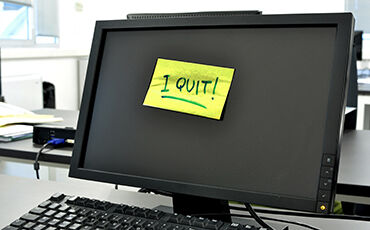
- “He just stood up and said, ‘I quit.’”
While some employees might think it would feel good to leave a job with a bang rather than a whimper, the downside is obvious. You can’t use an employer for a reference if you’ve broken up badly, and the gaping hole it will leave on your résumé is likely not worth whatever catharsis you might end up achieving.
(Continued)
But according to Idso, leaving in a “legendary” manner may have repercussions beyond permanently severing your relationship with your former employer.
“You know, Madison’s small,” said Idso. “It’s a big city, but it’s a small city at the same time. You might know somebody who knows somebody who works there or has a relative or whatever, and you just don’t want to leave that legacy even if you’re not going to utilize them as a professional reference. Things travel through that grapevine, and you just want to make sure that that grapevine has only positive things to say about you.”
Staying engaged
So what is the best way to quit?
Idso notes that her team touches on several points when advising workers who are ready to move on to a new career opportunity — and one of those is to avoid a case of “senioritis” when you’ve decided that you’re leaving your job:
“The top things that we always tell people is to give the proper notice, get things in order, supply written instructions to team members on projects, stay positive, do that exit interview, and don’t slack off. Use your last week on that job to complete as much work as possible, including any outstanding projects that you have. Because you want to be remembered as that strong contributor in the end, not as someone who really fizzled out.”
As for the standard two weeks’ notice? More is always better, says Idso.
“Offering to stay longer and train your replacement is absolutely looked upon as flexible, as professional, and if your future employer allows it, it’s definitely something that we encourage people to do, to say, ‘Okay, I’m able to stay three if that’s something you need, or even four. I want to make sure that you guys are taken care of.’”
As for employers’ role in ensuring a smooth transition, Idso notes that it’s important for them to remain diligent as well.
“I think one of the best practices is to stay close to the situation,” said Idso. “We want to trust that people will be training all aspects of their job in a professional manner, but stay close and make sure that’s happening, and stay close to make sure that all of the positive things are coming through when they’re training their new employee, rather than just leaving it to trust.”
Meanwhile, it never hurts to keep your antennae up with regard to employees who may be looking for a change.
“One of the signs that an employee might be looking to leave your organization is a wardrobe change,” said Idso. “So if somebody is coming in wearing business professional but you usually see that person wearing business casual, they might be dressing up for interviews. Or if they’re consistently having absences. So you should be aware of an employee calling in sick or having to have meetings or appointments outside of the company.
“The other thing is personal calls. That’s a big sign that people should be aware of. Are they closing a door, are they stepping out with their cell phone? … And loss of enthusiasm. Is this person checked out of the current position and looking for something different?”
Click here to sign up for the free IB ezine – your twice-weekly resource for local business news, analysis, voices, and the names you need to know. If you are not already a subscriber to In Business magazine, be sure to sign up for our monthly print edition here.

