
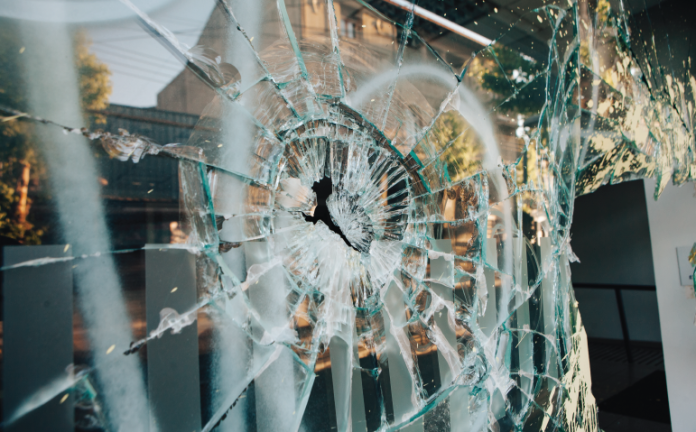

The unrest that gripped the nation last week in the wake of the police-involved murder of George Floyd made its way to Madison this past weekend, as Madison police report at least 75 businesses — a conservative estimate, some say — were damaged or looted or both when demonstrators took to the streets, particularly State Street.
But are the affected businesses insured in the event of such an event? Yes, if they have standard insurance policies, according to Martha Lester, a risk management insurance instructor at Madison College. In fact, Lester says they are more likely to be insured in this type of situation than for business disruption caused by the COVID-19 pandemic, which closed so-called nonessential business for several weeks.
“Riot and civil commotion are basic perils under your commercial property policy and also under business interruption,” Lester notes. “So, in certain insurance policies that are standardized today, those two perils are built in automatically.”
Good thing, too, because even with a state of emergency declared through June 3, a curfew imposed on Sunday night and lasting into the early part of this week, and the Wisconsin National Guard being deployed to trouble spots, more damage ensued. No matter how many people try to provide a lawful example by protesting peaceably, there is no guarantee that violent demonstrators are done — not in Madison, not anywhere.
Just a riot
While riot and civil commotion are covered, there are caveats that are built into standard policies, Lester notes. Things that are excluded include any intentional acts of the insured that result in damage, and situations in which the insured fails to take reasonable steps to protect their property from further damage.
While those steps generally are not specifically prescribed, a store that saw its windows smashed would be expected to make temporary repairs and board up those windows before they can be replaced. Some policies might require a store to have additional security — an expensive jewelry store, for example — but in general store owners are expected to do what is reasonable to protect their property from further damage.
“Vandalism is also a covered peril under your policy. That’s also part of the basic coverage,” Lester adds. “Glass breakage is limited. Some companies might make it better, but there is roughly a $2,500 limit for glass breakage under a policy, and so most people that have the storefronts with a big, plate-glass window, their agents likely would have encouraged them to purchase traditional glass coverage beyond that, beyond the $2,500 limit in the policy.”
In terms of business interruption, what insurers look for in order to pay under business interruption coverage is structural damage that is covered as a peril under the policy, Lester explains. “Let’s take the glass of a window at a jewelry store. They are not going to be able to immediately go back into business, so their lost income would start providing coverage for them.”
In the case of looting, that’s considered theft, and most insurance policies provide coverage for the “peril of theft,” Lester notes.
In an example that is particularly applicable to State Street businesses whose buildings are connected, Lester notes that if a neighboring property has damage and your business is closed as a result of neighboring property damage that’s covered by your business interruption insurance, your policy probably provides what’s called civil authority coverage. This coverage would pay your lost income because a civil authority — a city, county, or state government — closed access to your business due to a covered loss to a neighboring property. Such policies typically have a 72-hour deductible, so it won’t pay for the first 72 hours, and they have maximum coverage period of four weeks.
In addition to riots, civil commotion, vandalism, and fire, any property damage caused by things that are being set on fire, such as a police car or a flipped vehicle, typically are covered, as well.
Got the goods … back
Another point to consider is that insurance companies have the right of subrogation, which means if they can identify the person or people who caused damage to an insured company’s business, they can try to recoup from those responsible what they’ve had to pay out in an insurance claim. Obviously, the larger the crowd, the most difficult this becomes, but if they can identify the “perps,” with or without a lawful conviction of a crime, they can try to recover their losses.
“If they [the perpetrators] get charged, it just gives the insurers more evidence to say they damaged this and you were charged for it,” Lester explains. “But even not being charged, if they have got pictures of this person breaking the glass and they know who this person is, then they would have a right to collect their money back. Just like in a prosecution, they have to prove that the person actually did it. If they can prove that, they can collect.”
COVID-19 complication
At the moment, it could be difficult for insurers to determine the amount of loss of income because businesses have been shut down. Ordinarily, to estimate what the business would have earned had there not been a loss, Lester says an insurance company would request records from the past year to see what the sales have been and what they were last year at the same time. Being shut down is going to show potentially zero recent income and also makes it difficult to predict where they would be with the safer-at-home order just being lifted.
However, Lester believes that insurers will work with their insureds in a fair manner. Her advice is to have the sales records available and to document the hours that they are unable to be open. If possible, businesses also want to take pictures of the damage and cleanup. Filing a claim or contacting their insurance agents as soon as possible is important because they will provide direction on what the business needs to do.
“If there is a theft (looting), there generally has to be a police report on file for documentation,” Lester adds. “I am assuming the police are going around and taking notes, but further information, such as what was stolen and the value, will be needed.”
Related stories:
Madison Mayor declares state of emergency; Evers deploys National Guard
Local bakery sues insurance company over COVID-19 claim
Click here to sign up for the free IB ezine — your twice-weekly resource for local business news, analysis, voices, and the names you need to know. If you are not already a subscriber to In Business magazine, be sure to sign up for our monthly print edition here.

