

It’s hardly a secret that smartphones are nearly omnipresent in the United States in 2016. In fact, the Pew Research Center notes that 72% of U.S. adults report owning a smartphone in 2016, a number that only continues to climb each year.
Getting people — especially young adults and children, who, yes, increasingly have smartphones of their own — to put down their smartphones is an almost impossible task. Instead, the Aldo Leopold Nature Center (ALNC) in Monona has taken more of an “if you can’t beat ’em, join ’em” approach to engaging visitors.
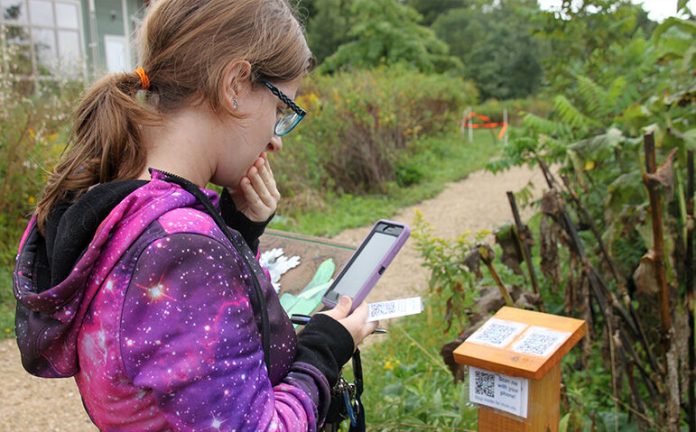
The Digital Docent program, unveiled in late August, encourages visitors to use their own smartphone or other mobile technology at various signposts throughout the grounds to access digital information and resources about featured species.
The pilot “Digital Docent: Climate Change Impacts” walking tour is the result of a collaboration between UW–Madison undergraduate Ethan Heyrman, Jack Williams, director of the Nelson Institute Center for Climatic Research, and Brenna Holzhauer, director of exhibits and digital curriculum for ALNC.
The Digital Docent provides a self-guided option for visitors to use a smartphone or other mobile technology to learn more about local species on the nature center’s grounds. Using a QR code app, trail users scan the square codes located on sign posts throughout ALNC’s grounds to link up with digital information and access resources about featured species — including identification and seasonal information, fun facts, climate change impacts, and additional resources. Anyone with a smartphone can download a number of free QR code readers, and ALNC staff is available to make recommendations or provide assistance. The nature center also has a paper version of the tour at its front desk for those who prefer the low-tech option or don’t have access to this technology.
Holzhauer notes ALNC is always striving to find innovative ways to bridge nature and technology and provide new offerings and interpretive information for visitors.
“We had been thinking of doing something like Digital Docent for a while, Holzhauer explains. “A few years ago we opened our Climate Education Center, full of exhibits and technology centered around teaching people of all ages about climate, energy, earth science, and all of these interconnected global systems. Since then, we’ve been working to come up with new ways to connect these concepts with our local ecosystems and provide engaging new ways for folks to connect the dots between what’s happening globally and what we observe locally in the field.”
According to Holzhauer, ALNC was approached earlier this year by Williams about applying with Heyrman for a Wisconsin Open Education Community Fellowship (WOECF) through the Morgridge Center for Public Service. In developing the application and outlining the fellowship, Holzhauer and Heyrman decided one of the ideas they wanted to tackle included creating scannable QR codes and distributing them throughout the grounds of the nature center in order to create accessible and mobile learning tools that teach the local effects of climate change.
Holzhauer says ALNC was able to keep the hard costs of the project to a minimum by using available and open source technology. “And, of course, we were very fortunate to receive the WOECF award, which helped to cover Ethan’s time, Professor Williams’ advising, and some of our staff time managing the project.”
That said, Holzhauer and Heyrman still spent many hours planning the program, researching technology to use, and developing the content, not to mention the time Heyrman put in on his own researching species and climate change information, searching for images, and building and installing the signposts.
“One of the main themes of this tour and our curriculum at ALNC is the concept of phenology, the study of changes in the natural world through time,” Holzhauer says. “This can include anything observed in nature, but especially happenings such as when leaves start to turn, when the pond freezes over, the first bloom of plants, or the arrival of migrating birds — in other words, tracking plants, animals, weather, and nature through the seasons. To this end we give ideas of what to look for at different times of year and encourage visitors to make observations and keep records of the world around them to help connect with their surroundings and learn about local climate and ecosystem changes over time.”
(Continued)
Where ‘high-tech meets high-touch’
With Digital Docent, ALNC is making a concerted effort not to shun technology in its ongoing quest to teach about the natural world.
“I do think that the trend is there to embrace technology these days, and even the most low-tech organizations are having to at least consider how to stay current and relevant,” notes Holzhauer. “But I also think that we at ALNC try to be especially innovative in our offerings, incorporating new technologies as teaching tools, and providing learning experiences that appeal to a broad audience. We have embraced the motto of being a nature center where ‘high-tech meets high-touch’ and are passionate about finding new and exciting ways to bridge the gap between 21st-century learning tools, increased attachment to screen time, and understanding of and connection with the natural world.”
Holzhauer acknowledges that increased screen time is a challenge an organization like ALNC faces when it seeks to attract younger visitors. “According to the National Institutes of Health, today’s children (and most adults) spend just 1% of their time outdoors.” Holzhauer says. “As a result, today’s kids have little exposure to the world around them or understanding of the systems that sustain life on Earth — and are also missing out on the joy and health benefits of spending time in nature.”
Holzhauer explains it’s important to the environmental educators at ALNC to encourage people to shut down their screens and use their senses to look around them and engage in the natural world. “But we also recognize that there are many benefits that come from technology — and, when used thoughtfully, it can help us to enhance learning and connect with new audiences. Kids and adults today are so digitally literate that we have made a point to embrace technology and try to use it as a tool instead of a distraction.”
That’s a sentiment echoed by Cara Erickson, interim communications manager and programmer of exhibits and digital curricula for ALNC.
“The nature center’s push to use technology as a tool is what made the Digital Docent such a no brainer,” Erickson says. “It literally bridges the gap between seeing a Sandhill crane wading in the pond and learning how to identify that species and how it is affected by both changes in season and climate change.
“We live in an age where endless information is available at the touch of a button — if we don’t know something, we simply ‘look it up,’” Erickson continues. “We no longer have to wait until we are at the library or at school to access information. What’s more, we are no longer socialized to wait to uncover the information — how many times have you said, ‘I will look that up when I get home,’ just to later forget what you were interested in, in the first place? This is why I think the Digital Docent is such a great teaching tool — it meets visitors who want to interact and engage head-on. Information is available as soon as the QR code is scanned, engaging visitors and educating them when they are inspired to do so.”
ALNC has already seen the benefits of incorporating technology into its exhibits. The nature center offers an exhibit area filled with touchscreens and multimedia theaters, which are used to teach about global issues and abstract earth science concepts.
“Nothing beats authentic experiences with nature, and we offer many different programs to engage kids, adults, and families in hands-on learning outdoors,” notes Holzhauer. “But sometimes there are concepts that are too distant or abstract or difficult to teach without using visuals and technology. Mobile technology is the perfect way to bridge all of this together. People always have the option to tune out and go out on our beautiful grounds and just feel the sun on their skin and listen to the birds and insects, but for those who prefer to engage and extend their experience with technology, we offer that option, as well.”
Of course, there are times when technology with the best intentions can still get in the way of educating visitors. Take the augmented reality (AR) game Pokémon Go, for example.
“Some AR games, such as Pokémon Go, while they get people outside, aren’t necessarily making an educational connection between people and nature,” Erickson explains. “It really depends on the nature of the software and how it will be used. The digital component in the Digital Docent connects visitors with local species by providing information about those local species.”
“There are pros and cons of these augmented reality experiences, and this is something we have only begun to look into,” notes Holzhauer. “We don’t currently have the resources to fully develop custom software or apps, but there are some wonderful open-source, place-based learning tools out there that we’ve been investigating and discussing if and how we might be able to incorporate more of this at ALNC.”
One app ALNC has embraced is Siftr, a field-based digital learning program, for visitors to upload, caption, and tag images to ALNC’s photomap, so the nature center can crowdsource seasonal observations. “Anyone can add their own and compare to others’ photos from various times of year,” explains Holzhauer. “And one of the great things about using web-based technology is that we can constantly add and update the content! We are collecting feedback from users and will use this to improve and enhance this offering down the road.”
Click here to sign up for the free IB ezine – your twice-weekly resource for local business news, analysis, voices, and the names you need to know. If you are not already a subscriber to In Business magazine, be sure to sign up for our monthly print edition here.

