
Paul Robbins has a list — an investigative list of project areas to explore for a more responsible approach to data center development.
Most are in the energy category, but others speak to a holistic version of what an ideal neighbor a hyperscale data center operation should be.
Wisconsin’s combination of ample fresh water and moderate climate have made the state an attractive place for the development of these large data center campuses, which serve growing artificial intelligence applications but also require massive amounts of energy and water. They are a controversial use of land, especially in rural areas, and environmentalists would like to see more clean sources of energy power them.
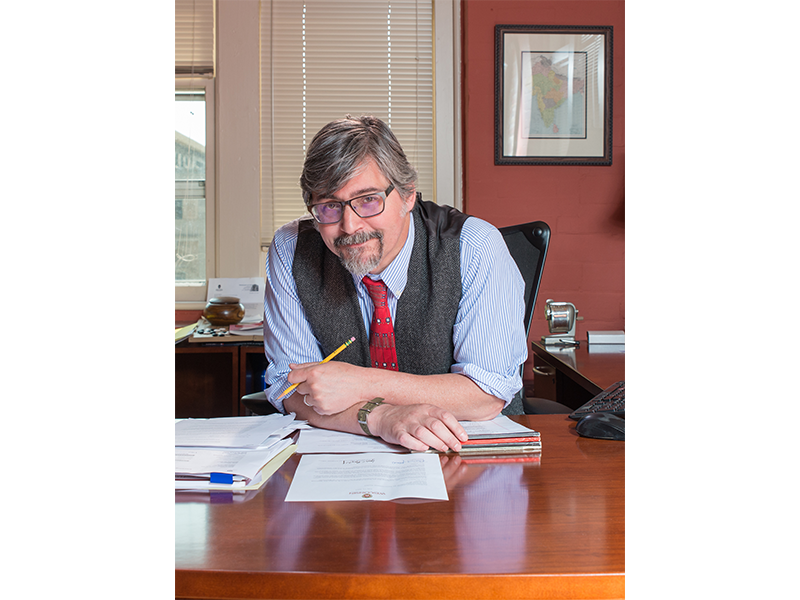
Robbins, dean of the University of Wisconsin-Madison’s Nelson Institute for Environmental Studies, said the $1.5 million research partnership the institute has entered into with QTS Data Centers is an opportunity to learn more about such operations and their effect on the environment, land use and energy load.
As QTS’s proposed data center campus in DeForest generates intense public opposition, Robbins said there is a history of mutually beneficial relationships between companies and the towns they operate in, even if they don’t last forever.
With the right approach, he said even large hyperscale data centers can live in harmony with their host cities. To do so, they must take a comprehensive look at how they affect a community.
“I don’t think you could be a responsible data center without thinking about energy throughput, land impacts, the possible positive benefits you could have on ecosystem outcome, so let’s put all that — sustainability, energy and land — in there,” Robbins said.
“Responsibility, it seems to me, (means) what does labor look like and what does your labor source look like? How are workers experiencing their relationship with the firm? How does the community look at the investments that somebody’s making in their community and their long-term commitment to that community?” he asked.
Areas to investigate
Several research projects have been identified as part of the partnership between QTS Data Centers and the Nelson Institute. The ones that could yield immediate dividends for improving the sustainability of data centers involve developing dispatchable energy storage solutions by coupling battery and storage gains with renewables.
“A lot of people on campus are thinking about how to do that, but not for data centers,” Robbins said. “To be able to actually get in there with the people who build and operate these things, get into the industrial function of how they work, would be a huge boon for a lot of our engineers and the people who are doing energy analysis and policy — and produce efficiencies.
“We know energy use is going to go up with these things, but the efficiency gains could be real at a high level,” he said. “So that seems pretty immediate.”
Another item on Robbins’ investigation list is an analysis of how power swings in workloads affect grid stability. He said spikes in the workload are one of the things that make data center facilities unattractive, and that strikes him as an engineering problem.
“I’m a geek, so I find that interesting,” he said. “If you really could conquer that and smooth (it) out, you’d get positive outcomes for everybody. So at least mitigate some of the negative ones.
“Is that about sustainability?” he asked. “Yes, ultimately, if your grid function improves, efficiency improves.”
Longer-term advances such as hybrid energy systems and advanced nuclear are exciting possibilities, especially for meeting climate goals, Robbins said.
“Advanced nuclear power is great,” Robbins said. “If we’re going to hit 2050 commitments, which I think we’re at risk to blow right through with the advent of all these data centers and related infrastructure, we’re going to have to onboard advanced nuclear in the next 25 years to get that curve to flatten once it rises.”
Robbins also believes there are underutilized energy sources that could enhance Wisconsin’s status as an attractive place for data center development. One of them is research into more efficiently managing effluent from dairy operations, including the capture of biogas from manure for use as energy, and other circular economic opportunities the agricultural system provides.
While this has been on the dairy industry’s agenda for years, he said it’s been a difficult area to “ramp up.” But it remains a potential revenue stream.
“The markets have been a little unstable for it,” Robbins said. “They can’t get the returns that the infrastructure costs them, but if you had a data center (to power) … again, the industrial ecology of that, I think we have underutilized that potential to integrate agriculture with the data center.
“Agrivoltaics, as has been proposed, is similar,” he said. “How do you get the solar rollout and maintain all of the agricultural advantages? Agriculture is the last thing you think of when you think of data centers, but if Wisconsin is going to be the place you do this, that would be where I’d start.”
Co-existing with nature
Even if energy wasn’t an issue, there are still land use issues, especially in rural areas, and biodiversity considerations for large data center campuses. According to Robbins, a better understanding of how built infrastructure at this scale can serve biodiversity needs is required, and it’s context specific.
For example, if a campus is built in the northwest part of the state, developers are dealing with a different suite of species than they do in the southeast region, Robbins said. Researchers who already know these landscapes can assist developers on designing a data center campus to serve migratory pathways and other aspects of nature, rather than just mitigating harm.
“The climate change question is always the biggest, but I am a biodiversity guy myself,” Robbins said. “In terms of looking at fish habitat, looking at bird habitat, looking at the migratory habitat, there are ways to put your hands on the land and physically nurture habitat for wild things.
“It isn’t just about setting aside parks, and a data center that can show how to do that.”
Asked whether he expects the institute’s investigation list to grow as the research unfolds, Robbins said that’s a possibility with more investment, and so is a broader research consortium involving multiple research universities. Yet the immediate focus should be on UW-Madison’s strengths in conservation science, he said.
“I see more scaling, I see more projects, but I also think we really need to begin to triage and prioritize because the urgency of these questions is really upon us,” he said. “The $1.5 million is welcome, wonderful and fantastic, but we owe it to these companies to say, ‘All right, if you’re going to make a bigger investment, this is where you’re going to get the best return on investment.’”
QTS seems to understand the need to address environmental and societal effects of large-scale digital infrastructure.
“As the (UW-Madison) deepens its investment in AI research, and QTS continues to expand responsibly, it made sense to collaborate,” the company said in a statement.
Water conservation has been one area where innovation has improved sustainability. QTS has implemented closed-loop water systems that reduce water consumption compared to traditional evaporative cooling methods.
QTS also has announced an agreement in principle with Alliant Energy to add renewable energy resources across Wisconsin. The agreement will be
facilitated by the sale of Renewable Energy Credits from approximately 750 megawatts of new renewable energy sources.
“Responsible data center development means designing and operating facilities in a way that minimizes environmental impact while meeting growing digital demands,” the company said. “This includes implementing our closed-loop cooling technology, prioritizing carbon-free energy sourcing and collaborating with academic and industry partners to advance sustainable practices.”

