

Data Centers
|
Market |
Data Centers |
|
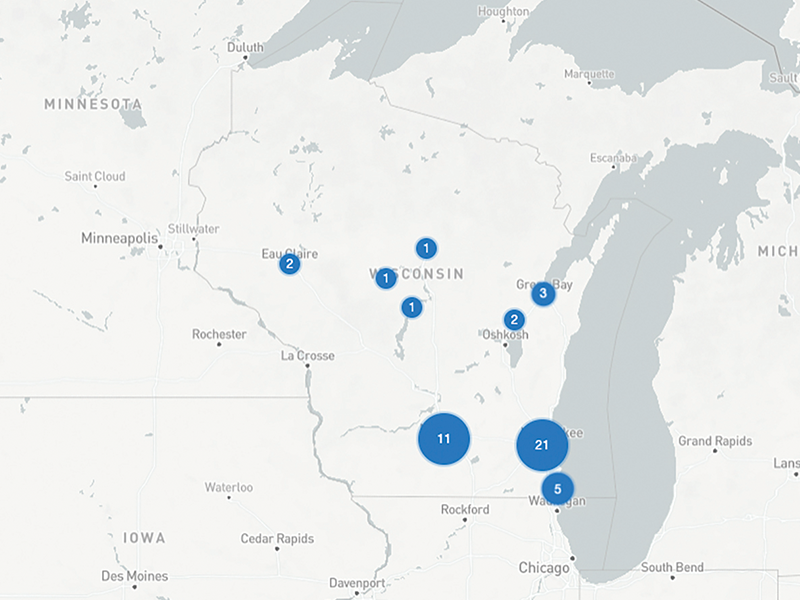
Milwaukee |
21 |
|
Madison |
11 |
|
Wisconsin Rapids |
1 |
|
Kenosha |
5 |
|
Appleton |
2 |
|
Green Bay |
3 |
|
Wausau |
1 |
|
Eau Claire |
2 |
|
Marshfield |
1 |
|
Total Data Centers: |
47 |
As large, “hyperscale” data centers needed to run artificial intelligence applications pop up in the state, fears about what these developments mean for climate change and water usage have surfaced.
Because such data centers and their AI servers require more powerful chips and intense cooling systems due to the heat they generate, some believe the only path forward is the continued reliance on fossil fuel sources.
Under that scenario, there is still a role for clean energy to play, but it may be a supporting role. The multiple business benefits of AI and the international race to lead in this transformative technology could mean a fully green energy economy will happen later rather than sooner.

“You can’t do what AI does in a small footprint,” said Bryan Schenker, president of 5NINES Data, a local internet service provider that also runs a small scale data center. Large companies “are going to rely on these larger data centers and new facilities that are being constructed to service (AI).”
Bryan Chan, founder and CEO of SupraNet Communications likewise runs an ISP and small data center. He is blunt about what the rapid growth of large data centers means for the environment.
“Data centers represent a threat to the environment that we should all be aware of,” Chan said. “I think AI is great and I certainly use it everyday as well, but I’m also conscious of the fact that it’s bad for the environment.”
An April report from the International Energy Agency said a diverse range of sources will be needed to meet future demand: “Electricity grids are already under strain in many places: we estimate that unless these risks are addressed, around 20% of planned data center projects could be at risk of delays.”
Wisconsin, with its ample fresh water and moderate climate, has become an attractive place for data center operators and tech giants such as Google, Meta and Microsoft. Most of the state’s 47 data centers are in metropolitan Milwaukee (21) and Greater Madison (11), according to the Data Center Map, and more are on the way.
Coming to a town near you
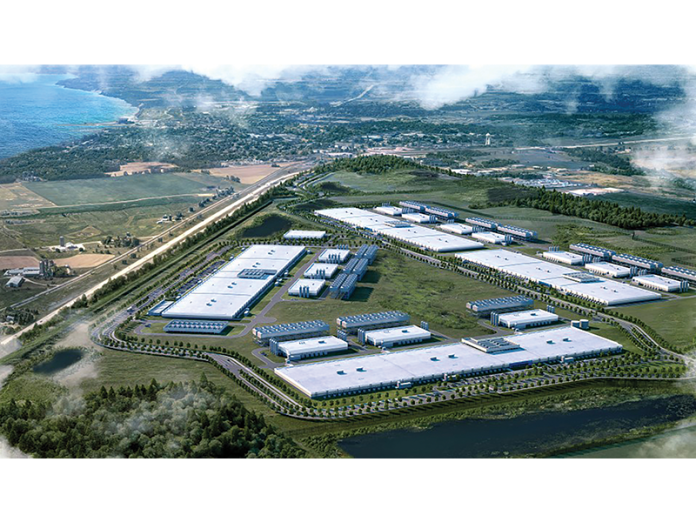
Microsoft is investing more than $7 billion in two large data centers, including a $3.3 billion, 4.4 million-square-foot AI data center — with related land purchases expanding beyond 1,600 acres — in the Racine County village of Mount Pleasant.
Data centers have been proposed for the Dane County town of Vienna, the Racine County village of Caledonia and, thanks to state legislation enabling the creation of tax incremental districts to attract them, Beaver Dam and Port Washington have taken steps to accommodate new, large-scale data centers.
For municipalities with data centers within their borders, there is a substantial increase in the local tax base. Still, some residents fear they will lead to water and electricity shortages, higher energy costs and the loss of farmland.
While municipalities, operators and utilities maintain clean energy will be part of the mix of sources powering these large centers, the recent Public Service Commission approval of two natural gas power plants in southeastern Wisconsin was not an encouraging sign for environmental groups.
“Data centers and utilities are pursuing the standard, lazy option, which is just build new gas plants (and) push back coal power plant retirements,” said Ciaran Gallagher, energy and air manager for Clean Wisconsin. “Then data centers are buying renewable energy credits, often out of the state, to claim that they are still working on and pursuing their climate and sustainability goals.
“This is the standard option that we’ve seen, and it is something that utilities are really comfortable with, which is building and operating large fossil fuel plants — and it lines their pockets.”
An opposing view comes from Scott Manley, executive vice president of government relations for Wisconsin Manufacturers & Commerce. He cited the “always-on” nature of data centers and the need for baseload power, the minimum amount of electricity demand required over the course of a given day.
“It’s important to realize that data centers operate 24 hours a day, seven days a week, 365 days a year,” he said. “They need to have a power supply that will enable that, which means… you need to have baseload generation…with natural gas or coal or nuclear.
“And so, this idea that we could somehow power 24/7 users like hyperscale data centers with intermittent sources of energy like wind and solar, it just simply won’t work.”
Measuring up
Without data centers and the storage, processing and distribution equipment they house, the digital world as we know it wouldn’t exist. They enable artificial intelligence, cloud computing, e-commerce, mobile connectivity and other online functions to run smoothly.
Their business models vary from monthly fees to subscriptions to pay-as-you-go usage, but they make money by leasing physical space, power and cooling to businesses.
The so-called hyperscale data centers, which house thousands of servers in multiple buildings, are designed to meet the massive computational and storage demands of major cloud and AI providers. While they are more automated and energy efficient than older centers, they still drive higher energy demand.
According to the U.S. Department of Energy, data centers are one of the most energy-intensive buildings, consuming 10 to 50 times the energy per floor space of a typical commercial office building.
A December 2024 report from the DOE found domestic energy usage from data centers tripled over the past decade and will “double or triple” by 2028.
The report, “2024 Report on U.S. Data Center Energy Use,” was produced by the Lawrence Berkeley National Laboratory in California. It said this electricity demand is projected to account for data center expansion and AI growth, plus domestic manufacturing growth and the electrification of different industries.
The report found data centers consumed about 4.4% of total U.S. electricity in 2023 and are expected to consume 6.7% to 12% U.S. electricity by 2028.
Watery footprint
Electricity isn’t the only resource that large data centers gobble up — water is another. Data centers consume water by using on-site chillers to keep their servers cool.
An April 2023 study by the University of California, Riverside noted data centers have used water in two ways. They draw electricity from power plants that use large cooling towers that convert water into steam emitted into the atmosphere.
Second, the thousands of servers at the data centers must be kept cool as electricity moving through semiconductors continuously generates heat. This requires cooling systems connected to cooling towers that consume water by converting it to steam. The cooling tower is an open loop where the water evaporates and removes the heat from the data center to the environment.
In 2021, Google’s domestic data centers used 12.7 billion liters of fresh water for cooling, according to the 2023 study. A 2024 update to that study found the boom in ChatGPT queries helped bring Google’s water consumption to more than 30 billion liters.
Though a closed-loop system has been developed to save water — it requires a one-time input of water that is later recycled — water conservation concerns persist.
An Aug. 20 report by the nonprofit Alliance for the Great Lakes illustrates why water conservation is needed in Wisconsin and other Midwestern states.
In the report, the alliance said hyperscale data centers can use more than 365 million gallons of water a year, equal to what 12,000 Americans use in the same amount of time. These data centers are projected to withdraw as much as 150.4 billion gallons of water in the next five years, equivalent to 4.6 million American households.
The report said between 20% and 40% of the Great Lakes’ water budget — the total water flowing in and out of the system — originates as groundwater, and between 40% and 75% of Great Lakes state residents rely on groundwater as their drinking water source.
Protecting and managing this natural resource requires long-term management and planning, the report said, particularly with “rising and unprecedented demand” from sectors like data centers, critical minerals mining and agriculture.
The report’s author, Helena Volzer, senior source water policy manager for the Alliance for the Great Lakes, said industries like data centers and semiconductor chip manufacturing are locating in the region because of its water resources, along with state laws and tax incentives that encourage investment.
“The region is simply not prepared to manage the competing and overlapping demands that may soon lead to more conflict over water resources,” Volzer said in the report.
Clean energy tools
In fall 2024, in an open letter to Microsoft, more than one dozen Wisconsin environmental groups urged the company to use renewable energy to power its Mount Pleasant data center campus.
The letter expressed concerns that the project could slow Wisconsin’s progress in the transition to clean energy.
Among the groups was Clean Wisconsin, which believes there are opportunities for data centers and utilities to be better community partners, according to Gallagher, its energy and air manager. This will require more innovation and “maybe not as much profit,” she said.
“There are a lot of tools… that data centers and utilities are not pursuing,” she said. “They’re choosing the far end of the spectrum, which is just build and operate using fossil fuels.”
There is a lot of space between “more fossil fuels” and “only clean energy,” she said. That space is occupied by several options.
“We could see data centers bring their own clean energy,” Gallagher said. “This could be behind-the-meter generation. It could be on the same location called colocation, where they have less ties to the existing electricity grid. They could be funding new clean energy projects in Wisconsin through power purchase agreements with independent power producers.
“It’s something we’ve seen data centers do in other locations.”
In Texas, Gallagher said a Google data center has helped fund three solar projects totaling nearly 900 megawatts of energy, and a Meta data center has helped build nearly 600 megawatts of (solar) energy.
In Wisconsin, the Port Washington Common Council approved an $8 billion data center campus proposed by Vantage Data Centers of Denver. The company plans to build four large data centers — more than 2.5 million square feet of space in all — on a 672-acre site on the north side of Port Washington, which is located along Lake Michigan.
Much of the power for the 1.3 gigawatt facility will come from clean energy, according to Mark Freeman, vice president of global marketing for Vantage Data Centers.
In an email, Freeman said Vantage is working with We Energies to provide power to its Wisconsin campus. He said Vantage will select the generation assets, which include a mix of renewable sources like wind, solar and batteries.
Of the total amount of resources selected by Vantage, he said 70% of the power capacity will be from zero emission, clean energy resources. The remaining 30% will be matched with renewable energy purchases.
In addition, he said Vantage will pay for the infrastructure and it will add approximately 600 megawatts of clean energy to the grid “to be used by Wisconsin consumers.”
With respect to cooling, Freeman said the campus will utilize chillers with dry coolers, a closed-loop system.
“This means we will use minimal water, saving billions of gallons of water annually compared to water-based cooling systems,” he said. “Our design creates no discharge to city systems, waterways or septic.”
In addition, Vantage will contract for available city water and it will not withdraw water directly from Lake Michigan, Freeman said.
“The total water usage and sewer discharge will be the equivalent of approximately 65 residential homes,” he said. “For the small amount of water we do use, Vantage will invest in water restoration… to achieve water neutrality.”
He added there will be no effect on residents’ water availability or rates.
In the Dane County town of Vienna, Virginia-based QTS Data Centers reportedly is planning a 15-building
data center campus.
Tag Greason, co-CEO of QTS Data Centers, told National Public Radio that most of its Vienna data center will use the closed-loop system.
Gleason also told NPR the closed-loop system already is used in projects in Arizona and Texas, which has saved more than 48 million gallons of water annually in the operation of each center.
Gleason could not be reached for comment about other features of the Vienna data center. Vienna Town Clerk Kathleen Clark declined to comment.
Meanwhile, Microsoft said its new Mount Pleasant data center will use recycled water by employing a closed-loop cooling system that does not require any additional water after startup.
The company said “a relatively small” portion of the facility will use water for cooling, but only when the temperature outside is very warm.
Microsoft also has partnered with Geronimo Power of Minneapolis to build a 250 megawatt solar project in Portage County that will debut in 2027.
Gallagher said while the closed-loop systems save water — they cool more with air as opposed to water, she noted — it also increases energy demand, so there is a tradeoff.
The environmental impact of closed-loop systems is still being studied.
“It’s something that we are keeping an eye on and trying to understand… how this will impact our groundwater aquifers and the energy space,” she said.
“We think that just taking them on their word that this is the better option sustainability-wise, we’re not going to do that,” she said. “We’re going to do our own research and there’s a lot out there.”
Load flexibility
According to Gallagher, another green energy trend in relation to data centers is load flexibility, which is the ability to adjust electricity consumption (load) to better match the available supply.
“We built our electricity system to serve peak demand,” Gallagher said. “Right now, that is on the hottest days of the year when all of our air conditioning is running on high, and so the utility builds as much to make sure it can serve all of its customers on those few hours of the year where we have the highest electricity demand.
“But most times of the year, there’s a good amount of electricity generation that is just not running,” she said. “It’s not turned on because it would create excess. So what if a few hours of a year, the data center agrees to reduce its electricity demand? … It’s something that large industries have been participating in for many decades.”
Gallagher said some of this reduction in demand is through interruptible tariffs, pricing that rewards consumers for adjusting their electricity use based on the availability of renewable energy.
Load flexibility is something both hyperscale and smaller operators can and should consider, she said, but it requires more creativity and innovation.
“Folks in the energy space have heard… that the data center build rate is limited by energy,” she said. “If they’re limited by energy, if there are supply chain constraints and (trade) tariff impacts on the generation to build out our electricity grid, we think this creates a moment of opportunity for data centers to come in and compromise.”
REGULATING UTILITIES
Gallagher said Clean Wisconsin would also like to see more transparency as data centers come into communities.
In May, the Wisconsin Public Service Commission, which regulates rates charged to all customers, approved We Energies’ plan to build two natural gas power plants in southeastern Wisconsin. Plans include a $1.2 billion, 1,100-megawatt plant in Oak Creek in Milwaukee County and a $270 million, 128-megawatt plant in Kenosha County.
State regulators said the projects are needed to meet energy demands from data centers and other industrial development — and maintain the PSC’s ability to add clean energy. We Energies said the company is planning to close older, less efficient coal-fired power plants and invest in a mix of wind, solar, energy storage and natural gas.
Citing its own environmental report, the PSC also said the new natural gas plant in Oak Creek, which would replace coal-fired plants, would produce over 1.3 million tons of carbon dioxide emissions per year. According to the report, that’s roughly 3.5 million tons less than the emissions that would be produced by running the aging plants.
In a statement released by We Energies, the company said the new plants, along with other proposed natural gas pipeline and storage facilities, will provide critical energy when the sun is not shining and the wind is not blowing, and they will support new jobs, economic growth and robust power in southeastern Wisconsin.
“We are making the grid cleaner and greener while ensuring the lights stay on — no matter the weather — because we know that’s what matters most to our customers,” We Energies President Mike Hooper said in the statement.
The decision disappointed environmentalists, who said not enough consideration was given to green energy options, but WMC’s Scott Manley supports the PSC’s decision. “Given where we are with technology today for baseload generation, that’s really the most logical choice for the PSC to make.”
While rate-paying consumers worry about upward pressure on utility rates due to the energy demands of hyperscale data centers, the PSC is being challenged by 15 young people ages 8-17 who have sued it in Dane County Circuit Court.
The plaintiffs say their health has been adversely affected by poor air quality caused by events — extreme heat, flooding and wildfire smoke — that are the result of climate change.
Wisconsin Public Radio reported Aug. 29 the youths belong to the environmental groups Our Children’s Trust and Midwest Environmental Advocates. They hope the courts will strike down state laws they say prohibit utility regulators from considering pollution from new fossil fuel plants.
Nuclear option
In July, Gov. Tony Evers signed bipartisan bills that could strengthen nuclear power, a carbon-free but controversial energy source, in the state.
One measure orders a $2 million study to find the best location for a nuclear fusion power plant and the other creates a board to advance nuclear power and fusion technology in Wisconsin.
Evers said the state can’t afford to choose between mitigating climate change and protecting the environment or creating good-paying jobs and building a strong economy.
WMC’s Scott Manley agrees that it’s time to consider more nuclear energy.
“At some point in the future, hopefully we could be looking at colocating some small modular reactors near data centers that would provide the stable, steady baseload generation of nuclear power,” Manley said. “I think the technology is there, but just from a permitting standpoint and so forth, we’re not quite there yet.”

