




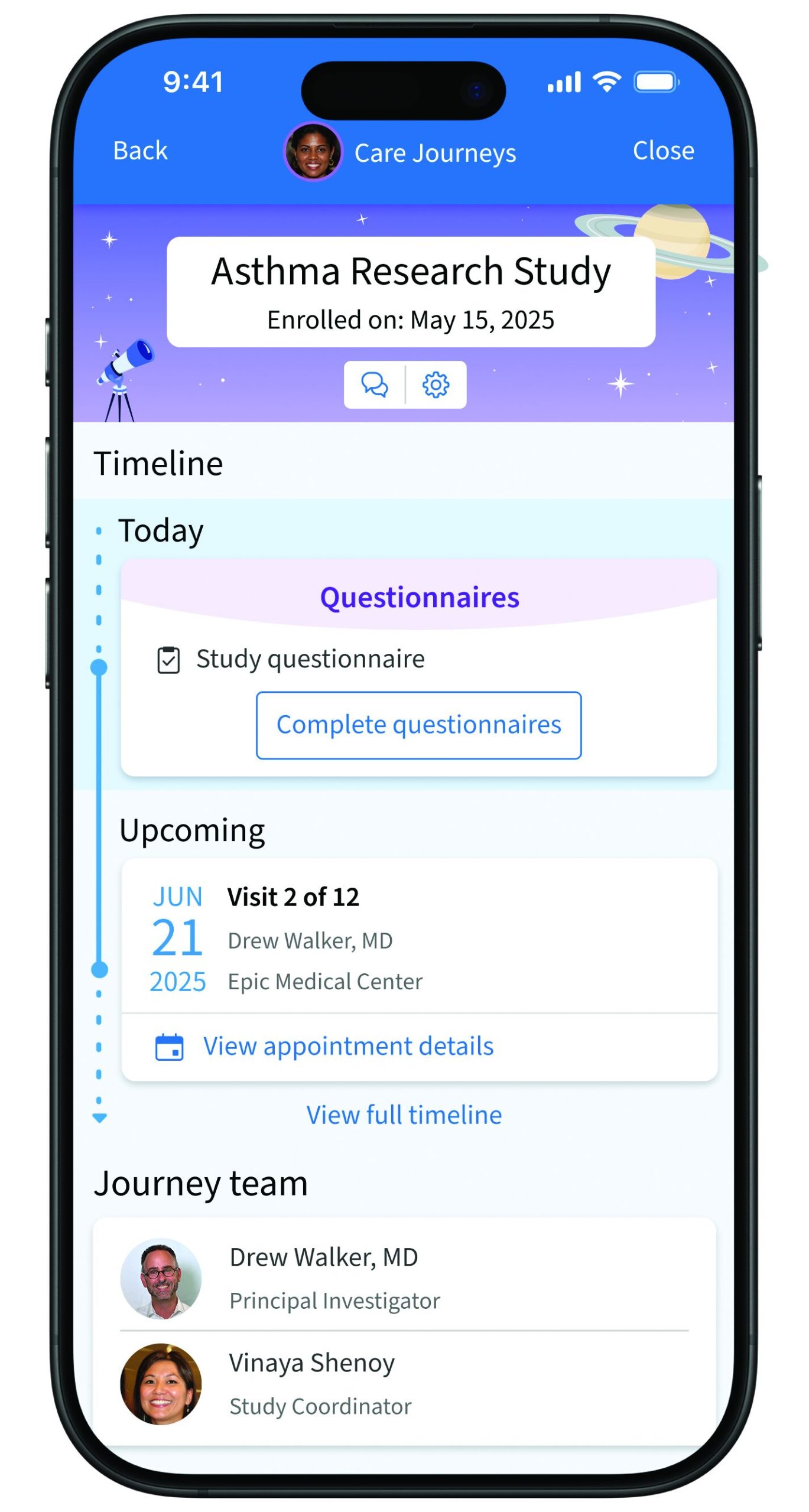
Epic Systems has become a market leader in the electronic medical records space by building and maintaining customer loyalty, and now customer feedback is playing a critical role in the development of its newest products.
Epic’s comprehensive EHR system is in use at 40% of U.S. hospitals, and its community consists of 2,900 hospitals, 65,000 clinics, 570,000 physicians and 280 million patients in the U.S., according to a Harvard Business School case study, “Epic: The Future of Health Information Technology,” published in March. A company spokesperson said the number of hospitals using Epic software is now 3,300.
Some of those customers want help with more than medical records technology, Epic leaders said.
Phil Lindemann, vice president of data and research, and Seth Howard, executive vice president of research and development for Epic, lead teams that are developing new clinical trial management and enterprise resource planning systems, respectively. A good deal of the design work came after some Epic clients asked the company to develop such systems.
“It’s important to understand that if you think about clinical research, or when a new drug is becoming available from a clinical trial perspective, the health systems that we work with are usually world-class health institutions — Mayo Clinic; Cleveland Clinic; and Stanford, Yale and Duke universities — and they are often the ones that are at the bleeding edge of care,” Lindemann said.
The most advanced health systems view clinical trials as a continuation of how they care for patients, he said. If one standard of care is not working for a cancer patient, they then look to clinical trials, and the best facilities think about how to create a great experience for patients.
“For years, our health systems have been providing that, and with us they have built some tools in Epic to help notify doctors when a patient would be a good fit for one of these trials,” Lindemann said. “Going back to the early 2000s, we had health systems publishing about how effectively they used Epic to help find these patients additional paths when there were really no more paths available.”
Fast forward to today and these health systems are still using Epic tools, but they’ve also had a separate clinical trial management system — not designed by Epic — which is used to manage each trial. Epic had been hesitant to develop its own version because it requires a significant development effort, Lindemann said, but after a continued push from customers, the company opted to pursue it.
While health care systems did the prodding, new innovations tried in these settings usually come from these systems’ partners in biotech, medical device, pharmaceutical or diagnostics companies, which typically serve as the financial sponsors for clinical trials.
Such companies “are making a new drug and they’re taking on significant risk,” Lindemann said. “They want to make sure everything is very safe and effective, so they have had this symbiotic relationship with all these health systems for decades. If done right, it’s also a revenue source for health systems who have extraordinarily low [profit] margins.”
Therefore, the clinical trial management stakes are high for health systems and for patients waiting for a breakthrough treatment, and data gleaned from Epic’s electronic health records can be of service when putting together a trial, Lindemann said. The value proposition over other products on the market is that none of them are integrated into the care experience for doctors, nurses and patients.
Epic would be the first to provide a completely integrated experience that also has the ability to communicate back to the trial sponsor eager to learn about a prospective drug therapy’s effectiveness.
“Our customers certainly think we’re the right ones to execute this, and there are a lot of reasons for that,” said Lindemann, noting that artificial intelligence is one of the patient identification tools being designed into the system for clinical trial matching. “The first thing to understand when someone is making a new drug is that they can’t just have that available at one health system.
“You have to have it at 20 health systems when we need to find 1,000 patients that have non-small cell lung cancer and have ‘X’ and ‘Y’ true as well,” he said. “That’s a small number of people, so they have to look across many health systems.”
In addition to finding patients, the components include forms, medications, financial, workflow information, scheduling (such as in Epic’s MyChart) and other modules built in to drive efficiency.
“What we’re saying is for those 20 health systems that are all going to be running the trial, it only needs to be built once and the information is available at all of those places,” Lindemann said. “So, imagine just for this one clinical trial, those 20 health systems almost act as one system, and from an IT perspective, with all the things they need to set up and coordinate, it’s vastly simpler.”
Enterprise resource planning
In its 45-year history, Epic has grown to a company with over $4.9 billion in annual revenue and 14,000 global employees with a customer-centric approach to business development. Its combination of unique and time-tested management, training and sales practices, and a suite of integrated software products has made it the go-to EHR vendor.
The same value of integration is true for enterprise resource planning, a business management system that integrates business processes and functions into a single, unified platform.
Epic’s Seth Howard said the company’s version will be a new suite of applications designed for health care in the same way its other products are, and it will be built on the same foundation as Epic’s EHR suite of products.
“When we go into a new area, our focus and philosophy is around building products using our own research and development staff,” Howard said. “We don’t acquire products and bolt them together. Everything we provide to our customers in terms of our modules is designed and developed by Epic.”
Howard said it will be integrated with Epic’s existing clinical revenue cycle and analytics applications, and artificial intelligence will be a key focus.
“In some ways you can think of it as sort of an extension of our EHR, although given the size of (enterprise resource planning), it’s quite a large extension, but that’s so it’s a little bit of both,” Howard said. “From a product standpoint, it will be a new suite of products.
“As you would imagine, it will span workforce, financials, supply chain, and all the individual applications within each of those areas,” he said.
Over the last couple of years, Howard said organizations had asked for help with such issues. Epic started developing some capabilities around the periphery of enterprise resource planning, and as it built software such as staff scheduling systems and materials management systems, it became clear that a better approach would be a comprehensive suite.
Howard estimates that last year alone, the ERP research and development team made dozens of trips to customer sites as part of Epic’s developer immersion program. They spent days shadowing Epic’s users to understand their needs in this new space.
“It sort of evolved into that over time based on the needs that we were hearing from our customers,” Howard said.
Harnessing AI
AI capabilities are being woven throughout all of Epic’s applications, both health record and resource planning apps. It will match staff preferences with available shifts, it might review time cards for potential issues before payroll posting, or predict supply shortages and then provide substitutions at the point of care, Howard said.
“There will be lots of capabilities that are powered by AI, but then the system overall will be integrated with an agentic AI framework that is part of both the EHR and ERP to bring together clinical, financial, workforce materials capabilities,” he said.
The term agentic AI, according to Howard, refers to modular capabilities in which AI systems can act autonomously and perform tasks for users. For example, one capability might be a scheduling capability that determines the best time to assist a patient to schedule an appointment. Another capability might be operating room utilization and another might be examining supply needs.
“There are these modular components that can then work together to perform certain actions,” Howard said. “Think of it in some ways like a digital workforce that’s working behind the scenes … interacting with users or directly with patients.
“By having AI components that can work together across all the different applications, it helps to automate processes and streamline work that users need to perform,” he said.
While Teamwork, the ERP scheduling system, is already available, other elements of the ERP products and clinical trial management system will be available later this year and in the near future.
Competitor concerns
Epic’s move to take on more elements of the hospital management process has some competitors crying foul. The company has been sued twice in recent months, most recently by CureIS Healthcare, a company that offers software for managed care organizations helping administer Medicare, the federal government’s health care program for senior citizens, and Medicaid, its health care program for economically disadvantaged Americans.
According to a civil complaint filed by CureIS in a federal court in California, Epic has instituted an “Epic-first policy” in which those using Epic’s electronics health records software must also use Epic’s versions of other products if it has a version of the product in question.
The lawsuit also said Epic has a practice of misrepresenting to customers that it either has plans to roll out a version of a competitor’s product soon, or that Epic has a current product that replicates the functionality of a competitor’s product.
The lawsuit accuses Epic of specifically targeting CureIS and says the company “coerced” shared customers to “terminate their relationships with CureIS, denying CureIS’s customers access to their own data.”
Epic has refuted those claims, noting that its customers are in the best position to choose the right products to meet their needs.
In Business Madison interviewed Lindemann and Howard before the lawsuit was filed, but both of them stressed that customer service is the company’s primary motivation for developing new products. Howard said development of the ERP product is a natural progression of the work Epic has done in the past.
“It’s interesting that the growth of this product has been sort of a natural extension of ways in which our customers have needed our help in other areas,” Howard said. “We see this as a natural progression from some of the areas that we’ve already started working on.”
Correction: An earlier version of this story incorrectly stated the number of hospitals using Epic software.

