
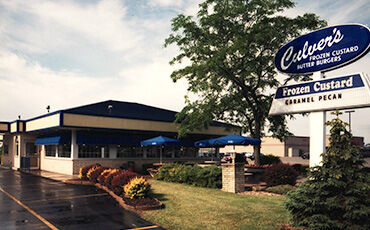

Craig Culver looks back on his family restaurant’s 30 years with great pride. “I had a grand plan,” he laughs. “I thought we’d operate one restaurant and live happily ever after. But I almost didn’t make it that first year.”
In fact, his family pulled him through. “Financially, I didn’t have the wherewithal,” he admits, “but they believed in me and my wife, Lea.” A stranger to the word failure, it was probably the only time in his life he came close to becoming familiar with the term.
“I had people around me in that first year assuring me that they’d do whatever it took to get to the end of the year. They were there for me. I lost lots of money but kept after it.”
Things got better in the restaurant’s second year, when it broke even, and by year three, Culver’s was well on its way and pulling a profit.
Culver’s started its franchise arm, CFSI, in 1987, and three years later, the first successful Culver’s franchise restaurant opened in Baraboo. Between 2000 and 2007, more than 40 restaurants were opened each year.
Then, the economy collapsed.
Now 500-plus restaurants and 25,000 employees strong, Culver’s blue-and-white signs can be found in 21 states and are quickly multiplying coast to coast. The franchise remains on track to open 35 restaurants this year, the most since 2007.
|
George and Ruth Culver’s A&W restaurant, in Sauk City. In 1984, the restaurant was converted to the first Culver’s Frozen Custard and ButterBurger location. |
“Our growth isn’t that fast in comparison to others,” insists Culver. “We’ve grown at a controlled pace.”
In fact, that was one lesson he learned the hard way, after trying to grow too fast in the 1990s. “I think we opened 14 restaurants in one year when I wasn’t ready with people,” he said. “We had to slow down and actually stopped franchising for about a year until we had the infrastructure in place.”
With hundreds of restaurants now and more on the way, is there a limit? “No,” he answers. “It could all end today and I’d be fine. But my dad once said, ‘Culver’s is not about how many, but how many good restaurants we have.’ We grow organically.”
The early years
It all started in the family kitchen. “My mom was a great cook,” Culver said. In fact, his parents, George and Ruth, owned several restaurants over the years: a Sauk City A&W; the Farm Kitchen in Devil’s Lake, where Culver met his wife, Lea; and the Ritz, a supper club in Baraboo.
In 1968, George and Ruth sold the A&W on a land contract. Years later, they were excited to be able to buy it back. The family then defranchised from A&W, renovated the space, and opened the first Culver’s Frozen Custard and ButterBurger restaurant on July 18, 1984.
While Culver will always credit his mom’s cooking — she’d spread butter on hamburger buns and grill them until they were crispy — he admits the name ButterBurger wasn’t an original one. There were others that used the term before him, like Kroll’s in Green Bay and a Milwaukee establishment as well.
(Continued)
As Culver tells it, he and a friend were sitting at the Ritz in Baraboo one night discussing Milwaukee’s penchant for attracting excellent, drive-in food establishments. “He told me about a butter burger served at the Milky Way in Milwaukee, and a light bulb went on,” Culver said. “When we got the A&W back, that was my opportunity.”
The Culver’s menu isn’t all about the ButterBurger, however. It’s also about staying relevant. Customers searching for other options can order salads, a chicken sandwich, or a veggie burger. The company is also testing a gluten-free bun.
Menu for success
But any way you slice it, the company’s mainstays remain burgers and custard. In fact, its ButterBurger and fries have never sold more. “People want good-tasting food,” Culver said. “They know they can have their salad once in a while.” Last year alone, the restaurants served up 40 million pounds of french fries, 20 million pounds of ground beef, and 16 million portions of cheese curds.
Yet its main ingredient for success isn’t any of those.
“It’s people.” he insists. “It took me years, honestly, to realize how important our people were. That’s the true magic of the business.
“I’m a food guy. I love great food. But honestly, I found out that that’s the easy part. It’s easy to make great food, but when it’s served with pleases and thank-yous from the heart, it becomes an experience, and customers want an experience, not a transaction.” That, he insists, is what separates Culver’s from the rest of the fast-food world.
He bristles at the suggestion that young kids today may not be looking for long careers in fast food. “I don’t believe that at all,” he says. “Leadership makes the difference. If you have top-notch leadership, you’ll get a top-notch experience. And leadership attracts positive people.”
And what about compensating those positive people? “I’m not a minimum-wage guy,” Culver answers. “I don’t believe in it. I want to compensate my people fairly.
I think of us as the employer of choice. It’s more than just serving burgers and frozen custard. It’s about being a good person.”
Asked if he has any thoughts of retiring anytime soon, he replies quickly with a “no.” He still has things to do, and a very clear vision of what he does and does not want the company to become: “I don’t want to be one of those places were you self-order, all on an app. I want personal interactions between our team members and our customers,” Culver says. “That’s our competitive edge. It’s part of the past, yes, but I don’t ever want that to change.”
Personally, Culver is in a good place right now. The 64-year-old says he feels like he’s 40. “I hope to be around for a long time.”
He wants the business to be around, too, and hopes his three grown daughters, who attend company board meetings, take a more hands-on role in the future, joining him and Lea, side by side. “That would be like a dream come true,” he admits.
Culver is especially proud of the Midwestern values and work ethic he says Culver’s has been able to spread to other states over the past three decades. “We export people. We have exported so many Wisconsinites across the country, and they take that culture right along with them.
“We’ll get cheeseheads to our ribbon-cuttings. Once in a while, we even get a Bears fan.”
Click here to sign up for the free IB ezine — your twice-weekly resource for local business news, analysis, voices, and the names you need to know. If you are not already a subscriber to In Business magazine, be sure to sign up for our monthly print edition here.

