

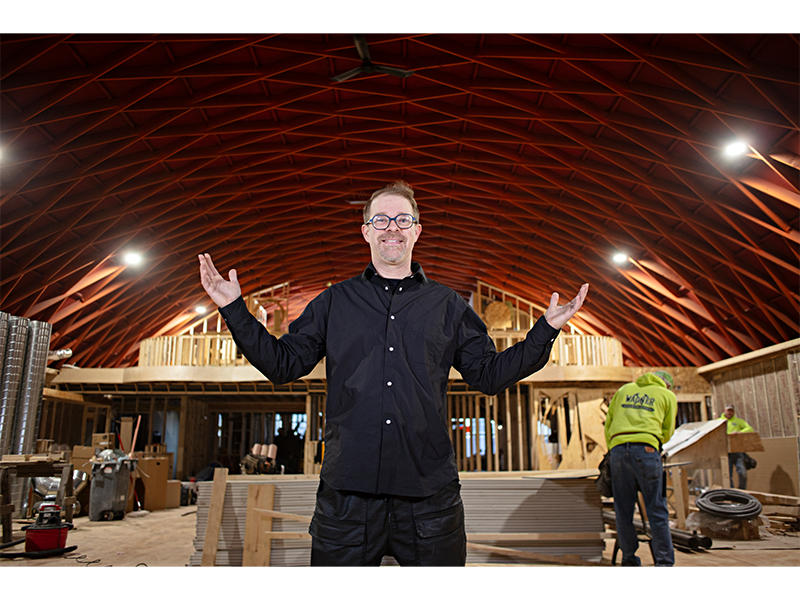
An almost century-old Madison building at 1925 Winnebago St. sings its history through a vaulted roof, its interlocking timbers painted by an artisan just before his death. Once a sanctuary for the 1,000 parishioners of the Madison Gospel Tabernacle, the sweeping space has been transformed by young people pursuing a new beginning.
The vision for the future Atwood Music Hall began with Toffer Christensen, co-owner of neighboring event venue the Bur Oak. He saw the project’s potential to fill a gap in the community cultural scene — creating a facility grand enough to accommodate large crowds but sufficiently flexible to suit smaller gatherings — and provide collaborative opportunities with organizations that prepare youth for diverse career paths. One of these organizations is Operation Fresh Start (OFS), a nonprofit that offers education, mentorship, and employment training to young adults, which was housed on the site from 1980 to 2018.
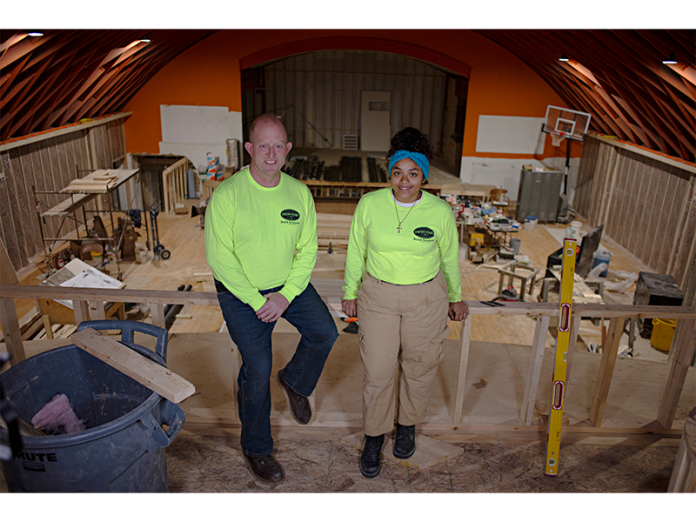
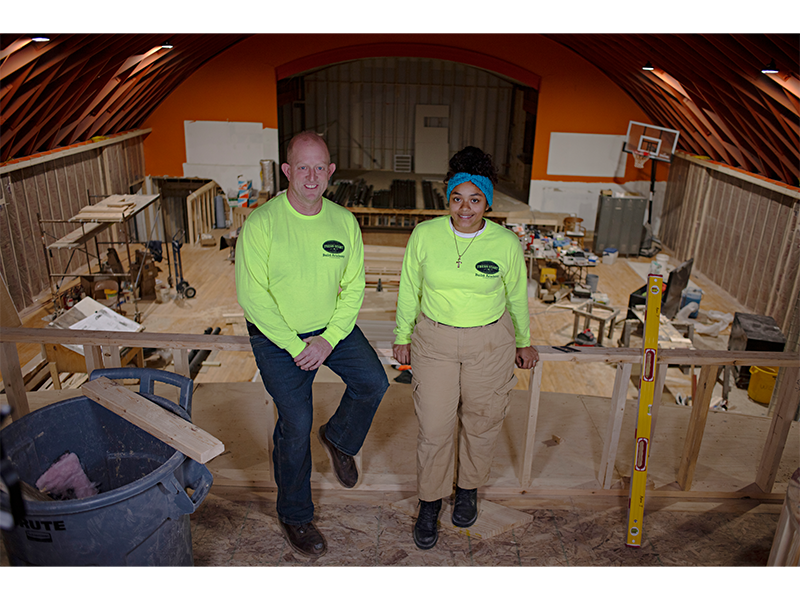
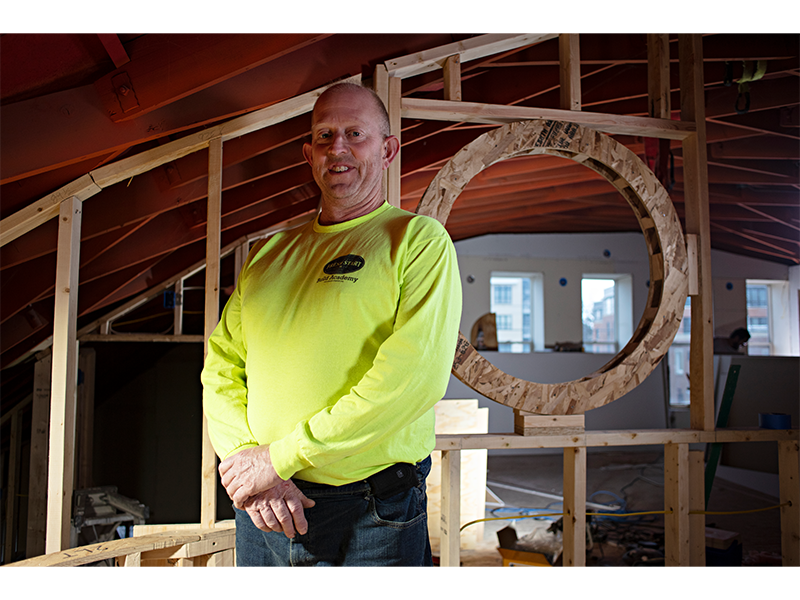
Students from OFS’ roughly three-year-old Build Academy program helped lay the groundwork — literally — for the new event space as part of their training for work in the trades. The fruits of their labor, and the efforts of onsite professionals, will be an asset to community culture and a boon to area workforce development.
“When we launched Build Academy, our goal was to open doors for young people into the trades, and provide a pathway to meaningful … careers,” said Brian McMahon, OFS’ executive director. “What’s cool about this is we couldn’t have imagined a better scenario than seeing … emerging adults who are training, working on a building that once housed our mission. So it’s truly a full-circle moment.”
OFS has strong ties with Threshold Builds, the architect-led design-build firm spearheading work on the Atwood Music Hall; they’ve collaborated on other commercial projects in the past and have more in the works. The nonprofit also has history with Jake DeHaven, whose company, DeHaven Design Build, is one of three collaborators under the Threshold umbrella.
“I go back a decade or more with OFS. My aunt was a big part of that [organization], and so I was always really fond of the mission,” DeHaven said. “These young participants bring so much energy, and they’re clearly very interested in the industry.”
DeHaven also formerly owned the Bur Oak with Christensen and noted the Atwood Music Hall venue is one he’s “been orbiting around for… years.”
Building a career
The project’s extensive renovation work was the optimal springboard for Build Academy participants, youth ages 18–24 who receive multiple tiers of training.
Build Academy director Steve Gardner said students enter the program focusing on “mental toughness,” tool safety, work ethic, and preparedness.
Tier One offers an opportunity to work on residential sites under the guidance of a supervisor, build key skillsets, complete OSHA and CPR/first aid training, and receive support in areas like financial literacy.
Tier Two provides work experiences in commercial settings, with new challenges like required deadlines and quality control, an exposure to a variety of fields, and the ultimate goal of placing participants in a local construction position.
“It’s a great pathway for a young person to have a career, not a job,” said Gardner. “They want something good, they just need some folks to help guide them, and get them there.”
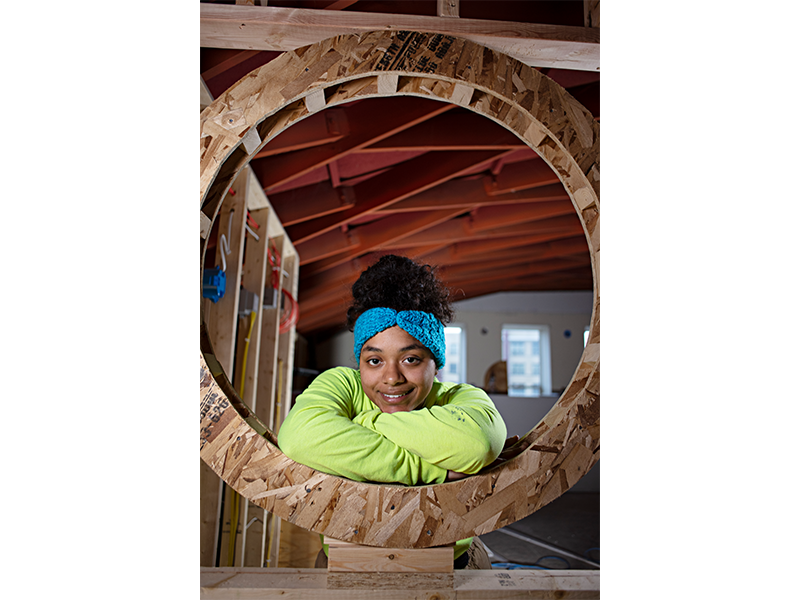
Build Academy participant Jamyia Rex-Dean, a former certified nursing assistant, said the program helped point her in “the right direction” and realize her dream of working in construction. “It just helps me better myself. … I want to stay in this field for as long as I can.”
She also believes the program helps raise awareness of career options that defy traditional gender roles. “I’m a girl, and most girls don’t see themselves in construction. I would love to be that face.”
McMahon said the Atwood Music Hall project represents more than a renovation to OFS. “It’s a real-world classroom where our Build Academy participants can apply what they’ve learned and see the impact of their hard work. These young adults are not just building a venue, but they’re building their futures at the same time.”
Gardner said Build Academy participants gained hands-on experience in several skill areas working on the future event space — “a bunch of demo, some reinforcing of the floor … some footings, put beams in, all sorts of work” — and that projects like these are intrinsically rewarding.
“[The participants] come sometimes from paths that didn’t allow them [success], but this is something that no one can take away,” he said. “They can always be proud of it.”
“[The Atwood Music Hall] was actually my first site that I went on in OFS,” said Rex-Dean, who was surprised by the skills she developed and the total transformation of the venue. “It looks completely different now. There’s just so much more to it. … I also learned how to put up drywall, which I never knew.”
Form and function
DeHaven said the project is unique among event venues, which he and Christensen found to be saturated with a homogenous, industrial style and plagued by a consistent conundrum: Due to high financial overhead, large venues often cannot support local acts likely to draw small crowds, and small clubs are quickly outgrown by acts that may not know where to go next.
“Toffer wanted to go the opposite direction,” said DeHaven, implementing “softer, warmer lights, lower lights” in a high-end, state-of-the-art space fit for rising stars and local bands.
DeHaven said the “blank slate” workers encountered in the project’s early stages left room for creative freedom, while the dramatic ceiling provided inspiration.
“We right away wanted to use that ceiling as sort of our north star in our design and really protect it,” he said.
Rounded walls were fabricated to complement the ceiling, and its painted beams dictated the interior color scheme. Curves implemented throughout the architectural design mirror the forms of sound waves and the ceiling’s dramatic arched vault.
“It was built for a church,” said Christensen. “They would have close to 1,000 people in this building for Sunday services. It worked really well for gathering, so we feel that the architecture of the space will obviously lend itself very well to music, or comedy, or arts presentations that we’re going to put on stage.”
Renovations also focused on “cutting-edge” sound quality — minimizing the sound that can escape the building during performances, and maximizing sound quality within. It was technical work, and DeHaven describes the sound system as “one of the most sophisticated” he’s worked with.
Both the form and the function of the Atwood Music Hall are designed to accommodate a range of future uses.
“The majority of the space is wide open, about 3,000 square feet of flat floor,” said DeHaven, adding that there will be accessible bathrooms and a 150-person balcony with “some of the best seats in the space.”
There will also be three bars. “If there’s 700 people in the room, you have to serve that many people, but Toffer also had a real desire to have the space work if there were 200 people at a local show,” DeHaven said. “Rather than having one really long, 60-foot bar, we have separate ones. The space can kind of ramp up and down.”
A community space
While construction is well underway, the timeline for completion is tight, and the project’s overall cost has topped $3 million. “It’s the most ambitious project I’ve ever been a part of,” said DeHaven, “but we’ll be open by June.”
Christensen said renovations — representing $2 million of the total investment — are on-schedule, and that Atwood Music Hall’s first show is booked for June 13, a Friday night. About a dozen other shows are scheduled to follow.
There’s a lot the venue has already brought to the community, and more is planned.
Christensen is partnering with the Goodman Community Center to develop a new program called Students of Live. Over the course of eight weeks, high school students from Goodman’s Lussier LOFT program, which supports student success at school, home, and in the community, will have the opportunity to learn about the live music industry.
Sessions will explore topics like scouting talent, booking shows, technical aspects, and more, culminating with the students putting on a show for the public.
“Students of Live … could be a revolution of some kind in our city in terms of people’s interest in participating in music,” said DeHaven. “Music venues, in a lot of ways, they’re kind of the heart of an interesting city. A lot of cities have restaurants and bars and churches, and I always think a measuring stick … is the culture component.”
“The intention from the beginning [was] just to have it be a community space,” said Christensen. “Yes, we’re a for-profit business, and yes, we’re going to do concerts, we’re going to do weddings, but we can enrich the community at the same time.”

