

From the pages of In Business magazine.
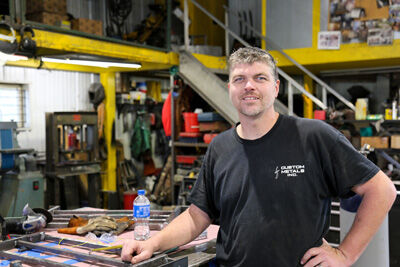
Driving down a country road on the outskirts of Madison, a collection of farm buildings seem an unlikely place for a custom welding operation, but that’s where we find Stephen Grant, 41, shop foreman at Custom Metals Inc.
With the peaceful surroundings providing a gentle backdrop, it’s instantly clear that projects created here are as much about art as function.
Inside the open-air metals shop, Grant and other fabricators weld and transform various pieces of metal. Grant has been a welder most of his life, but found his true niche seven years ago when he joined Custom Metals and moved from the production side of welding to fabrication.
|
Steel rods are pounded, stamped, or scrolled before being welded into a railing panel. |
There’s a distinct difference, he explains. “Production welding, which seems to be in high demand, is repetitive and for me not that appealing. I’ve done it, welding hundreds of parts together at various companies, but it was not really what I wanted to do with my career.”
What he wanted was to be able to start a project from scratch and take it through completion, rather than work on a fraction of something he would never see.
He landed in the right place. Business at Custom Metals has steadily increased by about 30% per year. In 2015 the company completed 365 projects, up from 323 in 2014 and 267 the year before that. Most of the work involves staircases and railings, but the possibilities are endless.
Getting jiggy with it
On a typical project, a CAD design is created before materials are cut to size and the welding team builds any necessary jigs — or forms — that will be used to mold metal into required shapes.
To demonstrate, Grant fires up a propane-fueled forge. Several 17-inch rods of pot-rolled steel will heat up inside until their ends glow red, which takes just a few minutes. He removes one rod, locks the hot end into a pre-formed jig at a worktable, and then uses his body weight to pull and twist the pliable metal around the jig to create a scroll shape. Almost immediately, he immerses the piece in a tub of water to cool before reaching for the next rod. All told, the process probably took less than a minute.
Once the various design elements are completed, the parts are welded together and in this case a railing panel begins to take shape. After welding, the piece will move on to an on-staff finisher who will grind the welds so they are virtually invisible. Depending on a customer’s wishes, the pieces may also be pounded with an air hammer to create a rustic or more artistic look before paint or patinas are applied.
Just barging through
At his worktable Grant shares an architectural drawing of a massive four-story staircase the company recently built and installed at an area business. The freestanding project took three months to complete and included 56 railing panels and more than 700 forgings (scrolled metal pieces). After completion, each 14-foot section of the staircase weighed between 3,000 and 4,000 pounds, Grant reports.
“Staircases go from paint to installation,” Grant explains. “Sometimes, the installs require six of us. A lot of the custom work we do is for lakefront properties, and it can be a challenge to get a staircase down a hill.” He recalls one installation at a lake home near a steep embankment. “We had to rent a barge to get the railing to the house,” he laughs. “Installations can be harder sometimes than fabricating, but it’s very important when you start a job to see it through completion. It does a lot for your psyche.”
(Continued)
These are not inexpensive projects, but Custom Metals takes on requests of all shapes and sizes. A surgeon once brought in a selection of eight different titanium knee joints and asked the company to attach handles to them so they’d be easier to work with. Another woman asked for a weld to repair an heirloom lamp, and then there was the fossil collector who asked the company to create bronze table bases for some of her most prized possessions.
“It’s just so exciting,” Grant says. “Every day I have a general idea of what I’ll do, but someone might walk in the door and change everything. It’s really rewarding work. Many times our creations are the crowning jewels in these homes or businesses.”
One customer wanted a door pull to match the rest of her cabinetry, just in a larger size. The company also makes countertops and bar tops, gates and fences, fireplace grates, and even walls such as a stainless steel version at the Chazen Museum of Art. Grant has also noticed an uptick in requests for high-end furniture and range hoods.
Of the various types of metals that can be welded, Grant particularly enjoys working with pewter because of its ability to “melt like butter.” The secret to a good weld, he notes, is the penetration on the two pieces of metal being joined. “You want a pretty weld so when you grind it out it disappears.”
As shop foreman, a part of his job is mentoring the other welders in hopes of instilling the same passion in them. “It’s the biggest challenge but also the most rewarding,” he says. “I like seeing them take what I might show them and turn it into an ah-ha moment.”
Fire and light
In many cases, that’s how he learned. As a youngster in Oxford, Wis., he watched his father fabricate trailers and equipment for people as a way to supplement his income as a school bus driver. “The welding fascinated me,” Grant says. “The fire and light.”
Fast forward to young adulthood. Grant was working in restaurants and enjoyed cooking, but he didn’t see himself as a career chef. So at the age of 20 he moved out to South Carolina where he lived with his brother, attended tech school, and searched once again for that fire and light.
Upon his return, he spent four years as a production welder at Electronic Theatre Controls before taking a job with a Lodi company that made stainless steel food- processing equipment. “That’s when I really learned how to weld,” he states. “We’d weld commercial smokehouses out of food-grade stainless which was very smooth. It was a game for me. I’d try to make each new weld better than the last.”
It’s all very relaxing to him. “When my helmet is down, all I’m thinking about is that weld. It’s calming. I’m just focused. I like the fact that there are very few people who can do this work to that caliber.”
He really enjoys seeing the fruits of his labors. “At the end of the day, it’s about creating something for a customer that is really beautiful and seeing how much they light up,” Grant acknowledges. Suddenly he gets emotional, choking up as he says, “I have the greatest bosses and owners a guy could ever ask for.”
Click here to sign up for the free IB ezine — your twice-weekly resource for local business news, analysis, voices, and the names you need to know. If you are not already a subscriber to In Business magazine, be sure to sign up for our monthly print edition here.

