
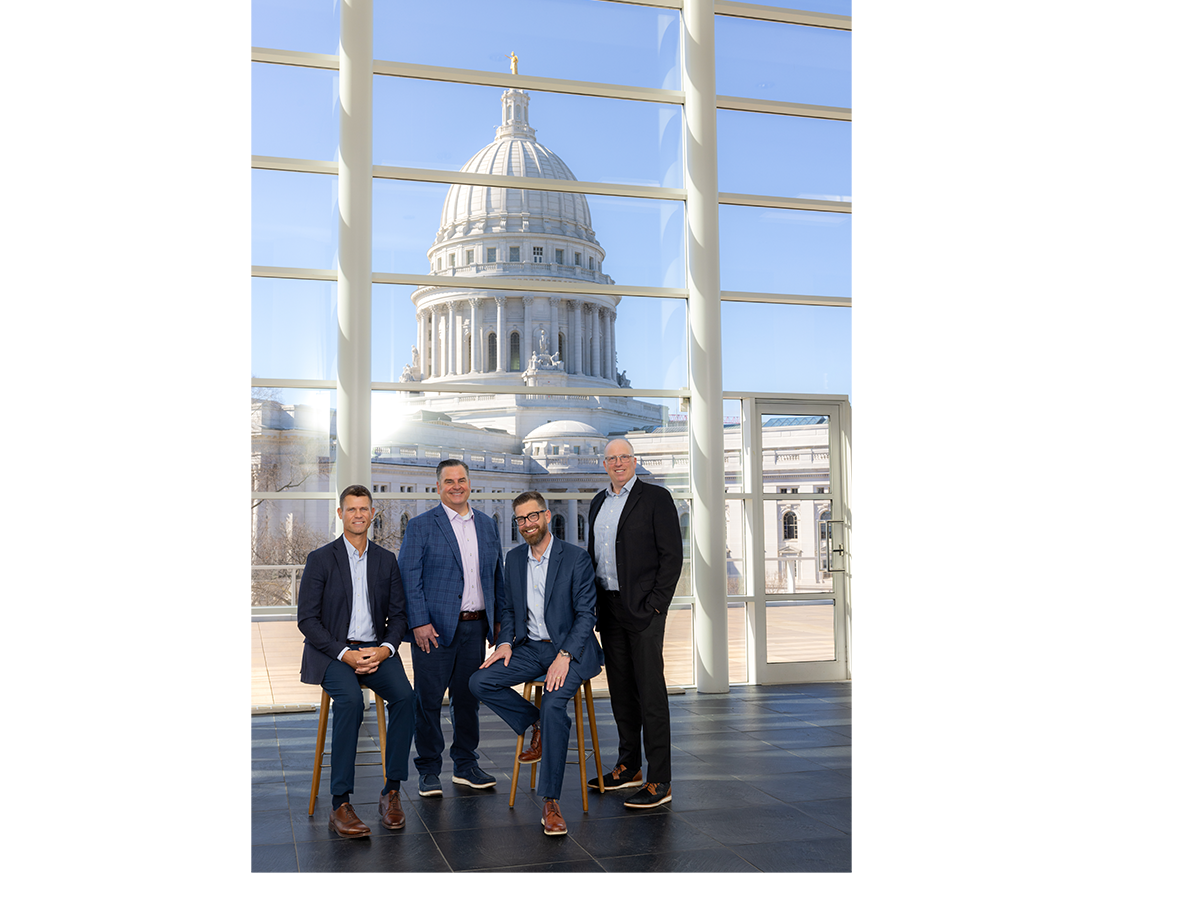
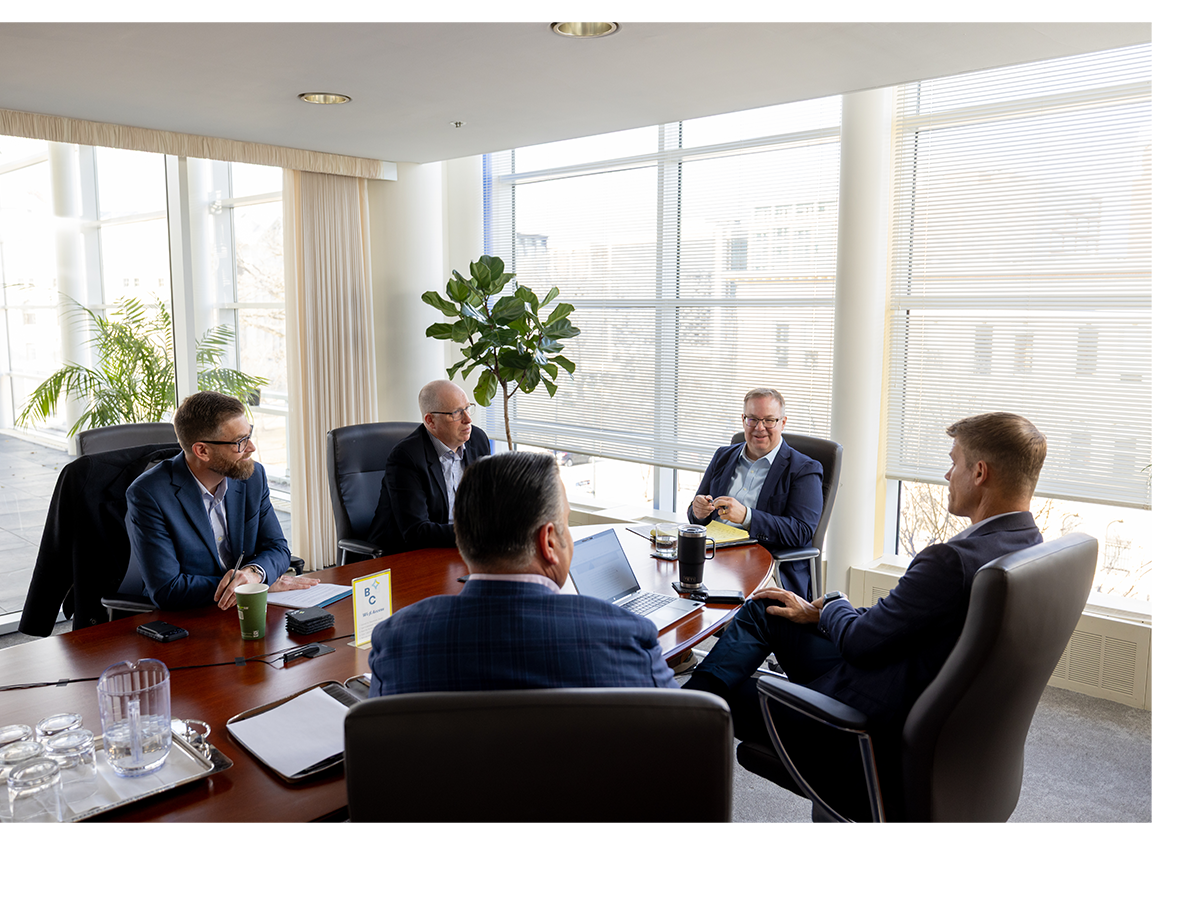
There’s no better setting to explore the state of building and development in Wisconsin’s capital region than in the shadow of the state capitol building in Madison — a city that often sets the agenda for the rest of the state. On a crisp and sunny Monday morning in February, In Business gathered four construction, development and legal experts from Dane County at the downtown offices of legal firm Boardman Clark for a far-reaching discussion about everything from the region’s burgeoning workforce development pipeline to the lack of commercial development in Dane County to how is AI reshaping the construction landscape. What follows are edited highlights of the approximately 90-minute discussion.
PANELISTS:
• Patrick Baldwin, principal/president, Advanced Building Corporation
• Tim Cleary, executive vice president, Ideal Builders
• Jamie Radabaugh, attorney, Boardman Clark
• Christopher Tatge, president, DC Materials LLC
MODERATOR:
Michael Popke, contributor, In Business Madison
MULTI-TENANT COMMERCIAL DEVELOPMENT
POPKE:
In Madison, one of most noticeable developments in recent years has been the slowdown of new office construction. The focus is clearly on residential development. What will it take for commercial construction to start getting more of the attention it deserves?
RADABAUGH:
My sense is that office development is still a long way from correcting itself. I chatted with a few brokers, and they laughed when I asked if they’ve considered a new office building project. They mentioned the potential for standalone office construction, but nobody is speculating on a multi-tenant development.
[Commercial real estate data and analytics company] CoStar predicts that office vacancies nationally — which peaked last year at more than 14% — will plateau this year. More locally, the Commercial Association of Realtors Wisconsin reported four new projects representing 67,000 square feet broke ground in the fourth quarter of 2025 in southeastern Wisconsin.
BALDWIN:
I agree that multi-tenant, spec-building office space is still a ways out. Because of the way people work — whether part time in the office or full time from home — the demand is just not there. You’ve also got to consider what’s happened with construction costs since the pandemic; you need to increase rent to cover those increasing costs. People are downsizing their office space as leases come up for renewal.
There’s some remodeling, and as Jamie said, people are building new office space for their own use. But when you talk about commercial construction, there are other markets to consider: flex space, industrial, warehousing, distribution. It would be nice to see more thought and planning for those types of opportunities throughout Dane County.
CLEARY:
Currently, there aren’t any speculative office projects under construction in Madison. We still trend better than the national average in terms of vacancy, but we’re still at a 17% vacancy rate, according to Broadwing Advisors. Historically, office construction has been a large portion of our business, but we’ve been focusing more on high-end tenant improvements, healthcare and hospitality.
Vacancy rates are starting to level out, and I think part of that is just company leaders figuring out, “Can we truly adopt to remote workplaces or not?” They sometimes lament company culture isn’t as strong with fewer people in the office, but they have to kind of thread that needle. It’s going take time for more people to say, “Boy, we went back to being in the office and here’s how it made a huge difference for us.”
TATGE:
It’s just math, right? You’ve got developers who have plenty of time to work on their spreadsheets, understanding potential returns on potential investments, and none of them are focused on office right now. Obviously, rent needs to increase and occupancy needs to increase for any of it to be viable.
In Madison, multifamily is working out, but it’s just barely penciling. Half the jobs I see go out to bid don’t start. I do think that tide is changing; I’m seeing a lot of plans from two year ago come around again, and this time, they have financing in place. New office construction is just not going to happen until somebody can make money putting it up.
DATA CENTER DRAMA
POPKE:
We recently saw the Village of DeForest shut down plans for a proposed $12 million QTS data center, which would have involved the annexation of more than 1,570 acres of land from the Town of Vienna. How do you feel about the push for data centers in Dane County? And how do those efforts affect the local construction and design sector, for better or for worse?
BALDWIN:
I have mixed emotions on data centers. I don’t know if they’re a real drag on a community. To me, they seem like a tax base that’s going to pay a lot of property taxes and not necessarily use a lot of services. But from a construction standpoint, it does spread our resources thin, and it’s a drag on land that has the potential to be developed for other uses. Concrete and steel are resources that are going to be in big demand with those kind of projects, which could mean cost increases for the rest of our projects. Same with labor; they’ll draw from the local labor pool of subcontractors.
TATGE:
There’s increasing strain on the subcontractor base right now. DC Materials has the strongest [project] backlog we’ve had in the last five years. I’ve got general contractor customers coming to me asking for other referrals, because our guys are just too busy. There’s a backlog of projects that have been ready to go, and all the economic forces are pushing them to go now. That’s why we’re seeing a lot of strain on our labor availability. So I wouldn’t be surprised to see prices start to appreciate from subcontractors very soon.
POPKE:
Is that directly related to the data centers, or do you think there are other factors at play?
TATGE:
Things that weren’t penciling a year ago are penciling now. Everyone has sort of tightened their pricing and sharpened their pencils. I can speak very specifically to lumber: I spend millions of dollars on lumber a year, and lumber costs are at an all-time low.
BALDWIN:
Even with the tariffs?
TATGE:
Even with the tariffs.
CLEARY:
This can be a polarizing topic. And as leaders, sometimes we have to be careful with how we communicate on this topic. On one hand — and I’m going to paraphrase Coleman Peiffer, who leads the data center analysis for Alliant Energy — we don’t have a data center that’s gone up here and don’t know the impact. There’s concern about environmental impact and loss of farmland, water use, and potential implication of rates, which leads to opposition to data centers, and maybe those reasons are just. The other side of the equation is [a data center’s] applicability to additional revenues and jobs. There’s little known about what a data center is and what it means to a community.
In the end, if that data center that was going to go in DeForest winds up in a different community, it will be really interesting to see what that means 10 or 20 years from now. I hope we figure out, socioeconomically, what the true impact is. What is the environmental impact of data centers? I’d love to find the truth in all that, and it probably won’t happen until we have a data center built in Dane County.
RADABAUGH:
I’m thinking of Amazon, which had a big surge during COVID that’s maybe slowed down in recent years. Maybe we could use the same analogy with data centers. There’s going to be a push for these AI data centers, but then that technology will probably catch up and plateau.
For the proposed DeForest project, I thought QTS picked a pretty good spot [west of Interstate 39/90/94, along County Highway V]. That’s in about as ugly a place as you can get in Wisconsin, right? I understand the objections, but the activity level would be nowhere near what it would be having a Costco go up.
I used to be a real estate attorney for Menard’s, and no one wants a Menard’s in their backyard — until it’s built. Then you get banks and restaurants going up, with people making millions by selling their land next door. Obviously, with a data center, people aren’t going to come and develop around it. But like Tim said, once one is built and we can see how it operates, the fear might go away. Maybe QTS could’ve done a better job illustrating what their data centers look like in other communities.
EARLY PARTNERSHIPS AND COMMUNICATION
POPKE:
This next question is one we had last year, and it’s still relevant: What is the value of selecting partnerships early in the design and construction process?
TATGE:
This is really where our company has found the most success — and where we’ve been able to differentiate ourselves from our competitors. We’re a lumberyard owned by framing contractors, so we’re expert carpenters. You’ve got very apt architects and engineers working on project plans, looking at them the way architects and engineers do. But when I get a plan, I look at it the way a carpenter looks at it: constructability. I also look at it the way a lumberyard looks at it: materials.
I understand the potential materials that I can swap out to add value to or save cost on that project. The most expensive thing in construction is risk. If I’m doing business with a new general contractor or partner, I don’t know exactly how that partnership is going to go, how smooth it’s going to be. Very early on, when I’m working out all the details, I’m mitigating risk at no cost to either party. It’s just my time invested. And if the job ends up going my way, great. So if you can identify and select partners early in the process, you’re going to save so much time and headache once the job actually goes.
The most important thing a GC can do is find really good trade partners and subcontractors to work with — to bounce questions off, to clarify things. We’ve had the opportunity on 200,000-square-foot buildings to do a wood species substitution and save $20,000. Partners bring very particular expertise, because all the things that are obvious to me aren’t necessarily obvious to a general contractor.
POPKE:
Everything you said makes total sense and seems obvious. Do you find that you have to educate people about that?
TATGE:
We spend a lot of time teaching, educating, and talking about how we’re different. Some of it can come off as sales-y, and some of it is. But bringing professionalism, and building that trust with general contractors, is really a great differentiator. I’m always competing with folks who don’t want to put in the time, who are willing to put a smaller number at the bottom of the paper.
RADABAUGH:
I’ve worn a lot of hats: construction partner, design partner, what have you. Menard’s brought their own design and construction teams, and their own supplies, for building their stores. But we also had great relationships with general contractors. We did a lot of store remodels, so we got to know subcontractors, architects and engineers, and that saved a lot of time and money — because then you can trust folks to tell you where mistakes are, whether in the design or in the ask for the tenant. A legal team can help by making sure you don’t go down the wrong path on a document or help identify risks, like “This community can be difficult to work with, but that community would love to have you.”
POPKE:
And some of those vital details don’t get sorted unless there are early conversations. Sounds like communication is one of the key reasons to encourage early involvement for all parties.
CLEARY:
Early communication, but also early partnership. Find your partners early in the process. Let’s assume that you’re going to build a $30 million building. There are two ways to go about it. One way is you select your architect, complete the design process with them, resulting in a set of drawings. These drawings are then used to receive bids from general contractors. Sometimes the selection is made solely on the proposed budget. Proposals aren’t always an apple-to-apple comparison. Think about it — in our personal lives, do we select the low-cost doctor, attorney, or accountant? No. Those are mission-critical things. Yet sometimes, when a business is making the most important investment it’ll ever make — in a hard asset like construction — people look for the cheapest route.
Madison is blessed with unbelievable architects, engineers, real estate brokers, contractors, subcontractors — men and women who are as competitive here as they would be anywhere else in the country. So instead of the process I just described, where you’re not able to capitalize on all of that knowledge and focus on the number on the bottom of the page, build a team that works together collaboratively. You just heard Chris talk about how swapping out a material on a project could save $30,000. That’s true of many project details.
BALDWIN:
We go out and meet with people and try to educate them on our process. Remember, this is not what they do for a living. They’re a manufacturer or they’re a retailer or whatever. We try to be extremely responsive and transparent and lay out as many things as we can: “Here’s what we envision your facility will look like, how it could be built, what the budget is, what the timeline is, the pricing set, the permitting process.” The construction part is sometimes the easiest part to control; it’s everything on the front end that can get out of control — especially in Madison and surrounding communities where that permitting process can be a little hard to push through.
Like Chris and Tim said, getting all the feedback and input you can along the line is a huge benefit to the overall success of your project. We see so many times, especially in municipalities, that people have competitive bid requirements. There are ways to work around that, by partnering with some sort of design-build firm to work through those bid packages. But a lot of times, municipalities hire an architect and spend $1 million on a set of plans, take a year to develop those plans, and put them out to bid. And then the bids come back three times what their budget is.
POPKE:
It sounds like the challenge for all of you, in one way or another, is getting clients, to understand the differences between processes…
BALDWIN:
Yeah. Like Tim said, a lot of them are going to default to, “We’re trying to find the lowest number.” And I don’t know if that’s always in their best interest. We were looking at a hard bid that happened a couple weeks ago in a municipality. There were three bids that were almost exactly the same, and one that was $2 million less. I don’t really think the one that’s $2 million less is the best route, because they’re going to look for ways to make up for that low bid throughout the course of the project. And it’s going to be a fight all the way through.
TATGE:
I think one thing that’s worth noting in this discussion is oftentimes, general contractors are working with developers who need to get to a specific number for the project to go. So you put in all this time and all this work, and if you can’t get to that number, there’s no project.
The alternative to that is really good communication. One thing I ask is about a project’s financing. Does the developer have their cash lined up? Have they built a capital stack for this job? I’ve had GCs in the past who have done a lot of work, put in a lot of time on projects, and then when it came down to it, the money was not there to make the project go. I’ve had the opportunity to pull a percent out of my end of the project to make the project still go. With good communication on your team, you can have that kind of pushing and pulling.
APPRENTICESHIPS AND TRADE SCHOOLS
POPKE:
The next question was inspired by a recent In Business cover story about Madison College’s new Construction & Remodeling facility. Generally speaking, how are apprenticeships, trade schools, and other similar programs helping prepare the next generation of builders and developers?
TATGE:
In Dane County, in particular, there’s a big upswing in the way we value opportunities for young people to get into the trades. You’ve got the McKenzie Regional Workforce Center [in Fitchburg], which has been a huge success, and the Madison College program is absolutely second to none. Those folks work really hard, talking to me and other general contractors about committing resources and sharing knowledge. So I think Dane County is doing a great job ramping that up and opening kids’ eyes to opportunities out there.
I’m a great example: I didn’t do well in traditional schooling at all. I got out of high school, I picked up a hammer, and I was really good at framing. I was really good at carpentry, and I fell in love with it. It gave me a confidence that I never had as a young person learning. Fast-forward 20 years, I grew from being a carpenter to becoming a businessman. I’ve got a success story that comes from the confidence that carpentry gave me.
POPKE:
What made you pick up that hammer after high school? Was it a program like the ones we’re talking about?
TATGE:
No, no. It would be nice to have a good talking point there …
POPKE:
I’m always looking for an angle.
TATGE:
My childhood youth pastor was general contracting his own house, and I volunteered to do some siding. I worked hard, and the contractors noticed.
RADABAUGH:
STEM [science, technology, engineering and mathematics] programs are awesome. I know a lot of contractors who have kind of jumped into mentoring kids and bringing them in for summer programs. There’s a real strong culture for that in Eau Claire, and it seems like in Madison, too. I think schools are now more aware that not everybody is going to go on to a four-year degree.
POPKE:
Are we at the point where, if the next generation doesn’t develop trade skills, we’re going to be in trouble?
TATGE:
There are so many different avenues for people to take. The trades are a place where people are usually willing to give you as much responsibility as you’re willing to take. There’s really not a ceiling in the way that there is in other career paths.
POPKE:
That’s a great point.
RADABAUGH:
Another thing that’s kind of coming in to play here is the fact that there seems to be a lot more financial literacy awareness among younger people. Which I think goes hand-in-hand with what we’re talking about, with people taking responsibility and finding their own paths.
POPKE:
How about you, Tim, are you concerned about the future of the workforce?
CLEARY:
I think our industries and the various stakeholders in construction and real estate development have worked really hard for the past couple of decades to remove the idea that somehow you can’t have a career if you don’t go to a four-year school.
I’ve been blessed to be a youth coach for 24 years in multiple sports, and I’ve formed relationships with hundreds, maybe thousands, of families and kids. I’m looking at this population of 15- to 25-year-olds, and the way they talk about a future in construction, or real estate, or development sounds more positive than even a decade ago.
POPKE:
Were kids even talking about that 10 years ago?
CLEARY:
Not as much. There are several young adult men that I coached who are now union plumbers, nonunion framers, custom home builders. And they’re thriving.
I think all of us here, between not only our companies but also all of our trade affiliations — the ABC of Wisconsin [Associated Builders and Contractors], the AGC of Wisconsin [Associated General Contractors], the Construction Business Group — I think we’re all kind of aligned trying to help make sure that kids understand what an unbelievably wonderful career and lifestyle it is to work in construction and development. Our company recently made a five-figure contribution to the Portage Ace Academy, which is specifically designed to help educate and bring people into the trades. And I think all of us are doing similar things in various ways.
BALDWIN:
To some certain extent, it feels like we always need more people who want to get involved in the trades. But I am encouraged by what has happened over the past 10 or 15 years. We’re all competing contractors, but with regards to this problem, we’re all on the same page in that we want to help these programs give people options. To echo what Tim said, to a certain extent, the stigma of what it meant to go into construction 20 or 30 years ago is gone. Maybe it’s been aided by the astronomical cost of college. And walking out with a bunch of student debt into a job market and potentially being replaced by AI — that’s a little scary. A lot of these jobs aren’t going to be replaced by AI any time soon.
The rewarding nature of the job is what drew me to this industry. You can walk away on a daily basis, stand back, and look at what you accomplished. You come to a piece of dirt, and you walk away from a finished product.
AI’S ROLE IN CONSTRUCTION AND DEVELOPMENT
POPKE:
Speaking of AI: Is there an evolving role that AI is playing in construction and development right now? And how might that impact the future of building in the Greater Madison area?
BALDWIN:
For our designers, their process of laying out sites is aided by AI, but the technology is going to continue to evolve and give more options quicker and at less expense up front when it comes to the design of buildings and sites. From our standpoint, we’re trying to utilize technology to do more with fewer people, especially from a management standpoint: manage process and submittals, scheduling accuracy and tracking, things like that.
There’s no real substitute for in-the-field manpower. But if we can have our project managers and estimators manage and estimate more work with fewer actual labor hours and utilize AI to do so, we want to be on the leading edge of that.
POPKE:
How would your clients benefit from that?
BALDWIN:
Greater accuracy, greater efficiency. If we have better information sooner, they can make better and more informed decisions. And I think that’s in everybody’s best interest. We want to be efficient with everybody’s time — whether it’s our subcontractors’, suppliers’, clients’, or our own time.
CLEARY:
Pat’s right. I think there’s going to be elements of construction that aren’t going to be replaced by AI. But we talked earlier about preconstruction, and there’s a lot of paper to move. There’s a lot of correspondence to be had. There are a lot of things that need to happen and there are a lot of AI apps that help optimize our staffs for that kind of work. For example, AI can review contract language, which optimizes our people’s ability to focus on other high-value activities.
I know that putting together a proposal with AI, responding to email with AI, things like that exist. But to Pat’s point, I don’t know if it’s widely adopted just yet because, at times, it’s imperfect. So you can’t just throw everything into AI and close your eyes and hit “send.” You do have to actually go through and make sure that what it’s producing is accurate. And I don’t think that human element will ever fully go away.
RADABAUGH:
AI is good at saying, “Hey, how are you doing?” and responding to specific prompts. But the leases I’ve seen that people try to create using AI are kind of messy. When it comes to understanding industries, I don’t think AI is there yet. At some point, maybe it will be. But it can start identifying good suppliers who are able to solve problems and direct you to those suppliers.
TATGE:
I think the most interesting opportunity with AI, in the short term, is streamlining user interface across all the different platforms we’re involved in. We’ve got ConstructConnect, Procore, and other workflow platforms. Every general contractor has got their own that they like and understand, and their project managers understand it. As a subcontractor, I need to know and interact with all of them. And so one of the more interesting opportunities I think AI presents is this chance to streamline user interface across multiple platforms.
I’ve got a colleague in the Mid-Atlantic who has a program that will estimate a 100,000-square-foot wood floor truss and can count every two-by-four with 98% accuracy in two minutes. He’s spent hundreds of thousands of dollars developing this thing. My nephew is in Finland right now. He’s the president of a company that can take a BIM [building information model] and map out all of the MEPs [mechanical, electrical, plumbing] in a ten-story concrete building in 30 minutes. So there’s a lot of folks working on really neat stuff. And I wouldn’t be surprised at all in the next couple of years to see products that are going to be rapidly adopted in our world.
WORTHY COMMUNITY-BASED PROJECTS
POPKE:
I want to give each of you an opportunity to talk about projects you’re working on — or ones you recently completed — that make a positive impact on the community at large. Tim, can you start us off?
CLEARY:
I can, and I would love to describe some projects that we can’t yet talk about. So I will use the term “Madison hospitality” as a catch-all project. We’re renovating and building new hotels that will affect Madison in a positive way — including the Spark by Hilton Madison Central hotel conversion at the Alliant Energy Center.
The other project I want to mention specifically is Middleton Glen, which is an independent living retirement community in Middleton. We’ve had the opportunity to improve its amenities and see the positive impact it has on residents.
POPKE:
Improve amenities while the residents are still living there?
CLEARY:
Yes. There’s definitely a lot of interest and residents trying to get a sneak peek. But part of the beauty is that the project accentuates that what our people do has a human element to it. Our team can form meaningful, lasting relationships not just with the client, but with the client’s clients. Giving back and providing a wonderful place for the retirement community to enjoy — and in an area that a few of us call our hometown — is particularly satisfying.
Another satisfying project is the Ginger Bread House. The childcare center’s Sun Prairie location is expanding, with Ideal Builders serving as the GC on the project. Ginger Bread has been a long-term partner of Ideal Builders. Our team previously built the current Sun Prairie facility as well as their location in Stoughton.
BALDWIN:
I have a couple projects that we finished in 2025. The first is the River Food Pantry. We built a facility for them, which is really high profile, and it’s easy to see how that impacts the community. We’re very proud to work on that project for an organization that makes lives better and now serves people in a more effective way.
Another project we finished late in ’25 is a small arms firing range at Truax Field. It was a design-build effort with the Army Corps of Engineers [for the 115th Fighter Wing]. It serves our national security mission by helping their forces have somewhere to train. Additionally, they’re trying to bring in other groups from throughout Dane County as another training-option facility. So, again, it’s easy to see the impact those things have.
Something else we’re working on right now is a new Kiddie Academy. They’re building daycares and have one in Sun Prairie, and they’re looking to do another one in Dane County. Young families having someplace they can trust to take their kids is really huge.
So is having more of those opportunities [with] an operator committed to helping form kids during their early years. It’s a state-of-the-art facility with all of the interior programs you might expect, as well as specified playgrounds, splash pads, things like that on the exterior. Daycare is one of those things that we really need in Dane County. And having operators committed to high-end facilities and programs is critical.
RADABAUGH:
We’ve been working with a lot of municipalities on solar projects, helping them realize what’s important on a solar project going forward on land they might own or in certain buildings. Those are projects that we’re involved in and spend a fair amount of time on.
TATGE:
We recently wrapped up the 252 Dunning project, which is one of the first market-rate multifamily passive-house certified buildings in the country. [Passive house is a voluntary, ultra-energy-efficient building standard that uses superior insulation, air-tight construction, and heat-recovery ventilation to significantly reduce heating and cooling energy.] We got involved really early with Krupp General Contractors, whose vision was to build a passive house, and it’s an incredibly high standard to try to achieve — especially in a multifamily situation, where there’s not a lot of focus on detail. It’s usually all about production and speed. And so it was an interesting opportunity to work through the process of figuring out the best ways to insulate, the best ways to attach balconies, the best ways to flash the windows.
A lot of pushing and pulling between design professionals, the tradesmen, and the general contractors was needed to make this whole thing go together. And I think everyone who was involved with that project learned a lot about passive house. That really parlays into Wisconsin, which recently adopted 2021 International Energy Conservation Code standards. So for all the multifamily buildings that are going up this year in Dane County, we now need to hit a higher standard in terms of energy efficiency. Working on [the 252 Dunning] project prepared us to be able to start thinking about discovering the best new assemblies to make these buildings more energy efficient and keeping them as cost effective as possible. It was a fun project that I think everybody who was on it is really proud of.
POPKE:
Will you be taking on more projects like that?
TATGE:
If the opportunity arises, absolutely. It’s something I can believe in, and it’s a great differentiator in the marketplace.

