
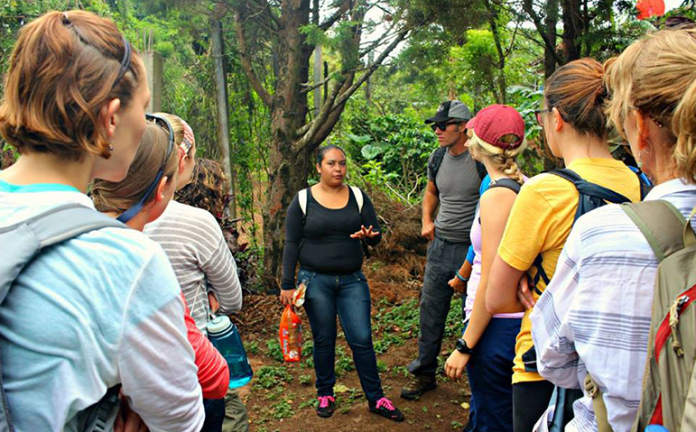

Not a lot of businesses start at gunpoint, but the seeds — or beans, if you will — of Just Coffee Cooperative were planted while co-founder Matt Earley stared down the barrel of Mexican paramilitary rifles.
While Earley and co-founder Mike Moon began Madison-based Just Coffee 15 years ago, it was earlier experiences in the rural Mexican highlands like the one above that helped plot their course as “reluctant entrepreneurs.”
Earley says his interest in Latin American politics and culture began early, when he was in elementary school. He remembers watching movies about the Mexican Revolution and thinking how cool it was that this seemingly completely different land lay across an imaginary line in the southwest.
“I went to a Catholic grade school in downtown Lexington, Ky., and when I was in fifth or sixth grade the school hosted a priest and two nuns who were working in El Salvador,” Earley says. “Instead of the droning lecture on saving souls I was expecting, they gave an impassioned talk about how the Reagan administration was supporting death squads and an anti-democratic government there. The teachers were scandalized by the criticism of our government, but I was drawn to that and thought the people speaking seemed really courageous.”
When Earley was finishing up his undergraduate degree at the University of Kentucky in his hometown of Lexington, he took a course on social movements in which the class discussed the Zapatista movement in Chiapas, Mexico. One of the professor’s hopes was to get students involved with progressive action, notes Earley, and at the end of the chapter he gave the students the email address for a group in San Diego that was hosting volunteers and taking them to Chiapas to help build schools for Zapatista kids. Even before the Zapatista rebellion the indigenous children had little access to schools, explains Earley. Since the uprising, the Zapatista communities purposely cut themselves off from the government and formed their own autonomous Mayan government.
“I wrote to the NGO building schools and then went to Mexico to meet up with the volunteers,” Earley says. “They sent us to the highlands where I met coffee farmers for the first time. Working with and getting to know the people there, I came to hear about how farmers were routinely paid less than the cost of production for their coffee.”
It was there that Earley also got a taste of the upheaval that marks the lives of the indigenous peoples he encountered.
|
An old photo of Just Coffee folks with farmers from Yachil Cooperative in Chiapas, Mexico. This was the first group of farmers Just Coffee’s founders met and who they formed to support. |
“Believe it or not, traveling around Latin America and other coffee regions has been super smooth in general,” Earley is quick to qualify, “with only a couple of exceptions. During my first trip to Chiapas the school construction teams arrived just after a massacre in a small nearby town called Acteal. Forty-five people — mostly women and children — were gunned down in cold blood by paramilitaries while they prayed in their town church. We were told that the army had surroundedâ the survivors in the nearby town of Polho, so we went to see if we could help.
“It was extremely tense and very moving,” Earley continues. “We were the first outsiders to speak to the survivors and we felt we needed to help. Our combo of radical Mexico City college students and gringo activists confronted the army detachment who were menacing them and told them that they were not wanted there. After a lot of tough posturing with their guns drawn they left. Unfortunately, they immediately returned when we left the area.
“Two nights later paramilitaries moved on our camp and we had to leave in the middle of the night with armed Zapatista rebel fighters and climb up the slippery muddy paths that led into the mountains in the pouring rain. After walking for several hours, we made it to a little mountain village and slept under the trees thinking that we would need to pick up and run again at any moment. We waited until morning and then returned to the road, loaded into our busses, and got out of there as fast as we could. I swore that I would never return — and then I was back again six months later. Completely randomly there was a group of high school students from the Waldorf-inspired Youth Initiative High School in Viroqua, Wis. on an ‘alternative spring break’ — quite an alternative, I’d say.”
During his subsequent visits to the Chiapas region, Earley and the local coffee farmers talked a lot about the idea of accessing better markets and he came back to the states with the idea of going to graduate school to study the coffee industry.
Earley attended UW–Madison in pursuit of a master’s degree and wrote his thesis on barriers to small coffee farmers. In his final semester he notes he “reluctantly” started Just Coffee with his friend, Mike Moon.
“We had been trying for a year to appeal to Madison and Milwaukee coffee roasters to buy the coffee of our Zapatista friends in Chiapas; however, no one here wanted to pay the premium they needed or to enter into a direct relationship with farmers who had never exported,” Earley explains. “After we told the coffee growers in Chiapas this, they convinced us to buy their coffee beans and roast them ourselves.”
(Continued)
Strange brew
Coffee was not where Earley expected his career to wind up.
“Over my life my imagined job trajectory went from paleontologist to pro baseball player to rock star to college professor and in reality looked like busboy, horse stall cleaner, lawn mower, gardener, and for many years dishwasher,” says Earley. “Starting and co-owning a coffee roasting business — or any business for that matter — was not on my radar in the slightest until our friends in Chiapas persuaded me to try it. Without a lot of dedicated co-owners, employees, and customers over the years, it never would have worked out the way it has.â It is great to have people who have your back and who can sometimes carry extra weight when it slips off your shoulders.”
Madison is also a long way from Mexico, but the community has also been integral to Just Coffee’s sustained success, Earley notes.
|
Just Coffee co-founder Matt Earley, left, with a farmer from ANEI Cooperative in northern Colombia. |
“Especially in the beginning, there are and were a lot of people here who want to connect with the people who grow or make the things that they use and who want to try to make sure those people are not being exploited,” he says. “When we started out I believe that our business model only could have been supported in a handful of cities.”
Like standing up to paramilitary forces though, even the local business ecosystem presented obstacles for a coffee startup, notes Earley.
“When Mike and I were writing our business plan and looking for support I went to the UW-Madison Small Business Development Center for advice and help. I expected that our ideas might not be totally familiar or smiled upon by the retired businessmen who volunteered to help startups in need. I sat down in a chair across from my assigned volunteer business expert and waited for some feedback.
“I had sent the plan to him a few days before so that he could get an idea of what we wanted to do,” Earley continues. “The expert put the plan on the table and pushed himself back in his chair. He slid his glasses down his nose,â peered at me over the frames, and asked, ‘You said you guys want to start a ‘for-profit’ business, right?’”
“‘Yes, that’s right,’” Earley replied, starting to feel like a misbehaving second grader in the principal’s office.
“‘Right. Well, there is a major problem with this. You want to be a ‘for profit,’ but you have a plan that — at its core — will drasticallyâ limit your profits.’”
“‘Well, we think that we can pay more for our coffee, make a little less money, create community around our brand, and really show how trade can work for all involved,’” Earley told him.â
There was silence. He looked at Earley with a mix of pity and fatigue. After a moment he spoke up.
“‘Here is the thing. There are six or seven other coffee roasters in town that already know what they are doing. You are coming into a full market where there is no space for you. You mention this term ‘fair trade’ over and over in your plan, but you have to realize that most people don’t really care about it. Did you know that 80% of food-and-beverage startups fail in the first three years?’”
Then he paused and hit Earley with this gem that Earley says he will never forget: “‘Listen, son, you cannot make a living selling coffee to a few dozen hippies on the east side of Madison, Wis.’”
“With that our session was over,” says Earley. “He pushed our plan back across the table and reached for my hand. After a firm businessman handshake, I started for the door trying to make sense of what had just happened. As I reached the doorway, the expert clapped me on the back and said, ‘Come back and see us when you have another idea. Or better yet, maybe write this up as a nonprofit.’”
Earley thanked him and left.
“We didn’tâ want to be a nonprofit,” Earley notes. “We wanted to show that it was possible to be a successfulâ for-profit business with an unconventional idea of how to operate. We persevered stubbornly and started up by the bootstraps. Although we have stumbled some along the way — and found out that within business exists an unstoppable force called ‘basic math’ — we have become successful by any standard business metric, and we have done it with our mission and core values intact and leading our way.”
Coast-to-coast coffee
|
Above, a Loring roaster at Just Coffee. Below, bags of coffee ready to ship. |
Fifteen years later, Just Coffee sells its products nationwide, although its biggest presence is from the Twin Cities to Chicago with a focus on Madison and Milwaukee. The company has a large presence in food co-ops across the U.S. from Seattle to Portland to San Francisco to Austin to New Orleans to Lexington, Ky., and, of course, here in Madison, notes Earley.
“We have around 30 people working at Just Coffee. Some are worker/owners of the business but the majority are not. We work with between 22 and 25 farmer co-ops every year. The majority of these co-ops are in Latin America, but also in Asia and Africa. And we still buy from the co-op of âfarmers we started up the business to support, as well as the co-op of farmers who are survivors of the Acteal massacre.”
Earley personally visits a number of farmer co-ops every year and Just Coffee still imports directly through an importing company it co-owns called Cooperative Coffees. To boot, Earley’s Just Coffee co-founder Mike Moon is now the head green coffee sales person at Cooperative Coffees, too.
Just Coffee is also a national leader in worker safety, a natural offshoot of its mission to improve the lives of the coffee growers it purchases from.
“We have been working with the CDC’s National Institute for Occupational Safety and Health (NIOSH) to measure and mitigate naturally occurring, but potentially hazardous, compounds in the workplace,” explains Earley. “âWe are currently consulting with them on the best ways to approach this and we have already put several things in place to cut down on the presence of dust and of these compounds. We are the first specialty coffee roaster in the nation to invite the NIOSH team into our facility, and we are really proud to be leading the industry on this issue.”
Click here to sign up for the free IB ezine — your twice-weekly resource for local business news, analysis, voices, and the names you need to know. If you are not already a subscriber to In Business magazine, be sure to sign up for our monthly print edition here.

