

Clean breakdown
|
The Clean Jobs Midwest report also provides data breakdowns by state, county and sector.
|
|
• At the local level, the report said Milwaukee County is the sixth-ranked Midwest county for clean energy jobs with 17,023 clean energy workers.
|
|
• Dane and Waukesha counties also rank in the top 20 in the region with 8,462 (16th) and 7,538 (17th), respectively.
|
|
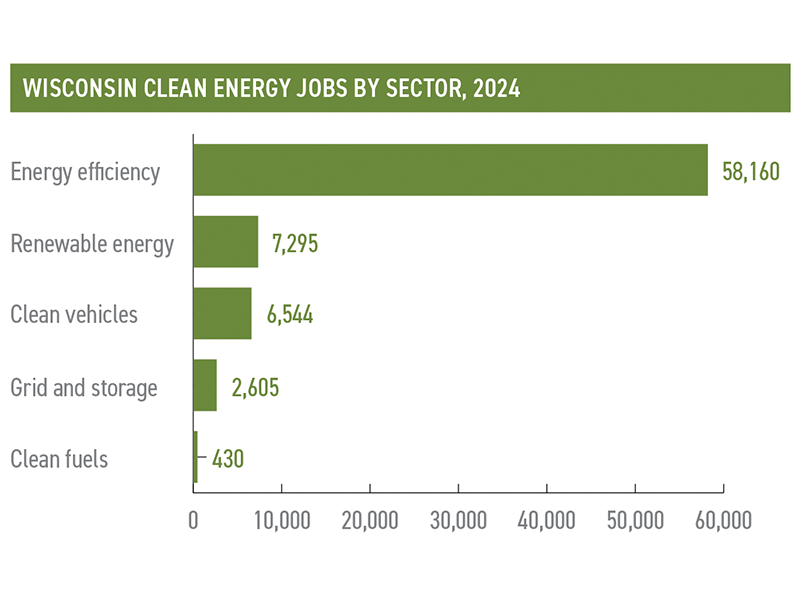
• In 2024, across all clean energy sectors, 74.1% of Wisconsin clean
|
|
Source: cleanjobsmidwest.com |
Wisconsin added more than 1,350 clean energy jobs last year, and while that outpaced gains compared to the rest of state employment, clean energy jobs grew at their slowest pace since 2020 in Wisconsin, according to the ninth annual Clean Jobs Midwest report.
The report released in mid-October by a group of green energy organizations led by the national, nonpartisan business group E2, said future growth could be curtailed by federal cutbacks that are part of the “One Big Beautiful Bill” signed into law in July by President Donald Trump.
Even with this growth, the state added 846 fewer clean energy jobs than it did in 2023, bringing its total clean energy jobs to 75,034.
That represents a 1.8% increase in clean energy jobs, which means the clean economy grew four times faster than the rest of the economy, which grew by less than 1 percent, the report said.
A general slowdown in the U.S. economy gets some of the blame for slower growth in 2024, the report said, but federal legislation could slow growth even further in 2025 and beyond.
The report said the One Big Beautiful Bill aggressively winds down wind, solar, vehicle and energy efficiency tax credits, threatening to kill clean energy projects, increase energy costs, and slow the onshoring of domestic energy manufacturing.
As a result, it said businesses had canceled, closed, and scaled back more than $22 billion worth of new projects nationwide.
That means state governments will be required to pick up the slack when it comes to clearing barriers to clean energy investments, according to Micaela Preskill, director of state advocacy for E2.
“And of course, this comes at a time when we’re in an energy emergency,” Preskill said during an Oct. 15 press conference. “Demand is rising fast, so making it harder to deploy clean energy, which is the cheapest, fastest source of new power, is bad for the economy and of course it’s bad for jobs.
“So state action is critical right now,” she said.
The 12 states featured in the report are Illinois, Indiana, Iowa, Kansas, Michigan, Minnesota, Missouri, Nebraska, North Dakota, Ohio, South Dakota and Wisconsin.
The analysis of U.S. clean energy employment is based on employment data collected and analyzed by the BW Research Partnership for the 2025 U.S. Energy and Employment Report.

