

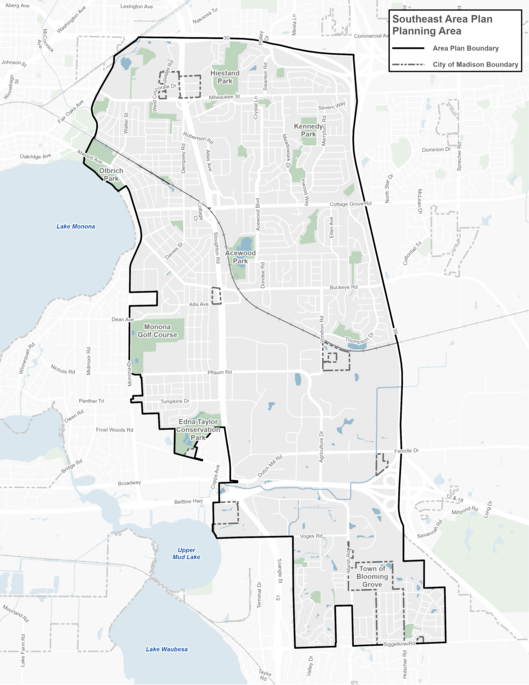
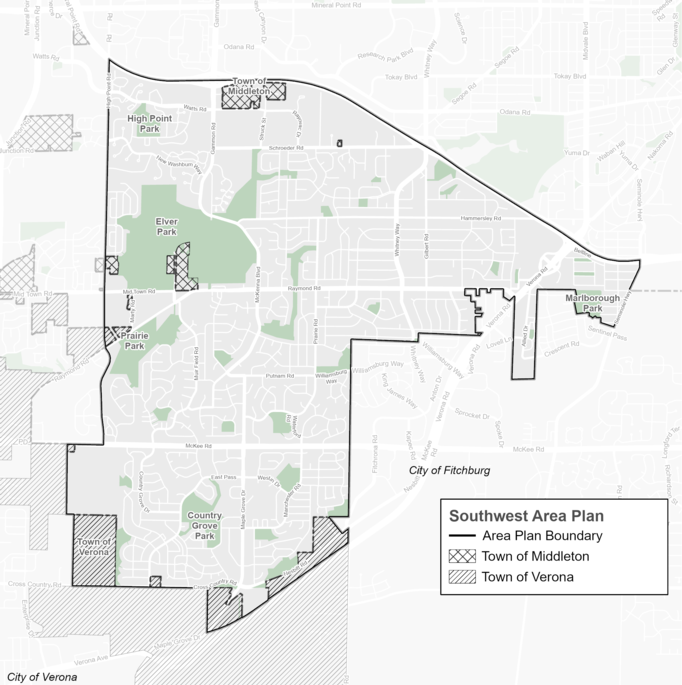
City of Madison staff has begun work on the next two Area Plans, the Southwest Area Plan and the Southeast Area Plan, after receiving authorization from the Common Council in early October, according to a news release. Now, they’re asking for public participation at a pair of kickoff events in the coming weeks to learn more about the process and ways to get involved early.
The Southwest and Southeast Area Plans will be the third and fourth of 12 area plans created under the updated Planning Framework passed by the Common Council in 2022. The order of the plans was determined by several factors, including the demographics of the people living in the planning areas and whether those areas had recent plans in place. Parts of the city that had outdated plans on the books or no plans at all were given priority under the updated Planning Framework.
To help address those needs, the city will hold in-person kickoff events at 6:30 p.m. on Tuesday, Nov. 19, at Toki Middle School for the Southwest Area Plan and 6 p.m. on Wednesday, Dec. 4, at La Follette High School for the Southeast Area Plan. Both events will be an open house format, allowing for informal conversations between community members and city staff.
Additionally, virtual events will be held from noon–1 p.m. and 6–7 p.m. on Tuesday, Dec. 3, for the Southwest Area Plan and from noon–1 p.m. on Thursday, Dec. 5, for the Southeast Area Plan for those unable to attend the in-person kickoff events.
“Each area plan is a guide for the future of our neighborhoods, so it’s critical that residents get involved in the planning process,” notes Mayor Satya Rhodes-Conway. “This event is your first opportunity to share your hopes, dreams, and concerns with the city so we can include them in the planning process and address them in the final plan.”
City staff are looking for insight into everything from the need for more affordable housing options to the need for more small businesses and amenities, like parks or community centers, that improve the quality of life in those areas of Madison, shares Jaymes Langrehr, public information officer for the city of Madison Department of Planning, Community & Economic Development.
“Many parts of the Southeast and Southwest Planning Areas are either working under outdated plans that have been in place for 30-plus years or have never had a plan in place at all, so in some cases, the planning teams are starting from scratch, and that’s why community involvement early on in the process is so important,” notes Langrehr.
“In the first two area plans that were recently passed, the city’s interagency area plan teams heard about things like the desire to keep some neighborhoods quiet and walkable but still close to shops and restaurants, the need for more lighting to keep parks and walkways safe at night, and potential locations for more public art,” continues Langrehr. “Those are the kinds of details that the people living in those areas know best because they experience it every day.”
Langrehr says it’s important to know that the area plans don’t dictate growth or development on their own but set the table for that future development by outlining recommended uses, and the feedback planners are looking for stems from that. Additionally, both the Southwest and Southeast Areas have significant employment and commercial areas. As part of these planning processes, the Economic Development Division will be reaching out and surveying those businesses and employers to understand what is important in these areas of the city.
Representatives from several city departments will be on hand at these events to answer questions from community members about the process and timeline for the area plans, and to collect early input from residents on what they would like to see considered in the plans.
“These kickoff events will also provide an opportunity for residents living in these areas to meet and learn more about the work of other city agencies — including engineering, parks, and Metro Transit,” notes city Planning Director Meagan Tuttle. “Residents’ feedback in these plans help guide not only the work of the Planning Division, but also the work of many city agencies.”
Like the West and Northeast Area Plans, the Southwest and Southeast Area Plans will ultimately include recommendations for each of the issues covered by the city’s Comprehensive Plan: land use and transportation; neighborhoods and housing; economy and opportunity; culture and character; green and resilient, effective government; and health and safety. A community action strategy will be developed for areas with a higher proportion of residents living with lower incomes.
The West Area Plan and Northeast Area Plan were passed with broad support from the Common Council earlier this year after minor changes made by various city boards, commissions, and committees during the final approval process. The final versions of both the West Area Plan and the Northeast Area Plan have now been posted.
According to Langrehr, city staff received hundreds of pieces of feedback throughout the West and Northeast Area Plan processes, including feedback that was often conflicting.
“For example, we heard from many people who wanted to see more housing density on the west side and felt the initial draft recommendations didn’t go far enough to address the need for more housing and mixed-used development,” explains Langrehr. “But we also heard from many people who felt the plans recommended too much density and mixed-use development, and the team working on those plans had to balance all those comments in putting together the final versions of the plans. That’s why we work so hard to make sure everyone has a chance to share feedback, including local business leaders.”
Public outreach timeline
Planning teams have already begun gathering background information and data about the Southwest and Southeast planning areas and have started meeting with community stakeholders, neighborhood associations, and others about the needs of the community.
After the kickoff events, there will be additional opportunities for the public to share its thoughts with city staff over the next year: A resident survey will be sent out to a random sample of the people living in the planning areas in January 2025, a second round of public meetings to summarize feedback received from the community will be held in February 2025, and city staff will visit businesses in the spring. Initial draft recommendations will be presented at a third set of public meetings in the summer of 2025.
Members of the public will have the opportunity to give feedback along the way, which may lead to further edits to the draft plans. Final drafts of the Southwest and Southeast Area Plans are expected to be up for review and approval by city boards, commissions, and committees and the Common Council by the first quarter of 2026.
Throughout this process, city staff will share updates on what they’re hearing from residents during engagement events and develop informational pieces to help describe some of the more technical topics that will come up during the planning process. These materials, along with informational slides and recorded meetings, will be posted on the project webpages.
More details about future public engagement events will be announced later. In the meantime, those interested in updates on the area plans can subscribe to receive email newsletter updates on the city of Madison webpages for the Southwest Area Plan and Southeast Area Plan.
By the Numbers: Southwest Planning Area
-
Bounded by the Beltline to the north and northeast, city of Fitchburg to the south and southeast, and South High Point Road to the west
-
Approximately 36,837 residents, according to the 2020 census
-
Approximately 16,443 housing units, according to the 2020 census
-
37% of the population is BIPOC or Hispanic/Latinx
-
Includes five different alder districts: District 1 (Council Vice President John Duncan), District 7 (Ald. Nasra Wehelie), District 10 (Council President Yannette Figueroa Cole), District 19 (Ald. John Guequierre), and District 20 (Ald. Barbara Harrington-McKinney)
By the Numbers: Southeast Planning Area
-
Bounded by I-39/90 to the east, Sigglekow Road/village of McFarland to the south, Starkweather Creek/city of Monona to the west, and Highway 30 to the north
-
Approximately 25,366 residents, according to the 2020 census
-
Approximately 11,100 housing units, according to the 2020 census
-
25.9% of the population is BIPOC or Hispanic/Latinx
-
Includes three different alder districts: District 3 (Ald. Derek Field), District 15 (Ald. Dina Nina Martinez-Rutherford), and District 16 (Ald. Jael Currie)

