
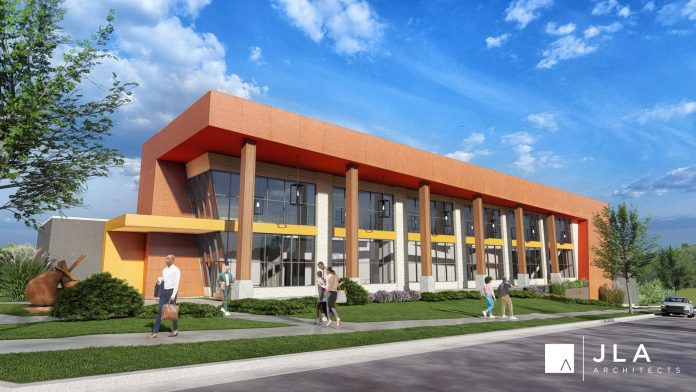

Programs designed for “thriving Black wellness and quality of life,” including a focus on youth leadership and entrepreneurship, mental health, and Black artistic expression, are in the works for the forthcoming The Center for Black Excellence and Culture (“The Center”), founder and CEO Rev. Alex Gee said Tuesday.
Gee, along with other community partners, provided an update on the Center, set to be located on 3.5 acres in the 700 block of West Badger Road on Madison’s south side. The project broke ground on June 19 and is expected to have a soft opening in November 2025. In the three years since its inception, the Center has raised $29 million from 1,200 donors.
Rafeeq Asad, vice president and director of team development for project architect JLA Architects, explained that a number of the design and building material choices for The Center aim to reflect “the Black aesthetic,” which he says is indicative of African American culture. He cited the example of precast concrete elements, chosen to represent strength.
Gee said the project will be a boon for the whole community.
“A lot of people have asked me, ‘What does it feel like to see this happening?’” he said. “I feel like it’s about time. I feel like the entire community will benefit from this because when the Black community feels a greater sense of belonging, we will invest, we will buy homes, we will send our children to school and college here, and this will be a place that becomes a true draw to everyone.”
He discussed the five different areas of programming The Center will offer. The first centers on Black youth.
“There will be STEAM [science, technology, engineering, arts, and mathematics] education, leadership development, financial literacy. Teaching young people about …becoming innovators and entrepreneurs, and learning about investment, about preparation for professional employment placement.
“This is an area where we will treat young people like leaders who are being developed and not problems that are being fixed.”
Another programming area will cover wellness and vitality. Gee said The Center will offer Black-led yoga, programs for expecting moms, nutrition education, meditation, and other wellness classes and workshops.
Dr. Richard Davidson, the founder and director of the Center for Healthy Minds at UW–Madison, added that a partnership between The Center and the Center for Healthy Minds will work to raise funds to create a position for a faculty member who will focus on local projects and research collaborations.
“I see this as a really great opportunity for scientists to learn from the Black community about what wellness means to the Black community, and to co-create practices to cultivate well-being that harness [its] spiritual and social fabric,” said Davidson. “In order for well-being to really be scaled … we need to figure out what is appropriate for different communities, and we need to have the communities themselves be ones to co-create this.”
Public health professional Dr. Jasmine Zapata built on the mental health implications of The Center’s wellness and vitality programming.
“Since the pandemic, we’ve been seeing increases in rates of self-harm, mental health concerns, depression, anxiety, especially among young people but across all ages,” she said. “Many are saying that the current pandemic that we’re entering into is a mental health pandemic because of all of the traumas that we faced during the COVID pandemic. We’re going to be seeing the ripple effects of that from a financial standpoint, mental health, [and] social standpoint for years to come, so it is critically important that … spaces like The Center are created for the sake of our health.”
Offering programming that fosters artistic expression and creating spaces for Black artists — which there has historically been a dearth of in the community — is another goal of The Center.
“There’s going to be Black stage performances,” said Gee, “Black visual art and gallery, art classes and maker space and workshops, spaces also for musical recording and podcasts and video editing, because when our stories are told, we become more woven into the fabric of this whole community and this whole state.”
Dana Pellebon, The Center’s performing arts coordinator, said the facility will include two spaces for shows and will bring in local and regional performances. She said these artistic spaces offer critical opportunities for Black performers.
“It is that type of transformative space that is necessary for our people to see our stories … told with our vision, with our words, with our movements,” Pellebon said. “This is a tradition that has gone back in our African culture for as long as there has been culture, and we have the opportunity to bring that here.”
Some of The Center’s programming will highlight cultural celebrations and intergenerational connections, with events recognizing everything from Black history, to Kwanzaa, to ethnic community observances and a concentrated effort to build education and understanding.
“Young children and grandparents working together, reading to each other, talking, sharing stories … is so, so important,” said Gee. “So there will be a place for family and cultural gatherings, and sharing of history, and a senior center, and educational programs … as well as school field trips for all students in schools around the state.”
He said schools around the state have expressed interest in field trips for students that promote an understanding of the contributions of Black individuals to Wisconsin.
The final programming area will focus on Black leadership and innovation. The facility will offer mentorship and coworking spaces, leadership development, Black-led research, and more. Said Gee, “Members of our community can work together, learn together, grow together, create solutions together.”
The Center has already established partnerships with a number of local organizations, and has seen financial support from major donors, but Gee said the work isn’t over. By March, organizers must raise another $1.8 million to ensure a debt-free opening, and Gee appealed to community members to help close the final gap by donating.
Due to matching gifts from IncredibleBank Foundation, Brewers Community Foundation, and an anonymous donor, every donation made through Dec. 31 will be doubled, up to $160,000.
“I’m not just doing this for 8 or 9% of Wisconsin’s population,” Gee said. “The impact of Black belonging will make this state live [up to] its motto, ‘Forward,’ and be a thriving economy … We need all of our partners to do this.”

