
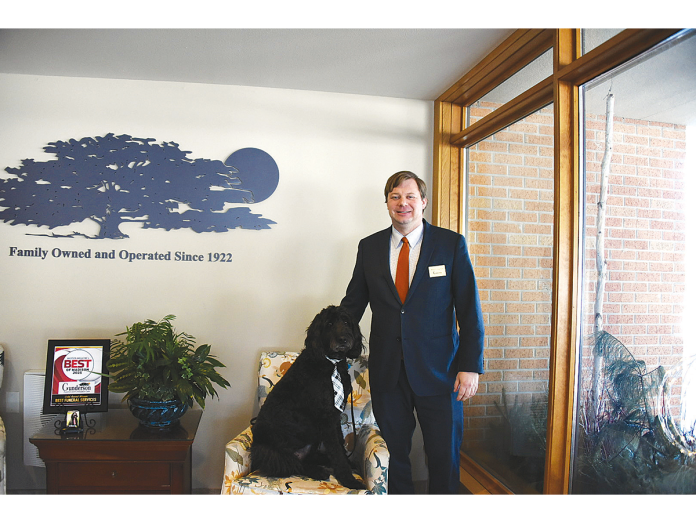

When Elmer Gunderson goes to work, he has several neckties to choose from. A red and white striped accessory goes especially well with his black curls. His dad usually chooses one for him before he goes to work in one of nine locations, in and around the Madison community.

Elmer, a labradoodle, works at Gunderson Funeral Home, helping to bring peace and care to those who have lost loved ones. He also goes into the community to events or churches when asked and available. The 3-year-old’s titles on his business card include grief therapy dog, chief treat officer and official cuddle ambassador.
Elmer works with owner Matt Gunderson, a fourth-generation owner and operator of Gunderson Funeral Home in Madison. Gunderson’s great-grandparents Elmer and Inez Gunderson founded their first funeral home in 1922 at Schenk’s Corners on the east side of Madison.
“He’s a really good boy and he does his work and enjoys it,” Gunderson said of Elmer the dog. “He brings a lot of relief to a lot of families.
“Elmer will find the person that is kind of having a tough time,” he said. “I’ve seen it a few times where he’s gone past three or four or five people and gone straight to somebody that’s sitting there, just having a tough time.”
The dog has been featured in ads and on billboards for the funeral business, bringing a unique and comforting option to its customers. Still, dogs like Elmer and his peers aren’t very common in the funeral business, directors say.
Dog lovers know anecdotally how such furry friends can provide emotional support. And research from entities like the Frontiers in Veterinary Science found that “short-term, unstructured interactions with a therapy dog can significantly reduce self-reported anxiety and distress levels.”
“They can bring any lightness to a dark room because they’re just being themselves,” said Mike O’Connell, owner and funeral director at O’Connell Family Funeral Homes & Cremation Services in Hudson, where Finnegan the English setter works.
“That unconditional love that they want to give anybody, that’s what makes them special.”

Elsewhere around the state, Millie is a certified therapy dog at Piasecki Funeral Home in Kenosha, the city’s first and only funeral home therapy dog. Her certifications include certified canine good citizen, canine good citizen advanced and canine good citizen urban.
Dan Ford, president of the National Funeral Directors Association, which is headquartered in Wisconsin, said recruiting the four-legged critters offers benefits to the funeral business and customers alike. Fox is also president of Alderson-Ford & Buckmiller Ford Mengacci funeral homes in Connecticut where his two dogs, Joey and Annie, are also certified therapy dogs.
Therapy dog qualifications
Dogs that provide the comforting service need to have the right disposition for the job, and some get officially certified.
“A true grief therapy dog does not need certification,” said O’Connell, who also operates funeral homes in other parts of northwestern Wisconsin.
According to the Alliance of Therapy Dogs, certified therapy dogs are not the same as a service dog.

O’Connell saw how Finnegan had a soft demeanor and never got upset. But it was a situation where a young mother had died that prompted him to draft Finnegan into service.
O’Connell asked the husband of the woman who passed if he could bring Finnegan in to help “take the edge off” for their children. It was a new concept at the time to have a dog comfort people who are grieving, he said, but it helped.
That’s how Finnegan began his role.
As for Elmer, Gunderson said he was a dog in a service dog program who failed out for being too friendly.
“He wanted to say hi to people and other dogs and couldn’t stay on task for a full-service animal,” Gunderson said.
Elmer has been working as a support dog for several years and did receive an initial certification related to therapy. But Gunderson said he doesn’t do any yearly upkeep on the certification front. He’s just a chill dog who has an innate ability to help.
In the case of Millie in Kenosha, her three certifications cost about $500-$700 total, though costs can vary depending on class location and levels.
For Ford, it’s not as simple. The initial cost for therapy dogs is not cheap, and he pays to renew any certificates every couple of years to keep them up to date in their roles.
Joey and Annie, the duo of dogs providing grief therapy with Ford, were chosen for several reasons, like being hypoallergenic.
“Those are all things that you have to take into account, which, again, plays into the cost factor as well,” Ford said.
The value of a therapy dog
While it requires financial investment, those in the funeral business find much value in the companions – for themselves and those who have lost loved ones.
“I have some heavy-duty empathy, and I’m trying to balance that and my regular workday,” Ford said. “It makes it very difficult, and that’s where the dogs come into play. The same goes with our staff. So, selfishly, we’re taking advantage of that front and center.”
And whether older or younger, funeral home dogs seem to have an ability to put anyone at peace.
When people see Elmer, Joey, Annie, Millie or Finnegan, they feel better.
“They basically just can’t wait to hold their pet or even just be near one of them, and basically it just deescalates everything,” Ford said.
“If you’ve got a sad situation where we need to soften it a little bit, we’ll bring up that we have Finnegan,” O’Connell said. “And now that he has a little more notoriety, people will see Finnegan here, and say, ‘Can we have him?’”

