

Fully cognizant of the economic pain it will cause, the Big Ten Conference has officiallypostponed the 2020 fall sports season, including the biggest revenue generator in football, due to the public health threats still posed by the COVID-19 pandemic.
In a statement released by the conference, Big Ten Commissioner Kevin Warren said the universities based their decision on the advice of medical experts and are still open to playing fall sports in spring 2021 and would continue to monitor the public health situation accordingly.
In a nutshell, there still is too much uncertainty about COVID-19, Warren states. “The mental and physical health and welfare of our student-athletes has been at the center of every decision we have made regarding the ability to proceed forward,” he said. “As time progressed and after hours of discussion with our Big Ten Task Force for Emerging Infectious Diseases and the Big Ten Sports Medicine Committee, it became abundantly clear that there was too much uncertainty regarding potential medical risks to allow our student-athletes to compete this fall.”
The decision came despite the admonitions of several football coaches, including Michigan’sJim Harbaugh and Ohio State’sRyan Day, to play the season or, at the very least, delay the season until more information can be obtained or more precautions can be taken.
Universities reportedly are concerned about more players developing a condition known as myocarditis, a heart condition that has been diagnosed in athletes post COVID-19, including a student-athlete at Indiana University. Myocarditis is an inflammation of the heart muscle that can reduce the heart’s ability to pump blood and can cause rapid or abnormal heart rhythms.
Warren, in an interview with the Big Ten Network, said myocarditis was not the primary reason for the postponement, but it was part of recent discussions.
The first telltale sign that the college football season was in real jeopardy came in July, when the Big Ten decided not to play the non-conference portion of the football season. That decision canceled a much-anticipated match up between Notre Dame and Wisconsin that was to take place on Oct. 3 at Lambeau Field in Green Bay.
A glimmer of hope came last week when the Big Ten announced plans for a fall football season with a schedule of conference-only games that was to begin the weekend of Sept. 5, and outlined its medical protocols for all sports. Even with prohibitions against large public gatherings, many believed that college football could follow the lead of other sports and play its games without fans in the stands, relying solely on television revenue to stay financially afloat.
However, when the Mid-American Conference announced it was postponing its 2020 fall sports season, speculation grew that the Big Ten would follow suit. MAC commissionerJon Steinbrecher said health experts told him they were uncomfortable putting players in an environment likely to spread COVID-19, explaining that playing sports is more of a risk than sitting in a classroom. “There are simply too many unknowns to put student-athletes into situations that are not clearly understood,” he stated.
Steinbrecher also said the MAC would look into resuming competitive sports, including fall sports, in the spring of 2021.
Business impacts
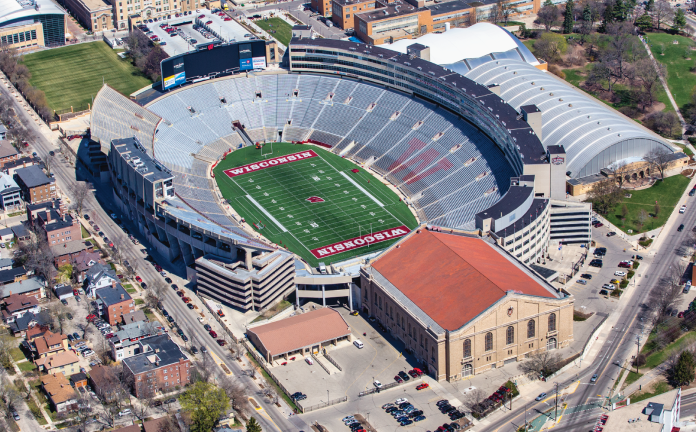
The economic loss of football will hit already devastated bar, restaurant, and hospitality businesses that feed on athletic events in Madison. Some Madison business owners seemed resigned to the postponement, noting that public health comes first. In anarticle published in the Wisconsin State Journal, the comments of Sam Brown, who operates a Rocky Rococo restaurant on Regent Street that draws up to 5,000 people for a Badger tailgate party, summed up that point of view. “I can understand the disappointment that some businesses might feel in there not being football,” Brown told the publication. “But at the same time, there’s no way you can conduct a football season with student athletes and conduct a tailgate safely.”
Jason Ilstrup, president ofDowntown Madison Inc. and the former general manager of HotelRED, located across Monroe Street from Camp Randall Stadium, says downtown businesses are apprehensive. They have endured the COVID-19 shutdown and a gradual reopening, they suffered vandalism and looting in the aftermath of George Floyd’s police-involved murder, and now they have lost UW fall sports, which is linked to one of their strongest revenue periods.
“It’s hard to operate a business without having a plan,” Illstrup says. “Everything is so up in the air when it comes to COVID-19. The numbers keep going up and down. It’s difficult. They don’t know where to focus their attention. They don’t know where the revenue is going to come from. These are precarious times for any small business down on State Street.”
One silver lining would be the possibility of a spring football season. “If there is the ability to play in the spring environment and it’s safe for players and fans, that would be fantastic for businesses downtown and around Camp Randall,” Illstrup states.
Deb Archer, president and CEO ofDestination Madison, also says the Big Ten has to make the health of its student-athletes the top priority. “UW sports programs are part of Madison’s family,” Archer said in a prepared statement. “We love to welcome the thousands of fans who come to games, experience our community, and provide support for our businesses.
“We know this fall will be different without those games but understand UW and the Big Ten Conference are addressing the need to prioritize the health of student athletes and the public,” Archer adds. “We plan on welcoming fans back to Madison when the time is right.”
Statewide, the impact of Wisconsin athletics is estimated to be $610 million, according to aneconomic impact report by Econsult Solutions Inc. The report measured the economic benefits that the university’s 23 athletic teams and supporting organizations generate. The most impactful events are home football games, each of which have $16 million in total economic impact on the state economy.
The financial damage to college athletics began with the cancellation of men’s and women’s basketball tournaments in March, which cost NCAA schools an estimated $375 million. The NCAA governs student-athletes from nearly 1,300 institutions.
Based on their individual health situations, some collegiate athletes had already opted out of fall sports, as various professional athletes have done, but others implored the Big Ten not to cancel the season.
Eligibility issues will be determined by the NCAA. At the moment, it’s unclear whether the Big Ten’s decision will increase the number of Big Ten athletes who enter the NCAA transfer portal, as other conferences face similar decisions on their fall sports seasons. On Tuesday, the Pac-12 Conference quickly followed the Big Ten in postponing fall sports.
Related stories:

