
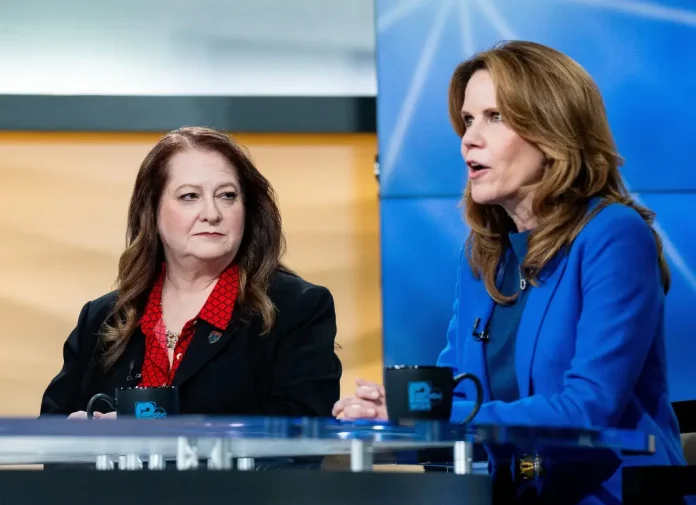

Reactions were split on how Judge Chris Taylor’s decisive victory in Tuesday’s Wisconsin Supreme Court race could affect businesses. The outcome gives liberals a 5-2 majority on the state’s high court.
Taylor, a former Democratic lawmaker from Madison, defeated Republican-backed Maria Lazar with 60.1% of the statewide vote.
It was the fourth consecutive victory for progressive Supreme Court candidates.
Taylor’s victory was cheered by Shawn Phetteplace, national campaigns director for Main Street Action, which represents the interests of small business owners. With Taylor on the bench, he said the state judicial system will move away from favoring large corporations with outsized influence, which leaves Main Street businesses at a disadvantage.
At the same time, Kurt Bauer, president and CEO of Wisconsin Manufacturers and Commerce, the state’s largest business association and chamber of commerce, said Taylor’s win will have a negative effect on the state economy and the affordability of government services.
From Planned Parenthood to the Court of Appeals
Taylor most recently served as a judge on the Wisconsin Court of Appeals since 2023. Prior to that, she was on the Dane County Circuit Court from 2020-2023.
Before joining the bench, she was elected to the Wisconsin State Assembly, representing Assembly District 76 from 2011-2020. The district, which now is represented by State Rep. Francesca Hong, D-Madison, covers the isthmus and the northeast side of Madison.
Prior to Taylor’s election to the Legislature, she was policy director for Planned Parenthood of Wisconsin.
During the Supreme Court campaign, she emphasized abortion rights, union protections and pledged to maintain the independence of the judiciary.
Bauer said in an email that Taylor amassed “a very leftwing voting record when she served in the Legislature” and said he expects her to legislate from the bench rather than follow the law.
“There is no question that she will take her progressive worldview with her to the high court and subsequent rulings will reflect her political beliefs, which are aligned with the other progressives on the court,” Bauer said. “For business, the soon-to-be 5-2 progressive super majority presents a major threat to the state’s business climate and our overall economic competitiveness.
“The business community can expect and needs to brace for judicial rulings based on leftwing political dogma rather than legal facts and arguments,” Bauer said. “The best example is the court’s ruling on the 400-year veto.”
In 2023, Gov. Tony Evers, citing the need to address past K-12 education underfunding, used an expansive partial line-item veto to extend a $325-per-pupil school funding revenue limit increase for 400 years (until 2425) by deleting digits and text. The Wisconsin Supreme Court upheld the controversial move in 2025 as constitutional.
Small representation
In contrast to Bauer, Phetteplace found plenty of reasons to be optimistic about Taylor’s victory. He said small businesses succeed in communities where people have money to spend, public services function well, and markets are fair — not just where regulations are minimized for the largest players.
“Small businesses benefit most from a fair, predictable and balanced legal system,” he said in an email. “This result is a step toward ensuring that the court reflects a broader range of perspectives, including those of workers, consumers and small business owners, not just large corporations.”
Phetteplace said many small business owners rely on strong public institutions, affordable health care, quality education and a stable workforce. A court that takes these factors seriously helps create the conditions in which Main Street businesses, not just multinational corporations, can thrive.
“This includes fair enforcement of regulations, protection against monopolistic practices and policies that support local economies,” he said. “In addition, the prior Supreme Court majority upheld the priorities of groups like the Wisconsin Manufacturers and Commerce, the Bradley Foundation, and their GOP supporters, rather than the people of Wisconsin.
“Once that majority was changed through the democratic process and new maps were passed, Wisconsin became a democracy again, where voters select their elected officials, not the other way around,” he said. “This is a win for democracy.”
Act 10 in crosshairs
Bauer said in an email that Act 10, the controversial 2011 law that restricted collective bargaining rights for most public employees, was in serious jeopardy even before Taylor’s election.
He said the law might be repealed by the Legislature if the Democrats sweep the November legislative and gubernatorial elections, but it also could be overturned by the Wisconsin Supreme Court.
If Act 10 is repealed, Bauer said there will be “few checks on the expansion of local government, which will spike property taxes, compounding the impact of the 400-year veto.”
He said Act 10 has saved taxpayers as much as $35 billion since enactment and Wisconsin already has the 8th highest property taxes in the country.
“Even without the repeal of Act 10, Wisconsin will move up in this ranking because of the 400-year veto,” Bauer said. “Without Act 10, Wisconsin will leapfrog to the top 5 in short order.”
He said higher property taxes will make homeownership unaffordable for many Wisconsinites.
“The median age for a first-time homebuyer in Wisconsin is 40 (in 2025),” he said. “That is up from 29 just 10 years ago.
“But higher property taxes also mean higher rents because landlords will have to pass their costs on to renters,” he said. “The bottom line is that housing affordability is greatly impacted by property taxes and one way or another, taxes are going up in Wisconsin.”
Phetteplace believes the court will rule on the merits of the case.
One criticism of Act 10 is that it treats certain public employees differently — police and firefighters are exempt — and therefore violates the U.S. Constitution’s 14th Amendment Equal Protection Clause. Using that rationale, a2024 Dane County Circuit Court ruling declared parts of Wisconsin’s Act 10 unconstitutional.
“From a small business perspective, what matters most is that decisions are grounded in the Constitution and support strong public systems, like education and infrastructure, that local businesses rely on to succeed,” Phetteplace said.
He said claims that justices will rule based on political dogma rather than legal facts undermines the role of the judiciary without evidence.
“Judges are bound by the Constitution, precedent, and legal reasoning,” Phetteplace said. “Disagreeing with past rulings does not mean those rulings were not grounded in law; it means there are different interpretations, which is a normal part of a functioning court system.”

