

Given the ambitious timetable for the construction phase of the initial east-west line of Madison Metro Transit’s $190 million bus rapid transit (BRT) system, 2024 always figured to be the year in which most of the network infrastructure construction work was done, and city transportation officials maintain the system will be open and running by the end of this calendar year.
To get an update on project progress through the winter months, we spoke to Tom Lynch, director of transportation for the city of Madison, and to Madison Metro General Manager Justin Stuehrenberg. From 2014–2020, Stuehrenberg served as vice president of planning for IndyGo, the BRT system in Indianapolis, Indiana.
The network infrastructure construction, which began in spring 2023, will proceed this year with the city trying to minimize disruptions to commuters and to business operators. Needless to say, there still are obstacles to overcome, but the system is still scheduled to go online before New Year’s Day 2025. “It will require focused effort,” Lynch notes. “There’s still a lot of things before us, but it’s on schedule right now.”
State of the stations
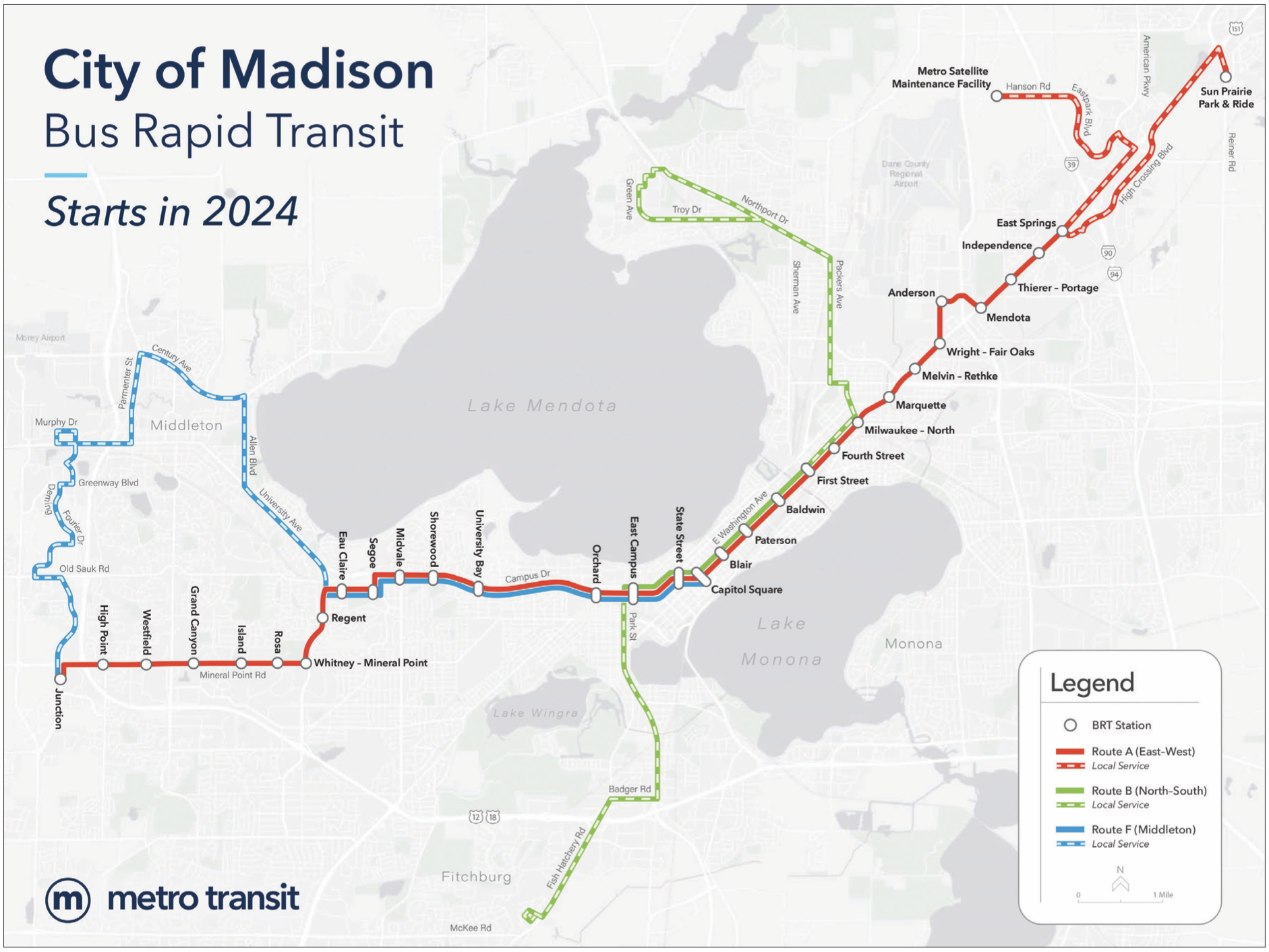
MetroForward, the city’s plan to rebuild its transportation backbone, of which BRT is one of four tiers, promises to pick up the pace of workforce transportation while reducing congestion as Greater Madison continues on its current population growth path. The first route, the 15-mile Route A, will feature 31 bus stations between Junction Road on the west side, where the first station will be built, and East Towne Mall on the east side. It will run on University Avenue, through the downtown area, and on East Washington Avenue. The second route (Route B) will be a north-south line that will intersect with the east-west line through downtown and the isthmus.
Construction of Madison’s BRT system will be funded with the largest federal grant the city has ever received. The construction process involves excavating and removing the pavement and the existing medians and traffic signals and other hardware, as most of the construction occurs at the intersections. Workers will build a platform and the station structure, which eventually will be outfitted with electronics such as real-time information signs. Finally, pavement markings will be added to designate the bus-only lanes.
Minimizing disruptions during road construction is always a challenge, especially when the BRT work has to be done in coordination with other, non-BRT road improvement projects. As with any construction project, there will be necessary lane and driveway closures and disrupted bike lanes during construction. To the extent possible, the city has pledged to keep two lanes of traffic open in each direction on each major arterial, and keep the sidewalks and pedestrian connections open throughout the BRT corridor.
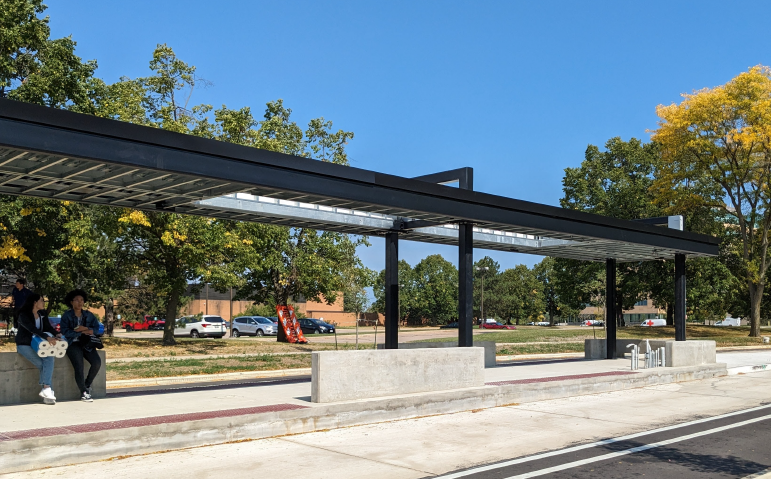
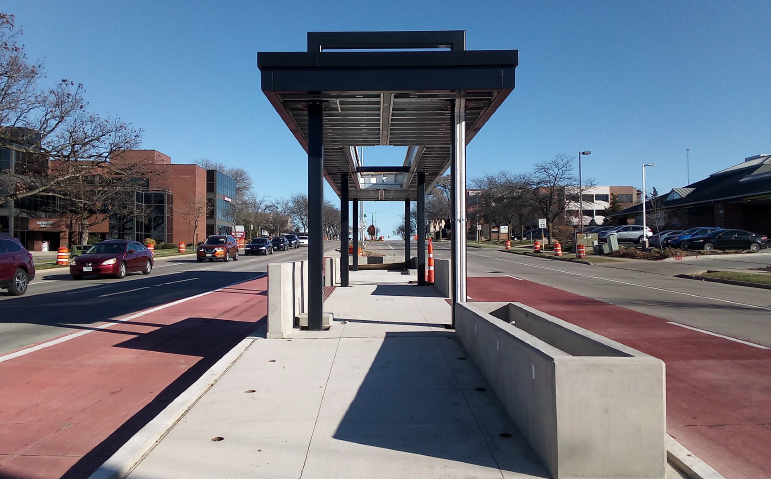
Thus far, winter weather has delayed the placement of a couple of bus shelters, which are fabricated off-site, trucked in, and put in place with the help of a crane. They were scheduled to be in place around the holidays, but occasional subzero temperatures and storms pushed the timetable back.
In all, the flat work (concrete work) has been done on 23 stations, to be followed by the roof placement and a holding period before the finishing work is done. “We don’t really do the rest of the finished work until the very end, where they come in and put up the glass and install the benches and the cameras and the electronics and all that stuff, because that’s sitting out there unused,” Stuehrenberg explains. “It potentially could be vandalized.”
There have been occasions where the city had to be flexible, and officials note that public informational meetings will be scheduled on an as-needed basis. The city delayed construction of the downtown bus stations until after the holiday season to reduce the impact on holiday shopping, which means a public meeting for some of the downtown businesses was delayed.
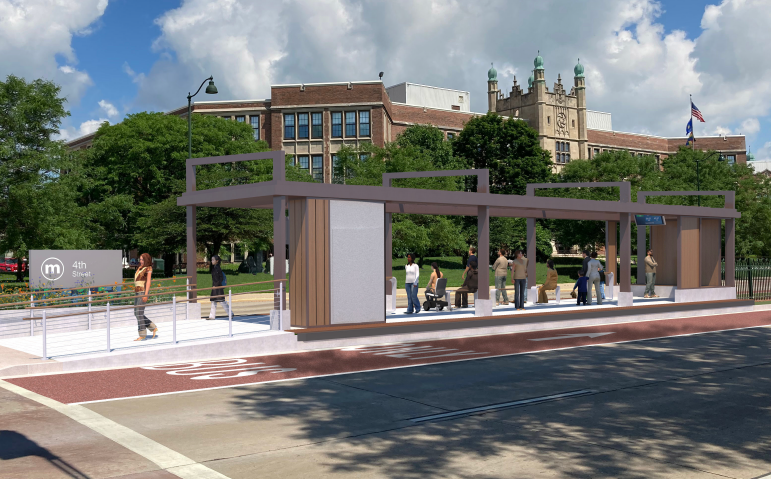
While there will be 31 locations for the bus stations, sometimes there will be platforms on each side of the street — more than 40 platforms in all — where people wait for the bus, and these will be custom-designed shelters generally 60 feet long and varying in width from 10–12 feet. When the frost is out of the ground, the city will begin work on several of the platforms that haven’t started yet. There are a couple of controlling platforms — meaning they will be used to help control the schedule — that will be among the last ones built, one on Milwaukee Street and another on Orchard Street, and those will have to be completed on time for the system to open.
“Even though this is one project, one construction contract, it’s really 43 distinct construction sites and structures,” Stuehrenberg notes. “So, anything we talk about regarding a delay is not a delay of all of them. It’s a delay of one or two of them. So, it’s likely that if there is any sort of delay, it’ll just be a few locations.”
On the west end of Route A, there will be a new park and ride near Junction Road, and the east end the system will be served by the existing Sun Prairie Park and Ride, along with bike parking at some of the stations along Route A. The all-electric buses will be charged by high-powered chargers placed at both ends of the route, allowing the buses to “top off” during a layover.
According to Lynch, all the charging equipment is on order, but those systems will be installed by a separate contractor — a subcontractor of the bus vendor, New Flyer. Zenith Tech, the construction company hired to build the east-west route, has to finish its work before the charging contractor “can get in and do their thing,” Lynch says. “But again, that’s one of the first milestones that Zenith Tech has to meet. Just to get that space ready for that charging, and the charging equipment is all on order and on time, so I would anticipate the first chargers coming in sometime in the May–June timeframe.”
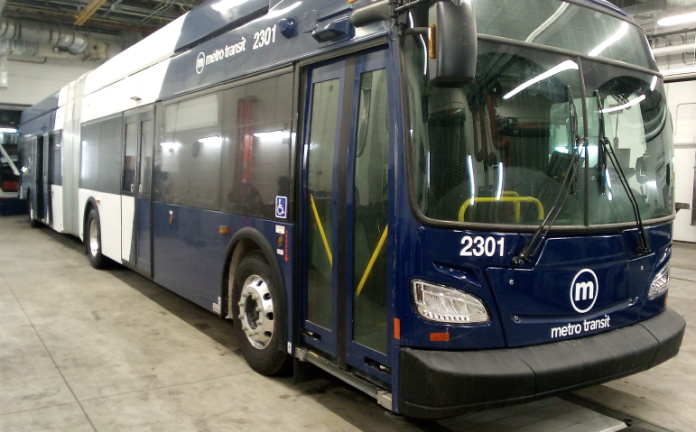
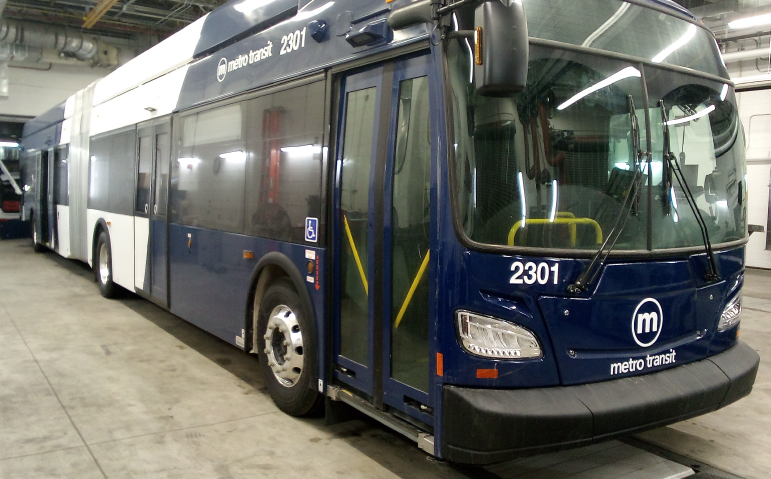
The 60-foot, mostly electric-powered BRT vehicles, about 1.5 times larger than Madison Metro’s existing buses, will allow more people to be transported, even with storage space on each bus dedicated for bicycle parking. With larger buses, all-day service with direct routes and fewer stops, the use of dedicated bus lanes and special traffic signals to get buses through intersections faster, and branded stations to serve the system, the city hopes to speed things up while also making public transportation a more attractive option.
The fleet of buses are fully compliant with Americans with Disabilities Act (ADA) provisions and accessibility requirements. People with disabilities will have a chance to see for themselves in advance of the system opening because the city plans to take them on tours with trainers and have them get acquainted with the stations and new vehicles.
To produce a reduction in travel times, BRT promises less frequent stops along the east-west route. Bus stations will be constructed along the new lines — stations where fares originally were to be collected beforehand at kiosks rather than on the bus. According to Metro Transit, there will be no need for fare monitors on the buses because instead of a payment system where riders pre-pay at a kiosk inside the station, the Madison system will have people tap “Fast Fare Cards” on a reader as they board the bus. The new fare system, which costs $4 million, is being funded entirely by a federal grant.
The cards, which will dramatically change how riders pay fares for all transit buses, will allow boarding on all doors of every bus and enable riders to add money to card accounts in several ways. As riders tap the card on a reader, the system will deduct $2, and those riding multiple times will receive ride discounts or automatic fare capping. The change will come prior to Metro’s launch of bus rapid transit. It will not increase fares; pricing is based on the existing fare structure.
Current plans call for the Route A line to run every 15 minutes on weekdays and Saturdays, and every 30 minutes on evenings and Sundays. In addition, BRT buses will have traffic signal priority at intersections, allowing the buses to move through congested intersections more easily.
Liaison logistics
At each construction area, there will be outreach to local businesses impacted by BRT construction. As BRT was debated, questions arose about the possible loss of parking and delivery space in front of businesses during and after construction, but Lynch notes that dedicated transit lanes won’t affect much of the parking supply along the east-west route.
The city of Madison and the Greater Madison Chamber of Commerce have partnered on a road construction survival guide that covers many of the issues that could emerge during the remainder of BRT construction. The fourth edition was released in 2022 under the title “Road Construction Survival Guide: Helping Your Business Prosper Before, During, and After Construction.” It offers planning advice, given by business owners who’ve been through the construction process, on how merchants can prepare and react.
In addition, Bill Plumley of AECOM, the firm the city has contracted with for project development and other engineering services associated with BRT, is the designated liaison to the community, including local businesses. He is the link between the community and Zenith Tech. There also are several points of contact — including the website madisonbrt.com — for the public to get periodic updates on the infrastructure construction project.
Although business owners on South Park Street already have expressed concern about the impact of the subsequent north-south line on street parking — talks with the city are underway to address those concerns — the liaison program for the construction of the east-west line has worked pretty well so far. “It’s been pretty smooth,” Lynch notes. “I think when construction started on Mineral Point Road, we had to get in gear and ramp up our communication with business owners. We brought on a specialist who could take all emails and calls and just get back to people, and so that’s worked well and now it’s kind of just a rhythm that seems to be working.”
Got a BRT question?
Madison residents and business owners can get more information on the bus rapid transit construction project by calling (608) 622-9659 during regular business hours, or by writing and sending an e-mail message to BRTconstruction@cityofmadison.com, or by visiting the project website at madisonbrt.com.

