

In the beer industry, growth is good.
We’re not just talking about growing yeast cultures though. If a brewer is doing things right, people want to drink their beer. The more people who drink their beer, the more a brewery can expand its capacity to produce even more of the ever-popular sudsy beverage.
It’s a great place to find yourself, says Carl Nolen, president/CEO of Verona-based Wisconsin Brewing Company (WBC), which he co-founded in November 2013 with his brother, Mark, and Brewmaster Kirby Nelson. It’s also a familiar situation for a lot of craft brewers these days.
“When you look at the growth rate of craft beer — in Wisconsin, and Madison specifically, and nationwide — the greatest challenge that all the craft breweries are going to have is preparing for expansion and additional capacity,” Nolen says.
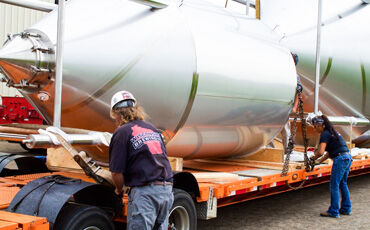
WBC is currently undergoing its second expansion in its short history. When it opened almost two years ago, Nolen notes, the brewery had a 20,000-barrel per year capacity. Six months after opening, in early 2014, it expanded capacity to 30,000 barrels. Now the brewery is adding four new tanks, which will expand capacity to nearly 40,000 barrels and allow for greater production and delivery of its brands.
“We are in an incredibly capital-intensive industry,” says Nolen. “The investment necessary for capacity is extraordinary because we’re buying stainless steel. So you have to make sure you’re in a position to have the capital resources available to plan for expansion as you need it and before you need it.”
Nolen says WBC built its brewhouse big when it opened on purpose, to allow for future expansion without having to build a new facility every time they needed to add capacity. He says WBC has the capability to produce close to 1,000 barrels a day if they ever wanted to grow that large.
With the added brewing capacity comes more beer, and more jobs for the people making and selling it. Nolen says the company has gone from just three employees at its start to 15 full-time positions today, with plans to add more salespeople and a couple more employees in brewing operations that will add onto that total. In addition, WBC has around 25 part-time employees who work in the gift/tourism center of the brewery.
Staying home
WBC sells its beers statewide, and also has a strong presence in the northern third of Illinois, Nolen says.
With the additional brewing capacity its natural to assume WBC will be looking to expand its geographic reach, but Nolen explains the company is happy to stay local.
“The question we get all the time is why did we go into northern Illinois,” says Nolen. “I really look at that northern part of Illinois as part of our home market. We can travel to Chicago quicker than we can get to Eau Claire and Green Bay. Our tourism tells us there’s an extraordinary number of loyal and faithful beer drinkers in the northern part of Illinois who like to travel Wisconsin and enjoy our state and drink our beer, so I look at them as our home market.”
(Continued)
Nolen says he sees the market share of craft beer growing so rapidly that he hopes it’s not necessary to expand the company’s reach geographically to be successful. “A few years ago success in our craft beer industry was defined as being nationwide or significantly regional. But the consumer is driving change and they’re enjoying products that are made much more locally. As long as we can meet the challenge and continue to focus on our portfolio of beers, I’m hoping our footprint is pretty much set and we can now just work on product develop and new brands.”
That includes making more of its popular Inaugural Red brand, which started as a project in collaboration with the Campus Craft Brewery at UW–Madison, and now looks to be a permanent addition to WBC’s portfolio of 20 beer brands. It also includes creating new seasonal or limited run brews like one the company is debuting this week. The new beer, a mixture of WBC’s porter and coffee from Madison-based Barriques, is called Porter Joe and will be available only through the winter months before making room in the catalog for something else.
Living its name
With a name like Wisconsin Brewing Company, its important to Nolen to keep as much of Wisconsin as possible in the beer-making process. Sprinkman, from Elroy, has provided all of the brewery’s tanks, including its four newest ones. And Nolen notes they source many of the grains they use to brew the beers from Wisconsin.
“Being able to work with companies that are iconic, or that have been in Wisconsin for a long, long time, is very important to us,” Nolen says. “Take Dickinson Manufacturing Solutions right here in Madison, which up until two years ago their sweet spot was making manifolds for submarines. Now here they are, a high tech manufacturer of materials, and they’re now making the tap knobs for our beer in bars and restaurants. How cool is that? I’ve known the owner, Keith Dickinson, since second grade. For us, being local really means making conscious decisions that way. We’re also very proud that everything we sell in our gift house is made in America. We do it because it’s what we want to do and we think it’s the right thing to do.”
Nolen notes WBC, along with other area craft brewers, also plays a big role in the local tourism industry.
“We’ve got numbers from the state Department of Tourism, that the average spend during a trip for a tourist visiting a Wisconsin brewery is $50 per tourist. However, on average they only actually spend $10 at the brewery. So $40, on average, is being spent in the community somewhere else. Just think how that spins out. In the old days you’re picking up a 24- or 30-pack of a national brand — there’s not a lot of other beneficiaries in that model.”
For more on the local craft brewing scene, check out our market report feature in the October print issue of In Business magazine.
Click here to sign up for the free IB ezine – your twice-weekly resource for local business news, analysis, voices, and the names you need to know. If you are not already a subscriber to In Business magazine, be sure to sign up for our monthly print edition here.

