




Catalyst.org, a global research firm, reported in May 2023 that only 6.5% of women in the United States with full-time jobs worked in male-dominated industries such as construction, manufacturing, and transportation and utilities.
But women are increasingly making inroads.
Catalyst reported a 7% increase of women in construction jobs and 15% in warehousing and transportation jobs between February 2020 and March 2022.
In fact, women accounted for 58% of the U.S. labor force in 2022, according to the Bureau of Labor Statistics, including 14% of construction workers.
On the medical front, data from the Association of American Medical Colleges in 2021 reported that 37% of active physicians across the U.S. were women, as were 47% of residents and fellows.
Gender lines are blurring, according to a February 2023 Business News Daily report. As women move into male-dominated careers, men also are turning the tables and shifting into typically female-dominated roles such as nursing.
On the following pages, we introduce six area women who love what they do and have broken through gender barriers, intentionally or otherwise, rather than choosing more typical careers. They include a fighter jet pilot, a plumber, an HVAC technician, two women in manufacturing, and an auto service shop owner.
Maj. Zoe “Sis” Davies
Fighter Pilot
Wisconsin Air National Guard, 115th Fighter Wing, 176th Fighter Squadron
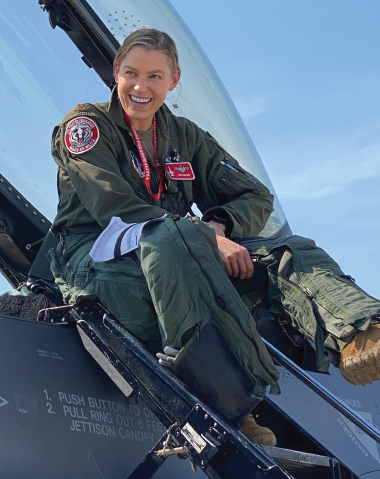
With just over 100 female fighter pilots in the U.S. military, Maj. Zoe Davies is a rarity, and only one of two women currently flying with the Wisconsin Air National Guard. The 34-year-old Poynette native recently moved back to Wisconsin after being on active duty with the U.S. Air Force for 12 years.
Davies, who was working at the Pentagon as she completed her commitment, was given the option to transition to back to Wisconsin and become part of the 115th Fighter Wing. She jumped at the chance.
She had another motivation: Davies and her husband, a retired Navy fighter pilot who now flies for FedEx, were looking to start a family and travel less. A few months ago, the couple welcomed their first child.
Davies hails from a family of aviators, including her mother, a private pilot, and her grandfather, who operated a small airport in Michigan’s Upper Peninsula and served in the Army Air Corps. Her family rarely missed a vacation in Oshkosh during the Experimental Aircraft Association (EAA) AirVenture, and if they were lucky, they’d watch Davies’ uncle, an aerobatic pilot, wow the crowds. “Our family was immersed in aviation culture,” she says.
It was at the EAA when the young pre-teen got the military itch. She distinctly recalls watching the pilot of a white NASA T-38 stopping the plane and jumping out of the cockpit. “It was a girl!” Davies exclaims — a formidable moment in her young life.
The T-38 is the jet trainer still used today to train fighter pilots before they actually get into their combat platforms, like F-16 and F-35. Enthralled, Davies remembers thinking, “Not only do I want to be a pilot, but I want to be a military pilot, and not only do I want to be a military pilot, but I want to fly fighters!”
In high school, she applied to the U.S. Air Force Academy in Colorado Springs, buoyed by a nomination from Sen. Tammy Baldwin. Four years later, she graduated with a Bachelor of Science degree, on track to fulfilling her skyward dream.
She had three choices — become a fighter pilot, a heavy aircraft pilot (e.g., tankers, cargo), or fly helicopters. “Some of it has to do with what you want to do, but most of it has to do with what the Air Force needs you to do,” Davies says. “Either way, it’s largely based on your performance in pilot training.”
She excelled, advancing from a T-6B Texan II turboprop, to a T-38C Talon, and finally to the F-16, where everything happens at lightning speed.
Flying a fighter jet requires supreme task management, she says. “There’s a lot going on in the cockpit, and when you’re a new pilot it’s so easy to get task-saturated with one thing. You have to use your eyes, your ears, your hands — every sense to make sure that you’re flying a safe aircraft.”
She describes her first solo flight as, “amazing and liberating.” The F-16 is capable of speeds up to Mach II; the sound barrier is broken at Mach I. “It’s a really fast, really nimble jet and things happen extremely fast in the cockpit. Learning how to fly it — not just safely but tactically — and perform combat missions is really rewarding.”
From 2019 to 2022, Davies’ spent an active duty assignment with the Wisconsin Air National Guard when the 115th Fighter Wing deployed to Prince Sultan Air Base in Saudi Arabia. She flew combat missions in Iraq and Syria.
She’ll never forget the flight overseas. They were taking F-16s from Madison across the Atlantic Ocean with a planned stop in Spain but couldn’t take off until 10:30 at night due to a weather delay. “It was an extremely long couple of days,” she recounts.
The combat-ready jets were laden with extra gear and weapons. “We felt heavy and sweaty,” Davies describes. “The cockpit is not big and there’s only room for one person. Sometimes I feel like a sardine in a tin can when I’m in my own F-16.”
Traveling that distance for seven or eight hours, particularly over the Atlantic Ocean, meant the jets had to constantly be refueled in the air in the pitch black night. Six F-16s were assigned to one tanker. Davies explains: “The first F-16 hits the boom and gets topped off with fuel, then the next one and the next one.” Once the sixth jet is topped off, the whole process starts over.
The best part of that flight was glancing to the north after the weather cleared. “The northern lights were incredible — a green shimmering curtain that spanned the width of the Atlantic!” she recalls. “It was amazing.”
The toughest part of her job, Davies relates, is managing stress and work-life balance. “A job like this is mentally, emotionally, and physically taxing for a number of reasons. You have an extremely important job that not only is important to your country, to your unit, to yourself, but it’s also inherently risky. You have to be really focused.”
With deployments on a rotational schedule, she knows two or more years in advance when she’ll be deployed again, unless a contingency operation or unforeseen world event dictates otherwise. Until then, she will continue training to become highly proficient in the various missions they’ll fly next time.
In spring, Davies will begin training on the much more technologically advanced F-35.
Had she not just had a child, she still would have transitioned to the Air National Guard in June. Family aside, at some point each service member needs to decide whether or not they want to continue their active duty career in the Air Force or transition to something else. “I love our squadron,” she states. “I love the leadership. I love that the Guard is a much smaller family and community than the active-duty Air Force, and I love coming back to my home in Wisconsin.”
Ali Christ
Journeyman Plumber/Service Plumber
Monona Plumbing and Fire Protection
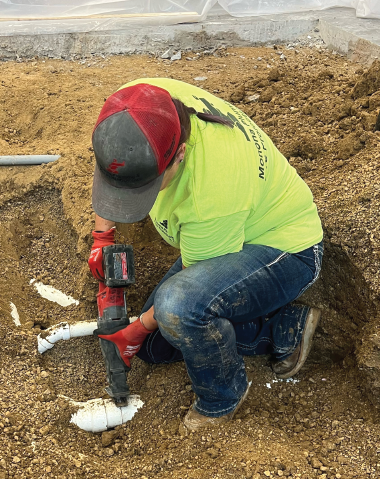
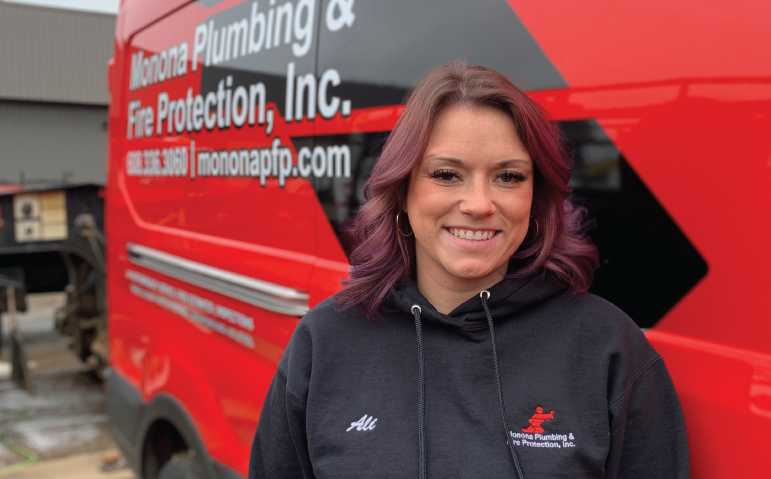
Ali Christ is living the dream as a service plumber for Monona Plumbing and Fire Protection Inc. After years of schooling and on-the-job training, she received her journeyman’s license in March. “That was a big-girl step,” she states.
The apprenticeship was five-years long, during which she attended school full time and got paid “as if I was working a normal workday,” Christ says. She started in a small non-union shop in Lake Mills early on and joined Plumber’s Local 75 in Madison last fall.
As a service plumber, Christ never knows what each day will bring, but she’s confident she can fix any problems that might arise — from a leaky faucet to a hot water heater to shower issues.
“My days are always different and filled with variety. I work on big commercial properties, restaurants, apartment complexes, and residential homes or condos, and have done bathroom and kitchen remodels as well.”
A dispatcher assigns her first call in the morning, but after that, all bets are off. Depending on job complexities, she might handle as many as 11 calls in a day, or just two.
Christ says service plumbers are sometimes hard to find because of the breadth of knowledge required and the fluctuating hours. “I could be done at 3 (p.m.) one day and then the next day I’m jack hammering a kitchen floor until the job gets done. It’s a commitment, but it’s very satisfying. I solve problems.”
She never would have considered plumbing as an option, and still pinches herself. Perhaps it was kismet that while working at a local establishment in Lake Mills years ago, she met her first employer, the owners of a local plumbing business who frequently stopped in for lunch. They recognized her work ethic and suggested she join the trade.
Christ worked as a laborer for about seven months before becoming an apprentice (the state term is “indentured”) just to make sure that plumbing was the right choice. After all, she had considered other careers in prior years — certified nursing assistant (CNA), dental assistant — but neither resonated.
This one did.
Christ explains the education process: “Once indentured, full-time schooling begins. A first-year apprentice makes 50% of whatever the journeyman wage is, and it goes up in 10% increments until your fifth year. By year five, the focus is on finishing an accumulated 10,000 working hours and preparing for the journeyman’s exam. Once you pass the journeyman’s exam, you earn the full journeyman’s wage.”
Currently, the 30-year-old receives a wage increase annually on her indentured date.
She earns $81.23 per hour but nets $54.10 after benefits and dues are taken out. A first-year apprentice would make just shy of $25 an hour right out of the gate, and required continuing education classes also are paid for.
Christ drives a company van, avoiding wear and tear on her personal vehicle, and best of all, she has no college loan debt.
“This really is the best career choice for me. It’s offered me financial stability as a single person, and significantly reduced my stress. No robot will ever do my job!”
Plumbing may not be for everyone, but it suits Christ perfectly. An athlete in high school, she was active in Future Farmers of America (FFA) and worked on dairy farms for years. She’s competed in strong woman competitions and especially enjoys the physically demanding aspect that plumbing affords.
“You work hard. You’re busting concrete. You’re carrying stones. It’s not beautiful by any means. It’s messy and sometimes smelly, but fixing problems is a great feeling.”
She’s met other tradeswomen through her involvement in empowHer Wisconsin [empowherwi.org], an organization that encourages women to get into the trades for financial stability, mentorship, and camaraderie.
And occasionally she runs into the skeptic who believes a woman can’t or shouldn’t be a plumber.
“Everybody’s entitled to their opinion,” Christ says. “It just gives me more motivation to change the mindset because I don’t just have a job. I have a career, and I’m living the best life that I can right now.”
Jill Heiser
HVAC Service Technician
Cardinal Heating & Air Conditioning
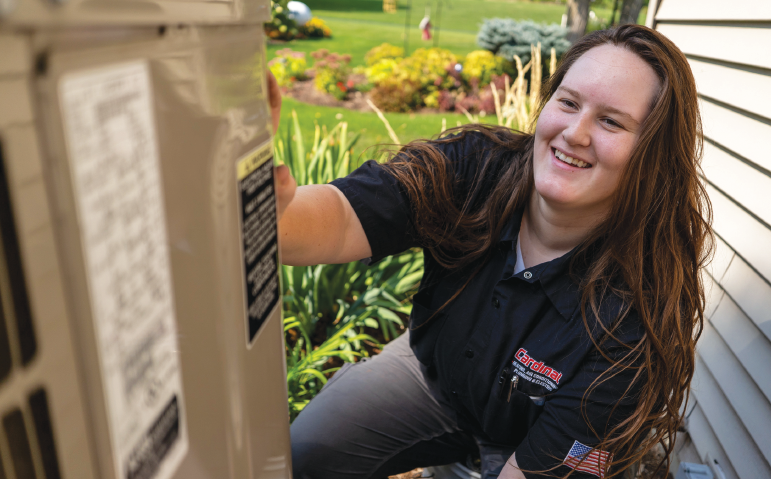
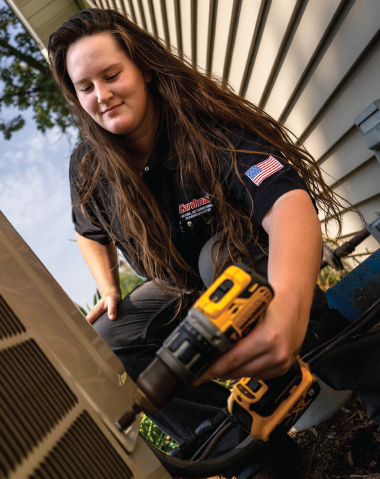
Sometimes it’s easier to figure out what you don’t want to do, rather than what you believe you should do. Such was the case for 24-year-old Jill Heiser, an HVAC technician at Cardinal Heating and Air Conditioning (Cardinal HVAC) in Sun Prairie.
Years ago, Heiser spent a day at her mom’s workplace for a take-your-daughter-to-work day. “I lost my mind!” Heiser says, emphasizing each word. “I was so bored. That’s when I realized that an office job wasn’t for me. I need to do something different every day. I vowed I would never work on a computer or in an office.”
Admittedly, school was not “her thing,” and she had no interest in going to a four-year college and piling up debt. Instead, she attended Western Technical College in La Crosse for two years, earning an associate degree and securing her pathway to a career in air conditioning, heating, and refrigeration.
Except for the first semester, Heiser was the sole female in the class. “I really didn’t pay attention to that,” she says. “I’m not going to pick a career based on that kind of nonsense. I have an older brother and always figured I should be able to do whatever he could do.”
Heiser joined Cardinal at age 20 and learned a lot on the job. “I chose service (versus installation) right away because there’s more money in it, and you never know where you’ll be from day to day. The best feeling in the world is walking up to something and knowing not only what it is, but how to fix it.”
There’s a lot of job security in HVAC, Heiser says, and for women interested in the trades, she recommends they explore options or just ask to be a helper to get their feet in the door.
Cardinal HVAC has one other female technician in the field, and the company now offers in-house training through its new Cardinal University. Thus far, no women have applied.
Heiser’s day begins at 7 a.m. and ends when the last service call is completed. Not every day is rosy, she cautions. “If you don’t want to be outside when it’s minus 40 or 115 degrees, a job in the trades may not be for you. You’re definitely exposed more to the elements depending on what you’re doing, and nobody likes being on call, but it’s part of the job.” She’s on call about every 13th weekend and is scheduled as a backup occasionally.
Some people don’t appreciate a female doing the work. “In Madison it’s easy because a lot of people see me coming and they’re thrilled, but that may not be the case everywhere.”
Heiser carries her tools in a five-gallon bucket — wrenches, nut drivers, screwdrivers, things needed for cleaning, meters, drills. The bucket serves a dual role, as a stool. “I’m not going to sacrifice my knees for a job,” she insists. “Otherwise, you’re kneeling on the ground, kneeling in front of a furnace, kneeling on rocks, and your knees are shot by the time you’re 35!”
Last winter, she dealt with a perplexing issue. A homeowner had recently installed a new furnace because the old one had failed. A few months later, Heiser was called back. Something wasn’t right and pressure switch codes were indicating a problem. What she thought would be a 20-minute service call took half a day.
She checked and rechecked everything, replacing pressure switches and troubleshooting all other options.
“One way we check venting is to roll a golf ball down the intake vent to ensure that the pitch is right. If it doesn’t reach the bottom, there’s a blockage somewhere.” But the ball she rolled down the intake cleared fine.
That’s when she removed the intake from the furnace and found three golf balls. Two were already in the pipe! She removed them, restarted the unit, but the code reappeared. Heiser finally cut the exhaust open only to find rocks, children’s toys, and more golf balls!
Final diagnosis: The vent had enough of an opening to blow exhaust out, but condensation was building up on the foreign items and creating too much water in the vent pipe, plugging a port for one of the pressure switches.
Heiser’s advice? “Keep your kids away from your vent pipes,” she laughs.
Raquel Cruz
Team Lead, Refrigerated Trailers
Stoughton Trailers LLC
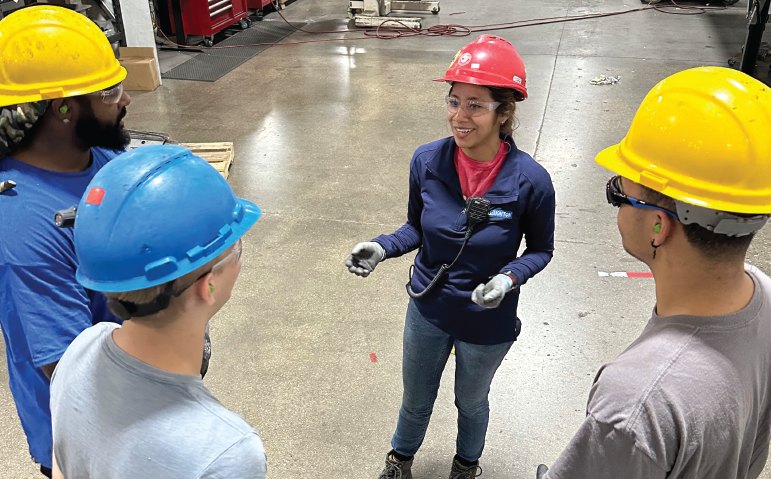
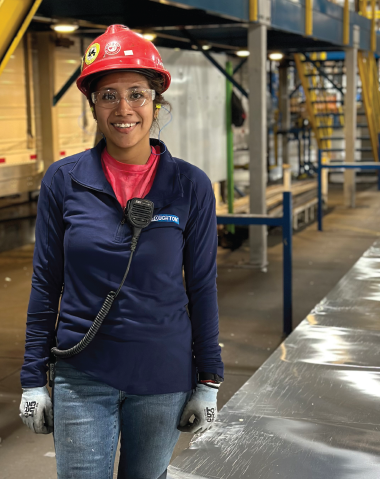
Raquel Cruz assembles trailers at Stoughton Trailers’ Evansville manufacturing plant. The 28-year-old started in 2018 and has advanced from caulking and cleaning refrigerated trailers to final approvals, each time gaining more skills and responsibility.
A mother of two, she works Monday through Thursdays from 5:30 a.m. to 4 p.m. If necessary, there may be an occasional mandatory Friday or rare Saturday, when she’s paid overtime.
When she first started, she was the only female on a small team and she struggled to fit in. “I felt like they didn’t always want to listen to me because I was a girl.” That was then.
Cruz leads about a dozen employees — men and women of all ages — through final assembly, putting final touches on suspensions, landing gear, electrical, and plumbing.
She enjoys working side by side with everyone on her team. When a trailer leaves her area, it moves to undercoating and then into quality control, where Cruz also plays a role.
Supply chain issues frustrate her but have improved, she says. “One of the biggest issues is making sure that when the trailer comes down the line, we’ve got all the pieces we need in place.”
Cruz enjoys her job and has recruited two friends who have since joined the Stoughton Trailers team. “I come to work happy,” she smiles.
Recently, she was asked to apply for another, more supervisory role, but she declined — for now. “I know there will be more opportunities along the way, but right now I feel like I’m not quite there yet. Maybe in the future.”
Nan Mortensen
Co-Owner
Dutch’s Auto Service Inc.
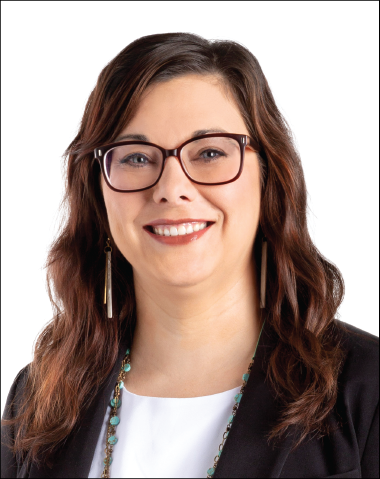
Nan Mortensen, 54, co-owns Dutch’s Auto Service, the area’s only woman-owned and operated auto service shop, with Crystal Rossman. Equal business partners, Mortensen says “she takes care of all the money. I take care of all the people.”
Mortensen has worked in the auto service industry for nearly 38 years. She and Rossman were employed at a cab company years ago, where Mortensen served as a fleet manager and fleet mechanic for 20 years.
She describes herself as the intuitive mechanic, whereas Rossman, she says, is the book-smart, academic mechanic who once led a corporate lifestyle until deciding to switch careers.
Funny and brutally honest, Mortensen appreciates every customer that comes through the doors (male and female) of the east side business. Just don’t question her knowledge or ability — as few things annoy her more.
“My biggest frustration is that I have to be 100 or 1,000 times better than a mediocre guy to be recognized as viable in this industry. I earned this!” she implores. “I know what breaker point ignition is. I know that you can gap breaker points with the matchbook. I know what a carburetor is. I know what multiport fuel injection is. I mean, do we need to discuss aspect ratios of tires?
“Here’s another secret,” she continues. “There’s not a soul in this industry that likes to change oil on a car. It sucks. The profit is really low, but it’s part of the continuity of care. It gives us a chance to look over our customer’s vehicles and thank them, and we pride ourselves on being honest about anything we might find in the process.”
In its heyday, Dutch’s was humming along with five bays, five employees, and the two co-owners. “We were pushing 35 to 40 cars out the door a day. Everyone was happy.”
For the time being at least, it’s just Mortensen and Rossman. The number of auto mechanics has been declining for years, and COVID accelerated the pain. “[The industry is] running out of mechanics,” Mortensen laments. “Besides that, the work is hard. You age in dog years when you do this job.”
Thing are getting worse, she bristles. “We’re losing small shops every year. Soon, everybody’s going to be forced to go to a dealership or the box stores. And what will you have there? Teenagers.”
Dutch’s is always competing for employees. “I can pay a great hourly wage based on experience, but it’s impossible for me to offer benefits,” Mortensen says. “I can’t offer reasonable health care because I can’t get reasonable health care rates for my employees because in the world of business, I don’t exist!”
She also has choice words for industry design engineers who fail to design tools specifically for women’s hands, or for putting oil filters in difficult-to-reach places. “I’ve had nine surgeries. Seven of them have been orthopedic and probably five of them are job related.”
If it sounds like she’s complaining, far from it. She’s proud that the Sherman Avenue business has helped more than 9,000 customers in its 12 years. She’s grateful every time a longtime client’s child — who used to play in the Dutch’s play area — gets their driver’s license. “Nothing marks time like kids,” she says.
“Our goal is to just keep doing what we’re doing because it works. Our little business model works!” The business also serves an important role and resource for car owners who prefer to take their vehicles to a woman.
“I think people inherently trust women more,” Mortensen states. “I really enjoy talking to people about the process and helping them understand how not to get ripped off.”
Dutch’s Auto Service provides general auto service and repair, preventative maintenance like brake work, oil changes, tire rotations, and tune-ups, but it passes on transmission or muffler work, hybrid systems, or electric vehicles. “There’s enough work out there for everyone,” she comments.
As for the worst car Mortensen has ever worked on, “That’s easy,” she chirps. “The poorly maintained one.”
Karen Rangel
Wall panel fabricator
Stevens Construction Corp.
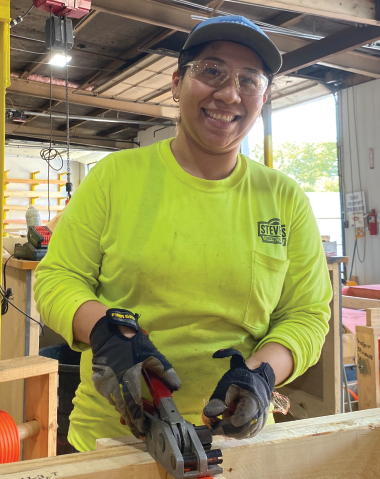
“This [job] is the best thing that’s happened to me,” smiles 34-year-old Karen Rangel. At the Stevens Construction Wall Fabrication Plant, Rangel puts the finishing touches on prefab walls before they get shipped out to a commercial project. She’s been a wall panel fabricator for eight months but has been employed with Stevens for three years. Of the seven wall panel fabricators in the shop, Rangel is the only female.
Her workdays begin at 6:30 a.m. and today she’ll work until 4:30 p.m., which includes one hour of overtime pay. Prior to joining Stevens, Rangel cleaned homes with her aunt and uncle who now help with her two children, ages 14 and eight, while she’s at work.
She was originally hired as a general laborer through a bilingual construction training program Stevens launched with the Latino Academy of Workforce Development. In fact, as we enter, an English as a second language (ESL) class is in session in a training room.
Down the hall, Rangel’s colleagues measure and build wall panels to exact specifications in an assembly-line process. She and another team member are at the end of the line, preparing panels before they leave the plant.
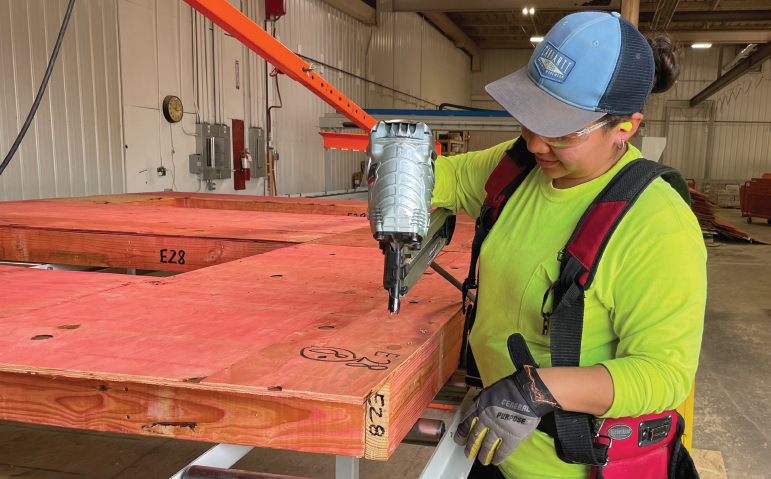
She attaches a heavy piece of plywood, or sheeting, to the panels, bands them together, and stacks them with an overhead material handling crane, one of the largest machines in the shop. This ensures they can safely be loaded onto a semi and won’t shift during transport. The panels Rangel works on today are heading to a building project in Madison.
Before this, she was working downtown on the Judge Doyle Square project, doing post-tension concrete work. “It was heavy,” she comments, “but I learned a lot.” Rangel also developed an interest in carpentry and approached a Stevens field resource coordinator one day who suggested she contact the panel plant to learn more.
Now, besides being warmer in winter, Rangel especially enjoys being a part of a quarterly Women in Stevens group, which brings together all the female employees from the company’s Madison, Milwaukee, and Minnesota offices for half-day seminars on safety, self-defense, networking, and a host of other interesting topics.
“I like to learn new things and to do better every day,” Rangel states.

