
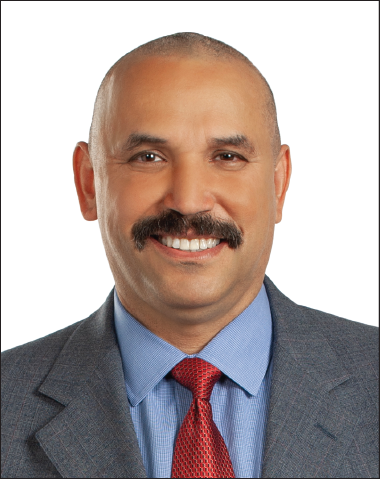

Baltazar De Anda Santana, 46, knows firsthand the challenges faced by many when they first come to America. From Mexico, he crossed the U.S. border at the age of 23 without knowing any English, unsure of what his future might bring.
A devout Catholic, he grew up with a passion to serve others and until about five years ago was determined to become a Catholic priest.
Undocumented in this country for 16 years, his story is one of perseverance and a dedication to help others like him. In Madison since 2008, De Anda Santana co-founded the Latino Academy of Workforce Development and serves as executive director.
Tell us about the Latino Academy of Workforce Development.
Our mission is to strengthen our community through bilingual and adult education, job training, and employment programs. It was launched in 2011 as a program of the Vera Court Neighborhood Center, and we just became independent in 2022.
We achieved our American dream in February when we moved to Landmark Place. We have eight full-time employees plus consultants. Many of our part timers are instructors. We are a nonprofit, but our goal is to run the academy like a business.
Let’s talk about your childhood in Mexico.
I come from a very poor family. My mom would take us to the market every Saturday, but she’d always enter through the downstairs. We’d collect the leftover fruit — the fruit that was good but not pretty — and my mom would cut the bad parts off. I never saw a whole apple until I was about 12 years old. The core of an apple was an apple to me.
I remember running behind trucks heading to the landfill that were filled with “bad” onions. When they were dumped, our job was to find the good ones. I’ll never forget the smell. My mom would use them to make onion soup and other recipes. That was pure happiness for me. I think that’s why it’s very hard for me to understand the value of money because I can navigate being poor. At the time, I didn’t even know I was poor.
Tell us about coming to the U.S.
I always wanted to serve the community, and growing up Catholic, it was very, very important to me to become a Catholic priest. I started my service to the community when I was in middle school and I went to a Catholic seminary, but being a gay man in Mexico was a challenge, so I crossed into the U.S. when I was 23. That day defined who I am right now, and I’m very proud of that decision.
My journey wasn’t as difficult as some have been. My sister was my first resource and employment support person, and she got me an appointment with a fast food restaurant. She told me, “Say yes to everything and tell the manager, nice to meet you, I am a hard worker.” She taught me about U.S. coins, and I was promoted to cashier. One day a customer got very upset with me and screamed that I needed to learn English. I decided that was the last time someone was going to humiliate me, so I worked very hard to learn the language.
I’m a U.S. citizen now.
How did you get to Wisconsin?
I found a more open religious order in Milwaukee that accepted my homosexuality as long as I remained celibate. I stayed for four years until I realized that without documentation, I would never be able to do anything. I couldn’t apply for loans or legally work, but I could own my own business, so my partner at the time agreed to pay for my college education if I promised to repay him. I enrolled at UW–Whitewater and graduated in multimedia/digital arts and just paid him off in February. We’re not together anymore, but we celebrated anyway.
When I moved to Madison, got involved with the Latino Chamber, and started teaching computer classes two hours a day at the Vera Court Neighborhood Center. That’s when I realized that I had found my place, not only teaching, but also helping to build community.
This is my ministry.
Many people have helped me throughout my journey, but I am not who I am because of someone’s help. I am who I am because someone gave me the tools and the dignity to push on.
And now you’re doing the same for others?
We partner with our community to help them succeed, but we don’t want to be saving our students. There’s nothing to save them from! They need access to resources and tools, and they can take it from there. Our goal is to help them achieve financial security.
The Academy offers a general education diploma (GED) in Spanish, English as a second language (ESL), digital and financial literacy, and more. We are a workforce institution, so everything we do must be connected to workforce development. We have a construction and green energy track, manufacturing, IT, and a child care and child-development track. We also are working on establishing a Regional Transportation Training Center because one of our most successful programs is our commercial driver’s license (CDL) program.
Our goal is to put folks into careers that will allow them to lead more comfortable lives and have some disposable income. I often say that the Latino Academy is an enemy of food pantries because our goal is to get people out of the food lines!
What would you like the business community to know?
Last year, the Academy served 2,249 students and provided around 35 classes. We are supported by the city of Madison, United Way, Dane County, and the state. I do my own fundraising as well.
We want to be a part of the conversations and establish partnerships with the “big” people. We’re tired of sitting at the children’s table. Traditionally, we’ve been in the restaurant, landscaping, or housekeeping industries, but I want more. We need opportunities to succeed.
This Academy complements Madison College. We charge minimal tuition, and some people aren’t charged at all, but if they miss one day, they’re out. This is not a charity organization! For some, it’s their first experience going to class, so they may feel like a fish out of water. We support them through their barriers, but they need to make this a priority and be held accountable.
This is a business with a heart, but it is a business.

