
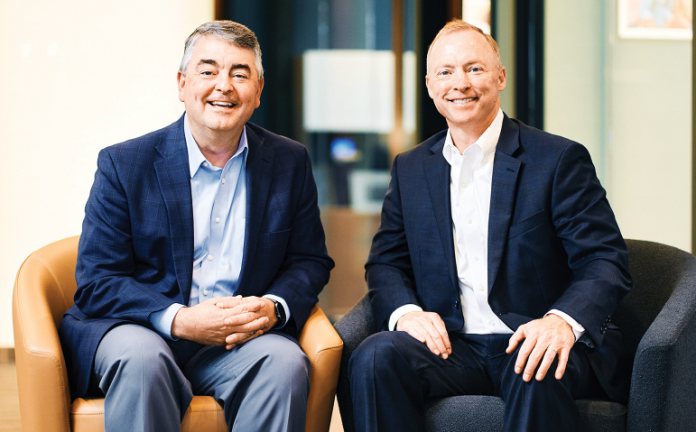

In February 2023, Lake Ridge Bank was formed from the “merger of equals” between Monona Bank and State Bank of Cross Plains. Despite the fact that both banks had acquired or merged with smaller banks in the past, this was different.
This time was more complex and a much bigger test of leadership.
In the past, one organization was always clearly larger and absorbed the customers, business clients, employees, locations, product lines, and more from the other. In fact, an acquisition often occurs because a business has a clear challenge or hurdle it is trying to overcome. So, it makes sense that the dominant organization would maintain its name and make major decisions.
While merger of equals is technically a legal term, it also clearly represents our approach to coming together in partnership with a shared vision for the future. Neither bank was dealing with hurdles. We were both making this decision from a position of strength. We simply realized we could achieve more together than separately:
- We were both focused on the future rather than past accomplishments.
- Greater resources meant better technology, additional services, and a depth of bench.
- A larger footprint meant the ability to serve more people and more communities. It was not about being bigger. It was about having the resources to help more communities become even stronger.
This approach can only be successful when two leaders trust each other so implicitly to put ego aside and focus on those we serve. It requires collaboration over competition.
If you consider an acquisition as a parent-child relationship, then a merger of equals is more like a marriage. Or if you prefer, an acquisition is about a coach-player relationship, with a merger being more about teammates with great chemistry.
The social game
Many of the social aspects of a merger don’t affect customers in an obvious or direct way. Yet if you don’t get them right, it can be catastrophic. The social aspects lay the foundation for everything else to work smoothly.
Social characteristics include:
- Agreeing on a new business name;
- Appointing the CEO and president;
- Electing the board of directors and chair;
- Choosing corporate headquarters; and
- Naming the executive team and other
leadership.
In addition to these checklist items that are best decided together to represent both organizations as equally as possible, the social aspect also includes pieces of the process. Things like how we handle conflict resolution are key to making this work.
For example, we didn’t keep score. There was no “if you get this one, then I get the next.” Instead, we asked what was best for our four stakeholders — customers, communities, associates, and shareholders — and the answer would seem obvious. Every decision made us better as a whole without focusing on individual identities anymore.
For example, we believed a new name was important to build an institution that felt like the future, not the past. We chose a name with elements from both banks that incorporated geographical touchpoints for the communities we serve. Suddenly, Lake Ridge Bank felt like home.
Embrace the evolution of change
There’s no light switch that creates immediate change. We need to respect change as an evolutionary process that happens little by little but always moves toward the end goal. For example, changing someone’s title doesn’t automatically change their behavior or way of thinking. It requires a transitional phase to allow for growth and maturity.
The same holds true with our organizational chart. We view it as an organic, living document that respects trial and error and looks to retain the very best associates who want to contribute in any way possible.
For example, Scott Ducke went from chief lending officer to chief operating officer. He modeled that behavior of “how can I set up the next CLO for success?” Despite moving to a very different role, his attitude projects, “I am happy to do whatever I can to contribute to the success of this organization.”
Avoid a clash of culture
Organizational culture can be measured in a variety of ways. Our mission statements almost exactly overlapped. Our benefits packages were similarly aligned, including an emphasis on volunteerism and community involvement.
We noticed a symbiosis in our leadership styles as well:
- Both of us are sons of bankers (there’s a joke in there somewhere). We had parents who truly lived community banking and grew up with those values ingrained in our family lives by attending every community event, supporting local restaurants and businesses, and discussing community issues
at dinner. - We both believe that community banking is the best form of banking. We like how it keeps us connected to the community at large.
- We share a servant leadership approach.
- We respect the strengths the other brings. Jim has expertise in lending; Paul excels at operations. Like a good marriage or a winning team, we each accept and play a role in the overall success and share the same goals and values.
Secrets to success
The questions we go back to over and over revolve around the customer experience:
- Will this decision make life better or easier for our customers?
- When we interact with our customers, how do we represent an attitude of gratitude for choosing us?
- Which products and services from each organization best serves our combined clientele?
If you maintain a focus on serving the right result, the rest will follow naturally. Conversely, don’t get wrapped up in a deal because it’s exciting. The reality is much more work and risk than fun. Instead, define your ultimate goal and make sure your actions stick to that goal.
Speaking of goals, don’t get big for big’s sake. If getting bigger is your ultimate purpose, then it is probably the wrong reason to merge because there are much easier organic ways to grow your business. Make sure you can actually achieve more together.
In short, it’s less about being bigger and more about being better together.
Jim Tubbs is the CEO and Paul Hoffmann is the president at Lake Ridge Bank.

