
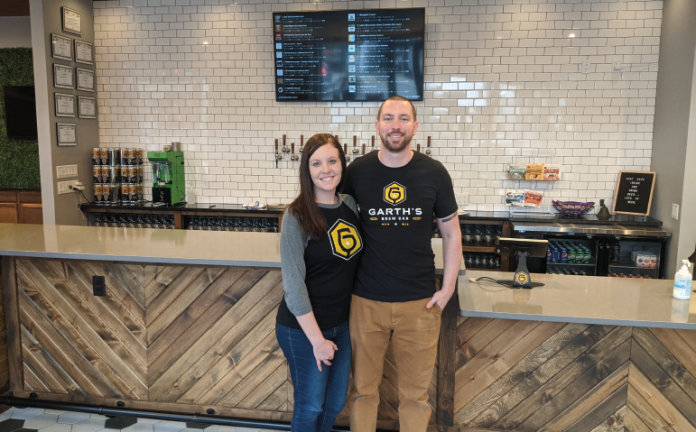

With his original business model for Garth’s Brew Bar, Garth E. Beyer anticipated 80 percent on-premise sales and 20 percent off-premise at his Monroe Street establishment. With the onset of the COVID-19 pandemic, it was 100 percent on-premise with the twist of pickup only, which was the last scenario on his mind when he opened the business last December.
Pandemic disruption was definitely not factored into Beyer’s original business plan, but he’s not alone there. Beyer runs the establishment with his wife, Briana, and even though they were deemed an essential business under Gov. Tony Evers’ safer-at-home order, business as usual was out of the question.
“Top-level things from the pandemic and the shelter-in-place environment have pretty much forced us to minimize hours to just keep those windows tight for people to come in, and then we’ve also had to furlough our team for the time being, but with every intention to bring them back as soon as we can open our doors for on-premise consumption again,” Beyer says.
With the actual delivery of beer still prohibited in Wisconsin, “to-go” beer was the only way to go. Another operational about face involved reassessing inventory. Normally, Garth’s would have $10,000 worth of beer in the cooler just waiting to be put out on a regular basis, but now the product is not moving as quickly, and so a reassessment of inventory control was mandatory.
“Right now, it’s been my wife and me running the show, so there’s not much necessity around social distancing there,” he jokes, “but with everybody that has come in, we’ve been respectful of them, letting them handle the situation to the best of their ability and the best of their knowledge. It really hasn’t been too much of a problem. Everybody has been extremely careful with the space they keep between one another.
“We’ve had folks wait outside before coming in while another person is finished perusing the beer selection, so it’s kind of been self-mandated to control that.”
Now established as a to-go venue, Beyer expects this service to survive the pandemic — to the point where the sales split is more 60–40 if not 50–50 between off-premise and on-premise consumption. That’s a little bit down the road but with its primary mission to support breweries — without a full kitchen, Garth’s isn’t set up to sell much food — the split isn’t as important as the mission.
As for the future of on-premise, Beyer is prepared for whatever social distancing and sanitizing recommendations come down. Don’t be surprised to see more distance between bar stools and hand sanitizer not only in the bathroom but all the way across the bar and on tables.
Beyer senses that customers are longing to connect and engage with people again, and as soon as he can provide that opportunity, he will. “What I love is that everyone has agency to decide whether they come or go, so those who are not comfortable with it don’t need to come right away,” he notes.
Consumers of beer can wait until the government permits 100% occupancy or until they are completely comfortable, but as much as public health officials open that door, Beyer says his establishment will accommodate that. “If that means half occupancy, pulling some chairs out, and spacing everybody, then we’ll go ahead and do that,” he states.
Pouring their hearts out
Beer bars and perhaps other kinds of drinking establishments will also have to be more mindful of the expiration dates on their products, Beyer predicts. “I’m sure you’ve read or seen that a lot of breweries and distributors are having to dump beer, but some of them are going to hold on to it and try to sell it down the road, and we’re going to have a conversation with them because I’m not going to sell a six-month, nine-month, or 12-month-old IPA to our guests,” he states. “Your best move as a brewery is honestly to dump that right now because that’s going to hurt the consumer who cares about the freshness of the beer.”
Another change could be an end to the prohibition on the delivery of beer to residences. That conversation is already happening in Wisconsin, and some states have allowed it on a temporary basis for establishments that also sell food. Some opened it up entirely, even for cocktails with a firm seal on them.
“The longer this continues, the likelier it’s going to happen to open it up to delivery of alcohol,” Beyer predicts. “That would help restaurants, as well.”
Click here to sign up for the free IB ezine — your twice-weekly resource for local business news, analysis, voices, and the names you need to know. If you are not already a subscriber to In Business magazine, be sure to sign up for our monthly print edition here.

